Foundry, the digital asset infrastructure giant and operator of the world’s most prolific Bitcoin mining pool, has officially announced its strategic expansion into the privacy-centric cryptocurrency sector with the planned launch of a dedicated Zcash (ZEC) mining pool. Designed specifically for institutional investors, public corporations, and large-scale mining enterprises, the new pool is scheduled to commence operations in April 2026. This move marks a significant pivot for Foundry, which has traditionally focused on the Bitcoin ecosystem, and signals a maturing perception of privacy-preserving technologies within the regulated financial landscape.
The announcement, delivered via an official press release on March 11, 2026, highlights Foundry’s intention to bridge a critical infrastructure gap. While Zcash has existed for a decade as a leading privacy asset, the mining infrastructure supporting the network has historically lacked the enterprise-grade features required by publicly traded companies and highly regulated entities. By leveraging the same robust architecture that propelled Foundry USA to the top of the Bitcoin mining rankings, the company aims to provide a secure, compliant, and high-performance environment for Zcash miners.
The Strategic Evolution of Foundry and the Bitcoin Mining Landscape
To understand the weight of this announcement, one must consider Foundry’s current standing in the global mining hierarchy. Foundry Digital LLC, a subsidiary of Digital Currency Group (DCG), operates Foundry USA, which consistently commands the largest share of the global Bitcoin hashrate. As of early 2026, Foundry USA often accounts for upwards of 25% to 30% of the total computing power securing the Bitcoin network.
The company’s success in the Bitcoin space was built on a foundation of transparency, regulatory alignment within the United States, and a suite of value-added services including equipment financing and advisory. The decision to bring this institutional rigor to Zcash suggests that Foundry perceives a growing demand for "Privacy-as-a-Service" among sophisticated market participants.
"Zcash has matured into an institutional-grade asset, but the mining infrastructure supporting it hasn’t kept pace," stated Mike Colyer, CEO of Foundry. Colyer’s assessment points to a common friction point in the crypto industry: while the underlying protocols may be ready for institutional adoption, the "middle-ware"—the pools, custodians, and reporting tools—often lags behind. The 2026 launch date provides a window for the company to refine these tools to meet the stringent auditing requirements of its target clientele.

Technical Foundations: Why Zcash and Why Now?
Zcash was launched in 2016 as a fork of the Bitcoin codebase, meaning it shares several fundamental economic properties with the world’s largest cryptocurrency. It has a hard supply cap of 21 million tokens and utilizes a "halving" mechanism that reduces the issuance of new coins approximately every four years. However, Zcash distinguishes itself through the implementation of Zero-Knowledge Succinct Non-Interactive Arguments of Knowledge, or zk-SNARKs.
Unlike Bitcoin or Ethereum, where every transaction’s sender, receiver, and amount are visible on a public ledger, Zcash offers "shielded" transactions. These allow users to prove that a transaction is valid without revealing the sensitive data behind it. For institutions, this technology presents a unique value proposition: the ability to maintain financial privacy while remaining auditable through "viewing keys" that can be shared with regulators or auditors.
The press release emphasized this balance, noting that by combining cutting-edge privacy technology with transparent blockchain verification, Zcash demonstrates how financial privacy and compliant digital infrastructure can coexist. For institutional miners, the attraction lies in the ability to secure a network that protects proprietary financial data—a requirement that is often at odds with the fully transparent nature of most public blockchains.
Analyzing the Recent Surge in Zcash Network Hashrate
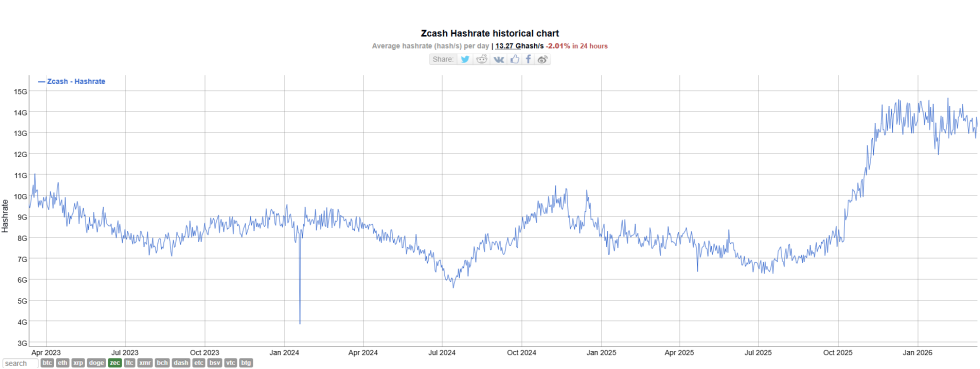
The timing of Foundry’s expansion coincides with a period of unprecedented growth for the Zcash network. Data from BitInfoCharts reveals a significant "hashrate boom" over the final quarter of 2025 and the beginning of 2026. In October 2025, the ZEC hashrate—the total computational power dedicated to mining the token—was measured at approximately 8 Gigahashes per second (Ghash/s). By March 2026, that figure had surged to over 13 Ghash/s, representing a nearly 63% increase in just a few months.
This spike in hashrate is indicative of several factors:
- Hardware Efficiency: The introduction of more powerful Application-Specific Integrated Circuits (ASICs) tailored for the Equihash algorithm used by Zcash.
- Miner Migration: As Bitcoin mining difficulty reaches record highs, some diversified mining operations may be allocating a portion of their resources to alternative Proof-of-Work (PoW) chains like Zcash to optimize returns.
- Institutional Interest: Anticipation of infrastructure developments, such as the Foundry announcement, often leads to pre-emptive capacity building by large-scale miners.
A rising hashrate generally implies increased network security and miner confidence. For Foundry, entering a market with a strengthening technical foundation reduces the risk associated with launching a new institutional product.

Industry Reactions and the Role of Shielded Labs
The announcement has been met with enthusiasm from the Zcash core community and its supporting organizations. Zooko Wilcox, the founder of Zcash and current Chief Product Officer at Shielded Labs, expressed his support for the initiative. Shielded Labs, an independent support organization based in Switzerland, has been instrumental in advocating for the continued decentralization and technical advancement of the ZEC protocol.
"We at Shielded Labs are delighted that Foundry—the largest Bitcoin mining pool, and one based in North America—is launching an enterprise-grade Zcash mining pool," Wilcox said. He highlighted the importance of North American participation in the Zcash ecosystem, which adds a layer of geographic diversity to a network that has historically seen significant mining concentration in other regions.
The collaboration between a US-based powerhouse like Foundry and a Swiss-based entity like Shielded Labs underscores the global nature of the privacy coin movement. It also suggests a coordinated effort to ensure that Zcash remains a viable option for miners who require strict adherence to Western regulatory standards.
Chronology of Development and the Path to 2026
The roadmap for the Foundry Zcash pool is expected to follow a rigorous development and testing phase.
- Q3 2025 – Q1 2026: Internal development of the pool’s backend architecture, focusing on the integration of Zcash’s unique shielded address requirements into an institutional reporting interface.
- March 2026: Official announcement and opening of the "Early Access" registration for existing Foundry USA partners.
- April 2026: Official launch of the Zcash mining pool, featuring US-based nodes to minimize latency for North American operations.
- Post-Launch 2026: Integration of ZEC mining into Foundry’s broader suite of financial services, potentially including ZEC-backed lending or specialized custody solutions.
The two-year lead time from the initial conceptualization to the 2026 launch suggests that Foundry is prioritizing the "compliance" aspect of the pool. Institutional miners require detailed tax documentation, SOC 2 Type II compliance, and robust anti-money laundering (AML) protocols—features that are non-trivial to implement on a privacy-preserving blockchain.
Market Implications: ZEC Price and the Privacy Coin Regulatory Landscape
At the time of the announcement, the market reaction for Zcash has been a mixture of short-term volatility and long-term speculation. ZEC was trading at approximately $209, reflecting an 11% retracement over the previous seven days. While the immediate price action was bearish, analysts suggest that the entry of a major player like Foundry could provide a long-term floor for the asset by increasing its "industrial" utility.
The broader implications for the privacy coin market are profound. In recent years, privacy coins have faced delistings from several centralized exchanges due to regulatory pressure regarding "untraceable" transactions. However, the narrative is shifting toward "regulated privacy." By providing a pool that is transparent in its operations but secures a private network, Foundry is positioning itself as a middleman that can satisfy both the privacy needs of users and the disclosure needs of governments.
If Foundry successfully captures a significant portion of the Zcash hashrate, it could lead to:
- Increased Legitimacy: Validation of Zcash as a "serious" asset for public companies to hold on their balance sheets.
- Hashrate Stability: Reduced volatility in network security as large, well-capitalized institutions replace smaller, more opportunistic miners.
- Regulatory Clarity: Foundry’s presence may force a more nuanced conversation with regulators about the difference between "anonymity" and "privacy."
Conclusion: A New Chapter for Institutional Mining
Foundry’s expansion into Zcash represents more than just a new business line; it is a bet on the future of financial privacy. By bringing the "Foundry Standard" to the ZEC network, the company is attempting to prove that the same principles of scale, security, and compliance that dominated Bitcoin mining can be applied to the more complex world of zero-knowledge proofs.
As the industry moves toward the April 2026 launch, the focus will remain on whether other major mining pools follow suit. For now, Foundry stands alone as the bridge between the privacy-focused origins of the cypherpunk movement and the rigorous demands of modern institutional finance. Whether this move will catalyze a broader resurgence in privacy-focused assets remains to be seen, but the foundation is clearly being laid for a more robust and institutionalized Zcash ecosystem.