

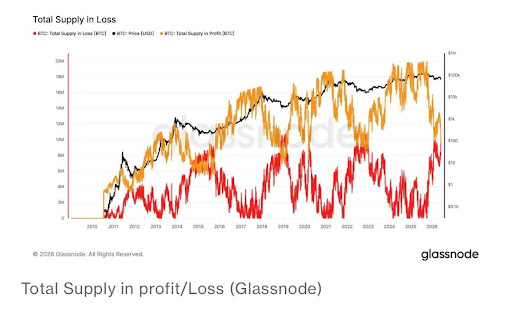
The global cryptocurrency market is currently witnessing a significant shift in investor positioning, as on-chain data reveals that more than 10.46 million Bitcoin (BTC) are now held at an unrealized loss. This threshold, which represents roughly half of the total circulating supply of approximately 21 million coins, has historically served as a critical indicator for identifying potential market bottoms. As Bitcoin struggles to regain its previous momentum, analysts are scrutinizing this concentration of "underwater" supply to determine whether the current correction is nearing its exhaustion phase.
The recent decline, which has seen Bitcoin trading near the $63,242 mark, represents a substantial pullback from its all-time highs. According to on-chain analytics firm Glassnode, this contraction in profitable supply underscores a period of heightened investor stress. As the market navigates this volatility, the interplay between long-term holding patterns and panic selling has become the primary driver of current price action.
A Chronology of Market Capitulation and Accumulation
To understand the gravity of the current situation, it is necessary to examine the historical context of Bitcoin’s market cycles. Major price floors in the history of the asset have frequently coincided with periods where the "Total Supply in Loss" metric exceeds the 10 million coin mark.
During the bear market cycles of 2018 and 2022, similar on-chain metrics signaled that the market had reached a point of maximum pain. In these instances, the high volume of coins held at a loss suggested that the majority of speculative participants had been washed out, leaving behind a core base of long-term holders (LTHs) who were less inclined to liquidate their positions at a deficit.

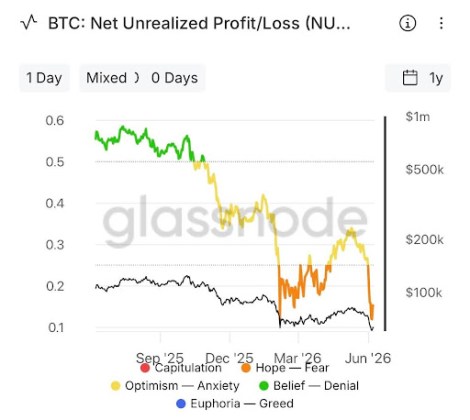
The current cycle has followed a distinct path. Throughout the previous year, Bitcoin enjoyed a period of relative optimism, with the Net Unrealized Profit/Loss (NUPL) indicator residing in positive territory. However, as the asset retreated from its recent cycle peaks, the market dynamic shifted rapidly. By mid-2026, the accumulation of losses across the network became pronounced, effectively pushing the market into the "Hope-Fear" zone. This phase is characterized by a lack of conviction among short-term holders, while long-term institutional and retail investors demonstrate increased patience.
Analyzing the Mechanics of Unrealized Losses
The concept of an "underwater" supply refers to the volume of Bitcoin that was last purchased at a price higher than the current market spot price. When this figure reaches 10 million BTC, it signifies a massive distribution of coins from high-conviction buyers to those who entered the market during the late stages of a bull run.
Analyst Ali Martinez has pointed out that this phenomenon often acts as a self-correcting mechanism. When a significant portion of the market is underwater, the incentive to sell diminishes. Investors who are faced with substantial unrealized losses are statistically less likely to realize those losses by selling into a downward trend, provided they are not forced to liquidate for liquidity reasons. This behavior leads to a contraction in sell-side pressure, which can pave the way for a bottoming process.
The Total Supply in Loss metric provides a transparent look into the psychological state of the market. As supply shifts from profit to loss, the market structure changes, making it increasingly difficult for sellers to drive the price down further without encountering significant support from those who view the current price levels as an attractive entry point.
Implications of the Current NUPL Data
The Net Unrealized Profit/Loss (NUPL) indicator serves as a barometer for market sentiment, ranging from "Capitulation" to "Euphoria." The recent slide into the "Hope-Fear" zone suggests that while market confidence has been shaken, the environment has not yet devolved into total capitulation.

In financial market theory, capitulation is defined as the final stage of a sell-off where investors abandon their positions in a state of panic, leading to a sudden, sharp decline in price and a massive spike in volume. The fact that the market has not yet reached a state of extreme capitulation suggests that the current correction is methodical rather than impulsive. This indicates that the market is currently in a phase of redistribution, where price discovery is being hampered by the overhang of underwater supply.
The implications for investors are twofold. First, the current environment demands a higher degree of risk management, as the volatility associated with this "underwater" phase can be prolonged. Second, for those with a long-term investment horizon, the current concentration of losses is often viewed as a precursor to a bottoming process, historically marking an ideal window for value-oriented accumulation.
Expert Perspectives and Market Responses
While the data suggests a potential turning point, industry experts remain cautious about declaring a definitive bottom. The current market environment is complicated by broader macroeconomic factors, including interest rate adjustments and shifts in global liquidity.
Market observers note that while on-chain metrics like the 10 million BTC threshold are historically reliable, they must be viewed in tandem with broader market conditions. For instance, the behavior of institutional investors—who have increasingly utilized Bitcoin as a treasury asset—could alter the traditional cycle dynamics. Unlike retail-dominated cycles of the past, the presence of institutional capital adds a layer of stability, as these entities often employ long-term hedging strategies that are less sensitive to short-term price fluctuations.
Furthermore, the decrease in sell-side pressure is contingent upon continued holding by long-term investors. If macroeconomic conditions were to deteriorate further, causing a broad-based "risk-off" environment, even underwater holders might be forced to liquidate to cover margin calls or liquidity requirements in other asset classes. Consequently, while the 10 million BTC mark provides a compelling argument for a potential bottom, it is not a guarantee of an immediate trend reversal.
Broader Impact on the Digital Asset Ecosystem
The ongoing correction and the associated increase in unrealized losses have broader implications for the digital asset ecosystem. Beyond just price, the current market structure affects the viability of various DeFi protocols and lending platforms. Many of these platforms rely on collateralized debt positions (CDPs) that are sensitive to price volatility. As more BTC enters a loss state, the threshold for collateral liquidation becomes a critical focus for risk managers.
Moreover, the current state of the market serves as a stress test for the Bitcoin network’s resilience. The ability of the network to absorb such a significant amount of supply in loss without a cascading failure speaks to the maturity of the asset class. As the market digests these losses, it effectively clears the "overhang" of speculative interest, potentially building a more sustainable foundation for future growth.
Looking Ahead: Factors for Recovery
The transition from a bear-market bottom to a new growth phase typically requires a catalyst. Historically, this has involved a combination of positive regulatory developments, renewed institutional inflows, or changes in monetary policy. For Bitcoin to move decisively out of the current zone, the market will likely need to see a stabilization in the supply-in-loss metric, followed by a gradual increase in the number of coins returning to profitability.
As it stands, the market is in a period of patient observation. The 10 million BTC threshold is not merely a number; it is a representation of the collective experience of millions of market participants. Whether this leads to a rapid V-shaped recovery or a prolonged period of sideways accumulation remains a subject of intense debate. However, the data confirms that the market is currently at a juncture that has defined the structural integrity of Bitcoin in previous cycles.
Investors and analysts alike will continue to monitor the Glassnode metrics and the NUPL indicators in the coming weeks. Should the supply-in-loss figure begin to trend downward, it would serve as a strong confirmation that the market is transitioning into a recovery phase. Until then, the market remains in a state of cautious consolidation, marked by a significant, though potentially temporary, loss of unrealized value across the network.
The current landscape of Bitcoin is a complex tapestry of historical patterns, on-chain realities, and evolving investor behavior. By focusing on the fundamentals—the movement of supply and the psychology of the holder—market participants can better navigate the complexities of this ongoing correction. As the dust settles, the resilience of the network will likely continue to be tested, but the historical evidence remains a testament to the enduring nature of the asset through even the most challenging market conditions.
