

The landscape of the cryptocurrency market has undergone a fundamental transformation over the past twenty-four months, shifting from a sector defined primarily by speculative retail interest toward one increasingly focused on functional utility and institutional-grade infrastructure. Central to this evolution is the role of Layer-2 (L2) solutions, which are designed to alleviate the computational burdens of primary blockchains. For Bitcoin, the industry’s most prominent asset, the integration of such layers has moved from an experimental concept to a critical necessity. Over a year has passed since the deployment of the Stacks Nakamoto upgrade, a pivotal hard fork that fundamentally altered the network’s architectural relationship with the Bitcoin mainnet. As market participants evaluate the long-term viability of Bitcoin-based decentralized finance (DeFi), the performance of Stacks offers a compelling case study on the friction between technological advancement and macroeconomic volatility.
The Nakamoto Upgrade: A Technological Milestone
The Nakamoto upgrade, which reached full implementation in 2024, was envisioned as a watershed moment for the Stacks ecosystem. Prior to this, the network operated with slower block times and distinct limitations in transaction finality, often hindering its ability to compete with high-throughput L2s found on platforms like Ethereum or Solana. The upgrade introduced a significant overhaul to the Stacks consensus mechanism, enabling block production every five seconds—a massive improvement in latency compared to the legacy Bitcoin network.

More importantly, the Nakamoto upgrade established a more robust security bridge between Stacks and the Bitcoin base layer. By decoupling the consensus mechanism to allow for faster execution while anchoring the state of the network back to Bitcoin, the upgrade effectively transformed Stacks into a viable environment for complex smart contracts. This shift was intended to facilitate the migration of Bitcoin’s vast liquidity into the burgeoning ecosystem of decentralized applications (dApps), effectively turning the "digital gold" narrative into a platform for active economic participation.
The Role of sBTC and Institutional Liquidity
A primary component of the post-Nakamoto strategy is the introduction of sBTC, a trust-minimized asset that allows users to move their Bitcoin into the Stacks ecosystem without relinquishing custody to a centralized entity. By locking native BTC and minting sBTC on the Stacks chain, users gained the ability to interact with DeFi protocols, participate in yield-generating activities, and utilize smart contracts—all while maintaining a 1:1 backing with the original asset.
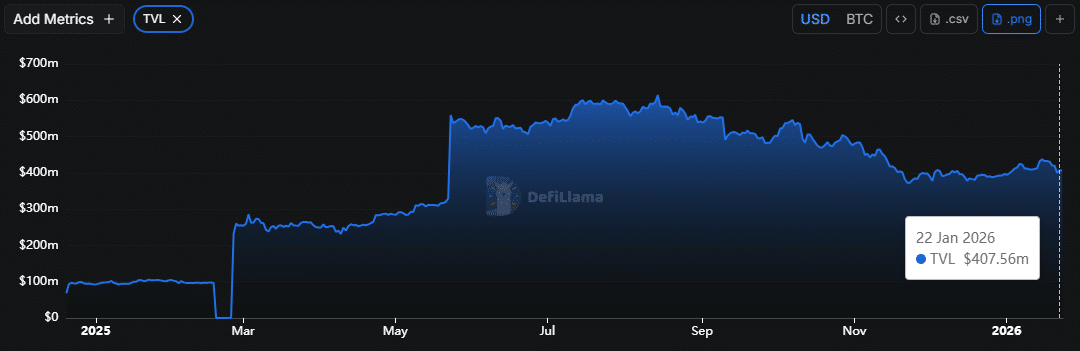
For a time, the promise of sBTC served as a significant catalyst for growth. Total Value Locked (TVL) in sBTC-related protocols climbed steadily throughout 2025, peaking at approximately $600 million in August. This figure represented a milestone for the Bitcoin ecosystem, signaling that capital was finally beginning to flow into utility-driven applications rather than remaining stagnant in cold storage. However, the subsequent trajectory of this metric has highlighted the fragility of emerging DeFi ecosystems when faced with broader market corrections.

Market Turbulence and the Correction of TVL
Despite the technical success of the Nakamoto upgrade, the latter half of 2025 and the early weeks of 2026 revealed that technological progress does not insulate an asset from systemic market pressure. Following the August 2025 peak, the TVL associated with sBTC saw a sharp contraction, falling to $400 million—a decline exceeding 50%. This downturn serves as a stark reminder that liquidity in the crypto space is often highly sensitive to the perceived risk-reward ratio of the underlying market.
When Bitcoin’s price undergoes significant volatility, capital often retreats from experimental DeFi protocols to safer, more liquid positions. The decline in sBTC TVL indicates that while the infrastructure for Bitcoin-based DeFi is technically sound, the psychological barrier to entry for mainstream investors remains high. The "flight to safety" observed in Q4 2025 underscores that even when a protocol provides real utility, the adoption curve is dictated as much by macro-market sentiment as it is by engineering capabilities.
Transaction Throughput vs. Price Performance
A peculiar divergence has emerged when comparing on-chain activity with price action. According to data from Token Terminal, Bitcoin’s transaction counts remained remarkably resilient throughout the latter half of 2025, exceeding 40 million transactions per quarter in both Q3 and Q4. This sustained high volume suggests that a core user base remains actively engaged with the network, utilizing it for transfers, inscriptions, and L2 interactions despite the turbulent environment.

Conversely, the market performance of the assets involved has been less forgiving. Bitcoin concluded 2025 with a Q4 Return on Investment (ROI) of -23%, the most significant end-of-quarter decline since the depths of the 2022 bear market. This inverse correlation—where network usage stays high while asset prices suffer—suggests that the "utility" narrative of Bitcoin is maturing independently of its role as a speculative instrument.
Broader Implications for the Bitcoin L2 Ecosystem
The current state of Stacks invites a broader debate regarding the trajectory of Bitcoin L2s. Proponents argue that the current market conditions are merely "noise" that masks the long-term trend of building a robust financial layer on top of the world’s most secure blockchain. From this perspective, the Nakamoto upgrade was not just an update, but a necessary foundation for the next decade of Bitcoin development. If developers continue to build sophisticated applications on Stacks, the network may eventually decouple its value from the simple price movements of BTC, instead deriving value from the transaction fees and services generated within its ecosystem.
However, critics point to the failure of TVL to maintain its growth trajectory as evidence that Bitcoin users may not yet be ready for the complexities of decentralized finance. The challenge for Stacks and other L2 developers is twofold: they must continue to refine the user experience to ensure that interacting with sBTC is as seamless as using a centralized exchange, and they must demonstrate that these protocols offer a tangible advantage over the simplicity of holding native BTC.
Conclusion: The Road Ahead
As the industry moves through 2026, the case of Stacks remains a bellwether for the rest of the Bitcoin Layer-2 sector. The Nakamoto upgrade successfully delivered on its technical promises, providing the speed and finality required for a modern blockchain. Yet, the reality of the past year confirms that no amount of technical innovation can entirely bypass the cyclical nature of the crypto markets.
The path forward for Stacks will likely be defined by the development of "sticky" applications—those that provide value regardless of whether the market is in a bull or bear phase. If the network can successfully retain its transaction volume and expand its developer ecosystem during periods of low price performance, it will have proven that Bitcoin has successfully transitioned from a static store of value to a dynamic, programmable financial engine. For now, the ecosystem stands at a crossroads: it has the engine to drive the next wave of adoption, but it must wait for the broader market environment to stabilize before it can fully realize its potential as the backbone of a new Bitcoin-centric economy.
