
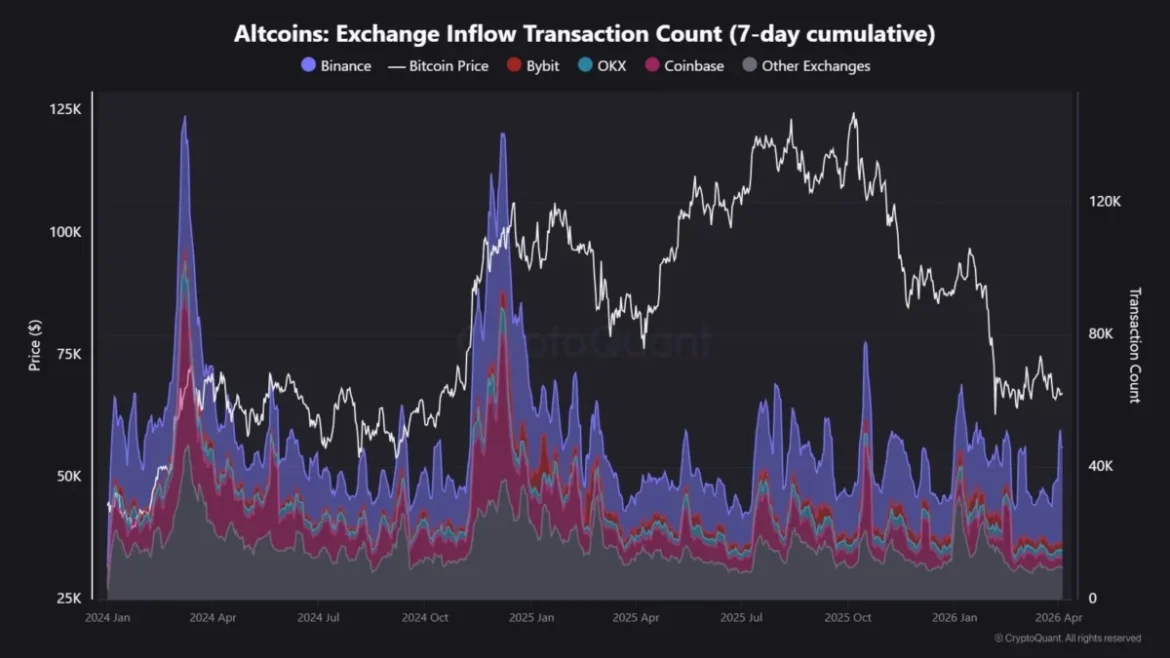
The altcoin market is currently navigating a period of heightened volatility and considerable uncertainty, a climate underscored by a peculiar transaction spike observed exclusively on Binance on April 2nd. This event, which had not been recorded for nearly three months, has prompted detailed analysis, revealing a significant shift in trader behavior that diverges from conventional expectations of renewed altcoin demand. The anomaly suggests a broader repositioning of speculative capital within the digital asset ecosystem, driven by the expanding availability of traditional finance (TradFi) instruments on crypto-native platforms.
An Unprecedented Inflow Anomaly on Binance
On April 2nd, data from analyst Maartunn, leveraging insights from CryptoQuant, highlighted an extraordinary surge in altcoin inflow transactions to Binance, reaching approximately 34,000. This figure represented the highest such reading in two and a half to three months, immediately raising questions about its underlying cause. Typically, a transaction spike of this magnitude would indicate a widespread resurgence of interest in altcoins across the broader market, manifesting simultaneously across major derivatives and spot exchanges such as Bybit, Coinbase, and OKX. However, the distinct feature of this particular surge was its pronounced isolation: the elevated activity was almost entirely confined to Binance. Other prominent exchanges registered no comparable increase in altcoin-related transactions on the same day, signaling that the event was not a symptom of generalized altcoin market recovery.
This isolated nature of the inflow points away from a broad-based return of altcoin demand and towards a more specific catalyst unique to Binance. Such a data anomaly is not merely a statistical artifact but a potent signal, compelling market observers to investigate what specific changes on Binance immediately preceded this concentrated influx of capital. The answer, as subsequently revealed by further analysis, was not what most altcoin enthusiasts or market watchers might have anticipated.
The Catalyst: Binance’s Expansion into Commodity Futures
The explanation for Binance’s isolated altcoin inflow spike lies in a strategic move executed by the exchange just one day prior, on April 1st. Binance had rolled out new futures contracts tied to traditional commodities, expanding its existing suite of TradFi instruments. Specifically, natural gas and WTI crude oil futures were introduced, joining established offerings like gold, silver, and various other traditional financial tickers. This expansion significantly broadened the scope of assets available for trading on the platform, blending the high-octane environment of crypto trading with the stability and global relevance of commodity markets.

These newly introduced TradFi pairs were not peripheral additions; they quickly ascended to become prominent features in Binance’s top volume pairs, competing directly with established crypto giants like Bitcoin and Ethereum for trading activity. This rapid adoption suggests a substantial appetite among Binance’s user base for exposure to these traditional assets. The strategic timing of their launch, immediately preceding the altcoin inflow spike, is crucial for understanding the observed market dynamics.
Maartunn’s analysis precisely articulates the implication of this sequence: the traders who directed capital to Binance on April 2nd were not necessarily motivated by renewed interest in altcoins. Instead, their primary objective appeared to be engagement with the newly accessible commodity futures for oil and natural gas. These traders, already familiar with Binance’s interface and operational mechanics, found a convenient avenue to access global commodity markets through a platform they routinely used for crypto trading. Consequently, the altcoin inflow, while appearing to signal altcoin activity, was interpreted as a secondary effect—a "footprint" of a different kind of migration entirely.
The Migration of Speculative Capital: From Altcoins to Commodities
This phenomenon represents a compelling shift in the deployment of speculative capital. The same pool of funds that historically rotated through altcoins, seeking high-beta opportunities and diversification within the crypto sphere, is now finding new avenues for speculation on the same platform. This does not imply that liquidity is exiting the crypto market entirely; rather, it suggests a significant internal reallocation within the broader digital asset ecosystem. Capital is shifting away from altcoins and towards assets that are more directly responsive to the prevailing geopolitical and macroeconomic forces currently shaping global markets.
In an environment characterized by inflation concerns, supply chain disruptions, and geopolitical tensions, commodities like crude oil and natural gas offer a distinct appeal. They serve as hedges against inflation, barometers of global economic health, and direct beneficiaries of supply-demand imbalances influenced by international events. For traders accustomed to the volatility and leverage offered by crypto derivatives, engaging with commodity futures on Binance provides a familiar trading experience with exposure to these powerful macroeconomic themes.
The implications for altcoins are far from neutral. Every trader who reallocates capital from an altcoin pair to a commodity futures contract effectively withdraws potential bid-side liquidity from the altcoin market. This reduction in liquidity can suppress price discovery, amplify downward price movements, and make it more challenging for altcoins to regain upward momentum. While this migration may be gradual, its direction is unequivocally clear: a move towards assets perceived to offer more immediate responsiveness to global economic narratives. This trend suggests a maturation of the crypto trading landscape, where platforms like Binance are evolving into hybrid trading venues that bridge traditional and digital asset classes.
Broader Context: The Struggling Altcoin Market

The isolated Binance event unfolds against a backdrop of an already struggling altcoin market. The total crypto market capitalization, excluding the top 10 assets (a common proxy for altcoin performance), is currently hovering near $172 billion. However, the overarching market structure reflects a persistent weakening trend. On the weekly chart, prices have formed a clear lower high after failing to sustain momentum above the crucial $300 billion region, indicative of a shift from an expansionary phase to one of distribution.
This rejection from mid-2025 highs triggered a sustained decline, pushing the altcoin market cap below the significant 50-week moving average and briefly testing the 200-week average. While a recent bounce from the $150 billion zone suggested some underlying demand at lower price levels, this recovery has lacked the conviction required to reclaim the 100-week moving average decisively. The current alignment of all three key moving averages—the 50-week, 100-week, and 200-week—shows them either flattening or trending downward, with the price trading beneath or around them. This configuration is a strong technical signal of a loss of trend strength and a transition into a range-bound or corrective phase, rather than the initiation of a new bullish cycle.
Volume patterns further reinforce this bearish sentiment. Selling pressure has been noticeably more aggressive during market downturns, characterized by higher volume spikes on red candles. Conversely, recovery attempts have been marked by weaker participation and lower trading volumes, suggesting a lack of strong institutional or retail conviction to accumulate altcoins at current levels. This asymmetry in volume dynamics strongly indicates a continued capital rotation away from smaller, more speculative assets within the crypto sphere, rather than broad-based accumulation. Should the critical support range of $160–$170 billion fail to hold, the altcoin market cap could face further downside, with a potential target of $130 billion. A sustained reclaim and consolidation above $200 billion would be necessary to signal a fundamental shift and a regaining of structural strength for altcoins.
Binance’s Strategic Evolution and Market Implications
Binance’s decision to integrate commodity futures is a testament to its evolving strategic vision. Initially a purely crypto-centric exchange, Binance has gradually expanded its offerings to include various traditional financial instruments, recognizing the demand for diversified trading opportunities among its vast global user base. This move allows Binance to attract a broader demographic of traders, including those with a background in traditional finance, while also providing existing crypto traders with new tools to hedge risk or speculate on global macroeconomic trends.
The introduction of TradFi futures also positions Binance more competitively against traditional financial institutions and other hybrid trading platforms. By offering 24/7 trading, high leverage options, and seamless integration with crypto assets, Binance caters to a modern trader profile that values accessibility and efficiency. This strategy effectively blurs the lines between traditional finance and decentralized finance, creating a new paradigm where capital can flow more fluidly between asset classes previously considered distinct.
From a regulatory perspective, such expansion also highlights the ongoing challenge for jurisdictions worldwide to categorize and oversee these increasingly complex hybrid platforms. As crypto exchanges delve deeper into traditional financial products, they are likely to attract increased scrutiny, necessitating robust compliance frameworks and clear regulatory guidelines.

Looking Ahead: The Future of Altcoins and Hybrid Exchanges
The April 2nd incident on Binance serves as a potent microcosm of larger trends at play within the financial landscape. It underscores a growing interconnectedness between the crypto market and traditional financial markets, driven by platform innovation and shifting investor preferences. For altcoin projects, this new reality presents significant challenges. The diversion of speculative capital implies a more competitive environment for attracting liquidity and investor interest. Projects will need to demonstrate stronger fundamentals, clearer utility, and more compelling narratives to stand out in a market where traders have an expanding menu of options.
Conversely, for investors, this evolution offers unprecedented opportunities for diversification and sophisticated trading strategies. The ability to seamlessly pivot between highly volatile altcoins and more macro-driven commodity futures on a single platform provides greater flexibility in managing risk and capturing profit across different market cycles.
In conclusion, the isolated altcoin inflow spike on Binance on April 2nd was not a harbinger of renewed altcoin bullishness but rather a clear signal of a strategic pivot in speculative capital. Triggered by the introduction of new commodity futures contracts, the event highlighted a growing preference among traders for assets that respond to global macroeconomic forces, even within a crypto-native environment. This shift, coupled with the weakening structural trends in the broader altcoin market, suggests a challenging period ahead for smaller digital assets, while simultaneously marking a significant step in the evolution of crypto exchanges into versatile, hybrid financial platforms. The interplay between traditional finance and digital assets is becoming increasingly intricate, redefining liquidity flows and investment strategies in the rapidly evolving global financial ecosystem.
