
Prediction markets are signaling a cooling of legislative enthusiasm for digital asset regulation in the United States, with Polymarket traders adjusting their expectations for the much-debated Clarity Act. As political friction mounts in Washington and resistance solidifies among key lawmakers and regulatory bodies, the likelihood of securing a robust bipartisan majority in the Senate has begun to recede. While the underlying cryptocurrency market structure bill previously enjoyed substantial momentum following its passage in the House of Representatives, recent wagering data reveals a marked downward revision in trader confidence, highlighting the complex legislative hurdles standing between digital asset proposals and their enactment into law.
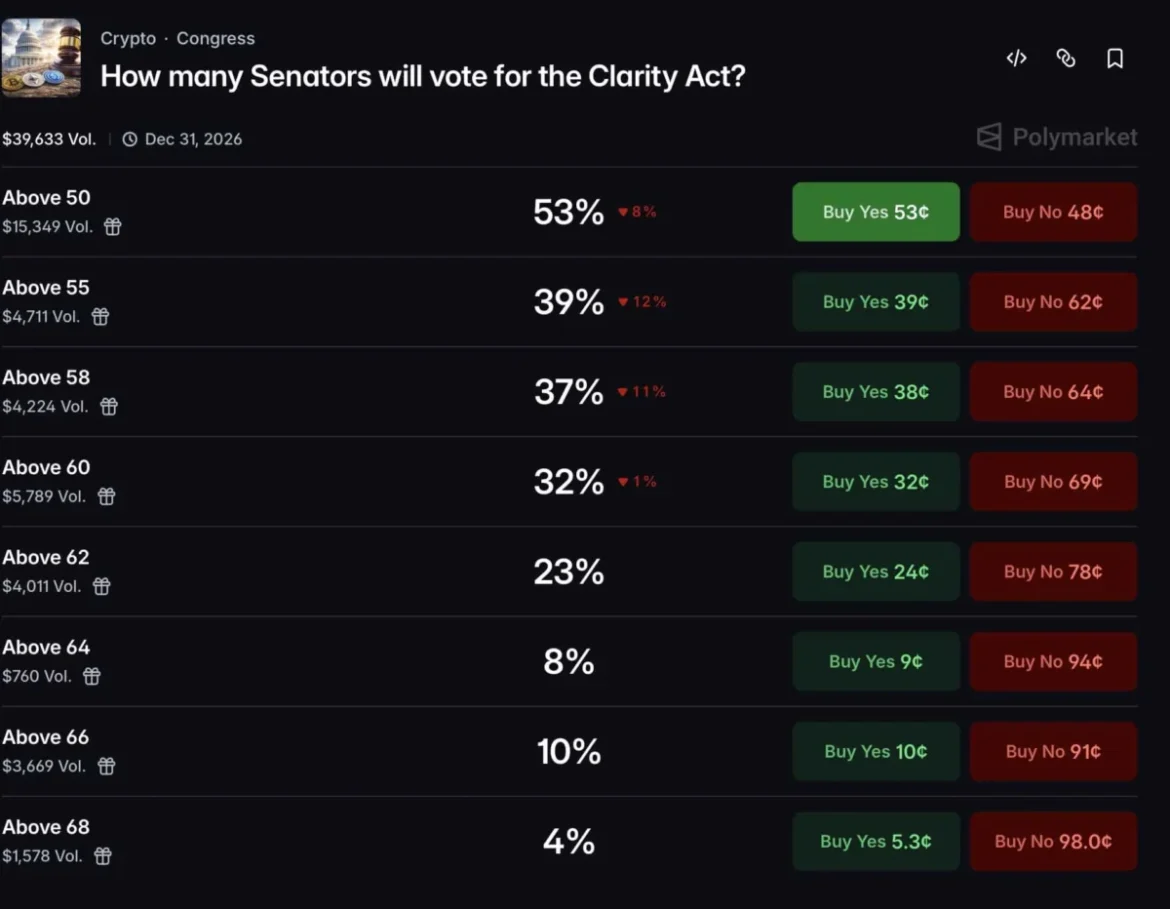
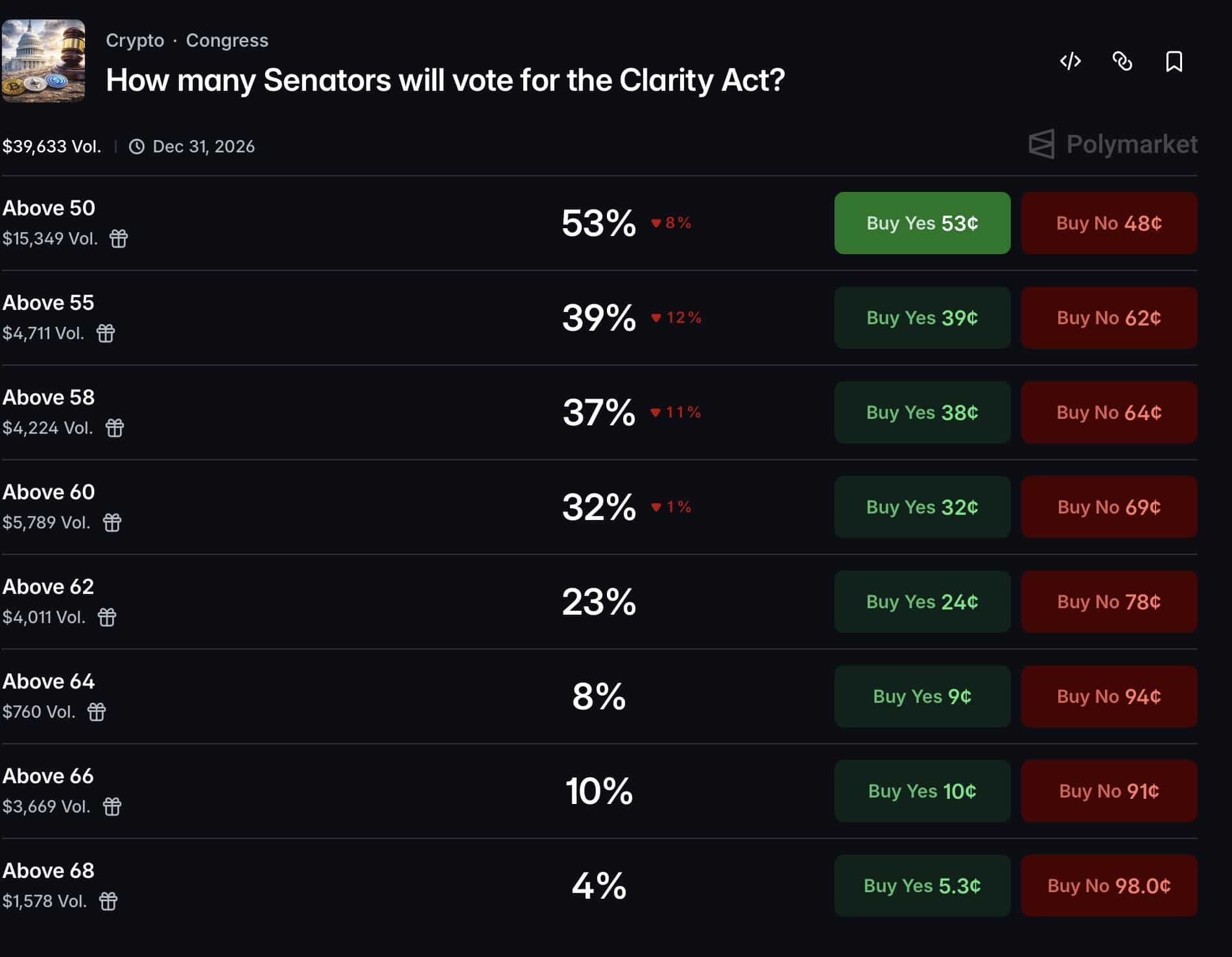
According to data compiled from the Polymarket prediction contract titled "How many Senators will vote for the Clarity Act?", participants currently assign a 53% probability that more than 50 senators will cast a "Yes" vote during the chamber’s initial final-passage ballot. This figure represents an 8-point decline over the course of a single week. Simultaneously, expectations for achieving a filibuster-proof majority of over 60 votes have dropped to 32%. Total volume on the specific contract has reached $39,633, with the market structured to remain open through December 31, 2026. Rather than merely forecasting whether the legislation will ultimately clear the upper chamber, these figures provide a granular look at the coalition size traders anticipate, exposing a significant gap between simple majority expectations and deep bipartisan consensus.
Decoding the Legislative Ladder and Procedural Realities
To understand the shifting sentiment among prediction market participants, it is necessary to examine the precise metrics governing the Polymarket contract. The terminology employed by the platform dictates that "Above" refers strictly to a greater number; thus, an "Above 50" outcome requires at least 51 affirmative votes, while an "Above 60" outcome demands a minimum of 61.
The probability curve steepens sharply beyond the simple majority threshold. Contracts predicting support above 55 senators are currently priced at 39%, while those anticipating support above 58 senators sit at 37%. Both categories have experienced double-digit percentage drops exceeding 10 points—representing the most severe value corrections anywhere in the market. Analysts note that these movements do not signify a wholesale abandonment of the legislation by traders, but rather a realistic trimming of expectations regarding a broad coalition. In the United States Senate, securing a simple majority is an entirely different procedural challenge than overcoming the 60-vote threshold required to pass controversial legislation or defeat potential filibusters, and the current market pricing reflects this structural reality.

Moreover, market observers emphasize the importance of distinguishing between a final-passage vote and preliminary legislative maneuvers. Per the resolution rules governing the Polymarket contract, the market settles exclusively on the first Senate vote concerning the final passage of qualifying crypto market-structure legislation occurring prior to January 1, 2027. Consequently, the contract explicitly excludes committee hearings, motions to proceed, procedural cloture votes, and individual amendments.
This distinction is critical. The 60-vote cloture threshold—which dictates whether a bill can bypass procedural obstruction and reach the floor for a final vote—operates as a separate legislative gate that this particular prediction contract does not directly track. If the upper house manages to clear the bill via voice vote or unanimous consent, the market automatically resolves as a "Yes," regardless of numerical vote tallies. Conversely, if no qualifying final-passage vote takes place before the deadline of January 1, 2027, the market defaults to a "No" resolution.
Legislative Chronology and Regulatory Friction
The journey of the Clarity Act through the United States Congress has been marked by extended deliberations, partisan friction, and competing regulatory visions. The legislative history of the underlying measure, designated as H.R. 3633, began in the House of Representatives, where the bill secured passage on July 17, 2025, by a decisive 294-134 vote. This early success fueled optimism that comprehensive market structure legislation for digital assets could swiftly transition through the legislative pipeline.
Following its transmission to the Senate, the bill was referred to the Senate Banking Committee, which subsequently reported an amended substitute measure on June 1, 2026. This milestone established that the legislation had formally advanced through committee review, though it left the timeline for a full floor vote uncertain.
As the legislative debate intensified over the summer and autumn of 2026, political resistance began to solidify. Democratic lawmakers reportedly rejected the final version of the Clarity Act put forward by proponents, instead introducing a formal counteroffer designed to alter the distribution of authority between financial regulators. Concurrently, state-level authorities have intervened in the national debate; the Office of the New York Attorney General publicly called upon Congress to block the current iteration of the Crypto Clarity Act, citing concerns over investor protection and state regulatory purview. These compounding pressures have driven broader market sentiment downward, with auxiliary prediction metrics indicating that the overall probability of the Clarity Act successfully becoming law within the calendar year has slipped to approximately 20%.
In response to the growing legislative gridlock, executive branch stakeholders have intensified their lobbying efforts. Reports indicate that the Trump administration has launched a major push to convince wavering senators to advance the Crypto Clarity Act, recognizing that regulatory certainty for digital assets remains a cornerstone economic objective for the administration’s financial agenda.
Fact-Based Analysis of Broader Implications
The downward adjustment in Polymarket odds serves as a useful barometer of political sentiment, but financial analysts caution against conflating a vote-count contract with the ultimate fate of digital asset regulation. The prediction market measures the size of a legislative coalition on a specific floor vote rather than tracking whether a presidential signature will be successfully secured.
The implications of this legislative struggle extend far beyond individual tally sheets. At its core, the Clarity Act addresses the foundational question of jurisdiction within the United States financial regulatory landscape—specifically, how oversight authority over digital assets is divided between the Securities and Exchange Commission (SEC) and the Commodity Futures Trading Commission (CFTC). For years, the absence of statutory clarity has resulted in regulatory enforcement actions, jurisdictional turf wars, and compliance ambiguity for decentralized finance protocols, centralized exchanges, and token issuers.
If the Senate ultimately struggles to assemble a bipartisan supermajority, or if legislative negotiations collapse under the weight of competing partisan priorities, the digital asset industry will likely face a prolonged period of regulatory fragmentation. Under such a scenario, market participants would continue to navigate a patchwork of enforcement-driven guidelines rather than codified statutory definitions. Conversely, even a modest majority vote—such as clearing the 51-vote threshold tracked by the primary Polymarket contract—would signal that a viable legislative vehicle exists, potentially opening the door for future compromises during subsequent conference committees or legislative reconciliations.
As the December 31, 2026 expiration date for the prediction market approaches, traders, institutional investors, and crypto-native enterprises will closely monitor Capitol Hill for signs of procedural movement. Whether the Senate can muster the political will to bridge the partisan divide and establish clear rules of the road for the digital economy remains one of the most consequential legislative questions facing the financial sector.
