Bitcoin, the world’s leading cryptocurrency by market capitalization, recently staged a significant recovery, climbing back above the $73,000 mark from earlier lows that had pushed the Crypto Fear & Greed Index into single-digit "fear" territory. This resurgence has ignited a familiar wave of optimism among market participants, with many proclaiming that the market bottom is firmly in, anticipating the imminent start of the next bullish leg, and forecasting a swift return to a full-fledged bull market. However, a prominent crypto analyst operating under the moniker "Max" on the social media platform X has voiced a strong dissenting opinion, arguing that the burgeoning bullish sentiment itself serves as a critical warning sign, aligning with one of the most consistent patterns observed throughout Bitcoin’s volatile price history. Max’s detailed analysis suggests that the current recovery might be a deceptive rally, with a true capitulation event and a much lower price point still on the horizon.
The Contrarian View: Premature Optimism Signals Further Downside
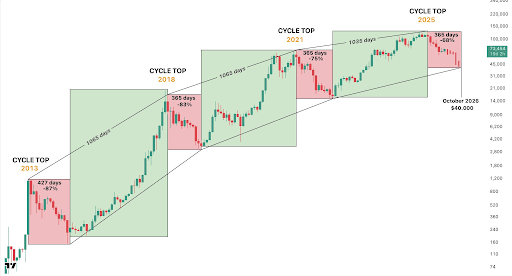
The recent uptick in Bitcoin’s price has naturally led to a gradual shift in market sentiment, moving away from extreme fear towards a cautious optimism. This sentiment shift is evident across social media discussions, trading forums, and mainstream crypto news outlets. While many interpret this as a positive indicator, Max posits that this early return of bullishness is, paradoxically, a red flag. In a comprehensive post on X, accompanied by a multi-cycle Bitcoin chart illustrating historical patterns, Max articulated that "When sentiment slowly starts turning bullish again, that’s usually your sign that the bottom isn’t in yet." This perspective challenges the prevailing narrative that the worst is over and that the market is poised for an immediate, sustained upward trajectory.
The analyst’s argument is rooted in the observation that historical Bitcoin cycles have frequently witnessed periods where a nascent sense of optimism emerges prematurely, only to be followed by further price corrections and deeper lows. This phenomenon often traps investors who enter the market based on early signs of recovery, only to experience subsequent losses as the market continues its corrective phase. Max’s analysis suggests that the current discussions surrounding a definitive cycle bottom and predictions of an impending historic rally are eerily similar to sentiment conditions that have historically preceded additional downside movements. In essence, the collective enthusiasm of the crowd turning optimistic too soon could indicate that the market has not yet completed its necessary cleansing or corrective phase, implying that further "pain" may be required before a sustainable uptrend can truly commence.
Unpacking Max’s Analytical Framework: The Psychology of Market Cycles
Understanding Max’s thesis requires delving into the fundamental psychology of market cycles, particularly as they apply to a highly speculative and volatile asset like Bitcoin. Market cycles are often characterized by distinct phases: accumulation, bull run, distribution, and bear market. Within these broader phases, investor sentiment swings dramatically from euphoria and greed at market peaks to despair and capitulation at market bottoms.
The Crypto Fear & Greed Index, a widely recognized metric, quantifies this sentiment by analyzing various factors such as volatility, market momentum/volume, social media sentiment, surveys, and Bitcoin’s dominance. Historically, extreme fear readings (often single-digit scores) have coincided with significant market bottoms, representing points of maximum financial opportunity for contrarian investors. Conversely, extreme greed readings typically signal market tops. Max’s concern arises from the observation that while the index dipped into fear, the swift rebound in price has pulled sentiment away from extreme despair before other structural conditions for a true bottom have been met. This "hope" phase, occurring too early, can be a deceptive interlude before a final wave of capitulation.
In previous bear markets, the journey to a true bottom has often been protracted and characterized by multiple false recoveries. These "dead cat bounces" lure investors back into the market, only to see their positions liquidated as prices fall further. The psychological toll of such repeated disappointments eventually leads to widespread investor fatigue and capitulation, where even long-term holders, or "HODLers," finally give up hope and sell their holdings at a loss. This final flush-out of weak hands is often a prerequisite for a healthy and sustainable market reversal, as it removes the last vestiges of selling pressure and allows for genuine accumulation by stronger hands. Max’s current assessment suggests that the market has not yet experienced this profound level of despair and capitulation, making the current optimism premature.
The Three Pillars of a True Cycle Bottom: Capitulation, Sweeps, and Structure
Max’s contrarian outlook is further substantiated by the absence of three specific structural conditions that have historically served as reliable signals for confirmed cycle lows in Bitcoin’s price history. These conditions are not merely subjective interpretations of sentiment but rather observable phenomena that reflect deep market dynamics.

-
Total Capitulation: This refers to the final, widespread surrender of market participants, typically characterized by high-volume sell-offs, panic selling, and a pervasive sense of despair. During true capitulation events, even long-term holders, who have weathered previous downturns, finally sell their assets, often at significant losses. This phase is marked by a complete erosion of confidence, minimal buying interest, and prices often falling well below perceived intrinsic value. Historically, total capitulation has manifested in significant drops in mining profitability, forcing some miners to sell their Bitcoin holdings or even shut down operations, adding to selling pressure. Exchange outflows might also indicate long-term holders accumulating discounted Bitcoin, but true capitulation usually sees substantial inflows as panic sellers move coins to exchanges. Max argues that the current market has not yet witnessed this scale of definitive capitulation, suggesting that many investors are still holding onto hope or have not yet faced the ultimate test of their conviction.
-
Repeated Sweeps of the Lows: A definitive market bottom is rarely a single point but rather a process involving multiple tests of support levels. "Repeated sweeps of the lows" refers to instances where the price drops to or slightly below a previous low, often liquidating leveraged positions or flushing out stop-loss orders, before swiftly rebounding. This process serves to "cleanse" the market of weak hands and establish a robust support zone. Each sweep confirms the market’s willingness to defend a certain price level, absorbing selling pressure and building a base for a future uptrend. If the price consistently fails to hold these retested lows, it indicates continued weakness. The absence of such clear, repeated tests and successful defense of critical low points suggests that the market has not yet established a firm foundation from which to launch a sustainable rally.
-
Confirmed Change in Market Structure on the Weekly Timeframe: For a long-term trend reversal to be confirmed, a significant shift in market structure must occur on higher timeframes, particularly the weekly chart. In a downtrend (bear market), market structure is characterized by lower highs and lower lows. A confirmed change in market structure for a bullish reversal would involve the price establishing a higher low, followed by a higher high that breaks above a significant previous resistance level. This demonstrates a shift in power from sellers to buyers and signals the initiation of a new uptrend. The weekly timeframe is crucial because it filters out short-term noise and provides a clearer picture of macro trends. Max’s analysis implies that while there might be short-term bounces, the weekly chart has not yet exhibited the definitive structural changes necessary to confirm a genuine, lasting reversal from a bear market. Without this fundamental shift, any upward movement is considered within the context of the existing bearish market structure.
Historical Precedent: Duration and Magnitude of Bitcoin’s Bear Markets
To contextualize his prediction, Max meticulously overlaid previous Bitcoin cycles onto its full price history, highlighting a consistent rhythm of extended accumulation and expansion phases followed by lengthy corrections. This cyclical behavior, often tied to the quadrennial halving events that reduce the supply of new Bitcoin, provides a powerful framework for understanding its long-term trajectory.
Max specifically cited data from the bear markets that followed the 2013, 2018, and 2021 cycle tops:
- 2013 Cycle Top: Following its peak, Bitcoin experienced a prolonged decline lasting approximately 427 days, culminating in a staggering 87% reduction in value. This was a brutal bear market that tested the conviction of early adopters.
- 2018 Cycle Top: After reaching its then-all-time high in December 2017, the market entered a bear phase that lasted around 365 days, resulting in an 83% price drop. This cycle, while slightly shorter in duration and less severe in percentage terms than 2013, still constituted a significant correction.
- 2021 Cycle Top: The most recent major peak in November 2021 saw Bitcoin initiate a correction that, by the time it reached its lowest point around late 2022, also spanned approximately 365 days, with a decline of about 75% from its peak. This demonstrated a trend of diminishing percentage declines with each successive cycle, suggesting a maturing asset class.
A key takeaway from this historical analysis is the remarkable consistency in the duration of these significant declines, often hovering around the one-year mark (365 days). While the magnitude of the percentage drop has shown a decreasing trend (87% to 83% to 75%), the time required for the market to find a definitive bottom has remained relatively stable. This consistency forms the bedrock of Max’s forward-looking projection.
Projecting the Future: Max’s October 2026 Bottom Forecast at $40,000
Applying this historical pattern to the current market landscape, Max’s most intriguing and perhaps controversial projection targets October 2026 as the likely window for Bitcoin’s next definitive bottom, with a projected price of $40,000. This forecast implicitly suggests that the current price action, even above $73,000, is not the ultimate bottom of the ongoing market phase or that a new cycle peak will precede a deeper correction.
To understand this projection, it’s crucial to clarify the "October 2025 peak" reference in the original article, which appears to be a crucial element of Max’s model. Given the context, it suggests that Max might be anticipating a future cycle peak around October 2025. If a new significant market top were to form in October 2025, then applying the historical duration of approximately 365 days for a subsequent bear market would logically lead to a bottom around October 2026. The projected price of $40,000 for this future bottom would represent a substantial correction from any potential 2025 peak, aligning with the historical pattern of significant drawdowns, albeit potentially with a further diminished percentage compared to previous cycles (e.g., a 50-60% drop from a much higher 2025 peak).

This long-term cycle projection by Max stands in stark contrast to the immediate bullish sentiment currently circulating. It implies that even if Bitcoin sees further appreciation in the near term, potentially towards a new all-time high or a significant local peak in 2025, a subsequent, prolonged bear market phase would likely follow, leading to the $40,000 bottom in late 2026. Such a bottom would align with both the duration consistency of previous bear phases and a reasonable magnitude of correction, rather than the much faster and shallower recovery some market participants are currently expecting.
At the time of writing, Bitcoin is trading at approximately $74,590, having risen by 5.4% in the preceding 24 hours. This price level represents a robust recovery from recent dips, fueling the optimism that Max’s analysis directly challenges.
Broader Market Dynamics: Halving, ETFs, and Macroeconomic Headwinds
The current Bitcoin market operates within a complex web of factors that influence its price and sentiment, making predictions inherently challenging. Two significant drivers in the current cycle are the upcoming Bitcoin halving and the recent approval of spot Bitcoin Exchange-Traded Funds (ETFs) in the United States.
The Bitcoin halving, an event that occurs approximately every four years, reduces the reward for mining new blocks by half, thereby decreasing the rate at which new Bitcoin enters circulation. Historically, halving events have preceded significant bull runs, as the reduced supply often clashes with growing demand, leading to price appreciation. The next halving is anticipated in April 2024, and many analysts and investors are banking on this event to propel Bitcoin to new all-time highs. This bullish catalyst is a strong counterpoint to Max’s more bearish long-term outlook.
The approval of spot Bitcoin ETFs in January 2024 has been a monumental development, providing institutional investors and traditional financial players with an accessible, regulated, and secure way to gain exposure to Bitcoin. These ETFs have seen substantial inflows, indicating growing institutional interest and adoption. The argument is that this new capital influx could fundamentally alter Bitcoin’s market dynamics, making it less susceptible to the extreme volatility and deep drawdowns observed in previous cycles. The consistent demand from ETFs is seen by many as a powerful force that could prevent the kind of prolonged capitulation Max describes.
However, the broader macroeconomic landscape also plays a critical role. Global inflation trends, central bank interest rate policies (particularly from the U.S. Federal Reserve), and geopolitical tensions all impact investor risk appetite. High interest rates typically make speculative assets like Bitcoin less attractive, as investors seek safer, yield-bearing alternatives. While inflation could theoretically boost Bitcoin’s appeal as a hedge, aggressive monetary tightening policies have historically put downward pressure on risk assets. The current global economic uncertainty, coupled with fluctuating inflation expectations, adds another layer of complexity to Bitcoin’s price discovery process, potentially supporting the argument that a full recovery might be more protracted than some anticipate.
Alternative Perspectives and the Maturing Bitcoin Market
While Max’s contrarian view offers a compelling argument based on historical patterns and market psychology, it is important to acknowledge that the cryptocurrency market is replete with diverse analytical perspectives. Many other analysts and market commentators remain staunchly bullish, pointing to factors that they believe differentiate the current cycle from its predecessors.
Proponents of an immediate bullish continuation often cite the unprecedented institutional adoption driven by the ETFs, arguing that this fundamental shift in market structure could negate some of the historical cycle patterns. They suggest that the influx of "smart money" and long-term institutional capital could lead to a more stable and less volatile market, effectively "flattening" the traditional boom-and-bust cycles. Furthermore, the increasing global recognition of Bitcoin as a legitimate asset class, alongside its growing utility in various applications, is seen as a sign of its maturing market.

Some analysts also argue for "lengthening cycles," where each subsequent bull and bear market stretches over a longer period, with diminishing volatility and percentage swings. This theory suggests that while the overall trajectory remains cyclical, the intensity of both pumps and dumps gradually decreases as the market cap grows and the asset becomes more mainstream. If this theory holds true, a 75% or 87% drawdown might be less likely in future cycles, and a $40,000 bottom might represent a significantly lower percentage drop from a much higher peak than previously observed.
The debate underscores the inherent uncertainty in forecasting the future of a nascent yet rapidly evolving asset class. The interaction between technical analysis, on-chain data, macroeconomic factors, and novel market developments (like ETFs) creates a dynamic environment where no single analytical framework holds absolute predictive power.
Implications for Investors: Navigating Uncertainty
For investors, Max’s analysis, alongside the broader market debate, highlights the critical importance of a well-informed and cautious approach to Bitcoin. The immediate implication of Max’s thesis is a warning against premature exuberance. Chasing rallies based solely on resurgent sentiment, without confirmation of deeper structural changes, can expose investors to significant risks.
For short-term traders, Max’s outlook suggests that caution is warranted, and that the current rally could be a relief bounce within a larger corrective structure or a period leading up to a more significant future correction. The absence of capitulation and structural changes implies that volatility could persist, and further downside remains a distinct possibility.
For long-term investors (HODLers), the analysis reinforces the importance of conviction and patience. If a $40,000 bottom in October 2026 is indeed a possibility, it means that current prices, while higher than recent lows, may still not represent the ultimate buying opportunity for those seeking to accumulate at the deepest discounts. Strategies like dollar-cost averaging (DCA), which involves investing a fixed amount regularly regardless of price, can help mitigate the risk of trying to time the market bottom.
Ultimately, the differing perspectives serve as a reminder that Bitcoin remains a highly speculative asset. Investors should conduct thorough due diligence, understand their own risk tolerance, and consider a diversified portfolio approach. Relying on a single analyst’s prediction, whether bullish or bearish, without cross-referencing with other data points and fundamental analysis, can be perilous. The path of Bitcoin has historically been marked by significant volatility and unpredictable turns, and the current market environment appears to be no exception, demanding careful navigation and strategic planning.
Conclusion: Awaiting Confirmation in a Volatile Landscape
Bitcoin’s recent surge above $73,000 has undeniably injected a renewed sense of optimism into the cryptocurrency market. However, the contrarian perspective offered by analyst Max serves as a crucial check on this enthusiasm, reminding market participants that historical patterns often dictate that premature bullish sentiment can precede further market corrections. By emphasizing the absence of total capitulation, repeated sweeps of the lows, and a confirmed change in market structure on the weekly timeframe, Max provides a detailed technical argument against the "bottom is in" narrative. His long-term projection of a $40,000 bottom in October 2026, stemming from a potential 2025 cycle top, underscores a more protracted and potentially painful path for Bitcoin before a sustainable bull market can truly take hold.
While the market grapples with powerful bullish catalysts like the upcoming halving and the transformative impact of spot Bitcoin ETFs, these forces are constantly weighed against broader macroeconomic conditions and the inherent cyclical nature of speculative assets. The divergence in expert opinion highlights the complex and dynamic nature of the Bitcoin market. As investors navigate this period of heightened volatility and