

The artificial intelligence landscape is undergoing a profound structural decentralization, driven by the rapid evolution of open-weight models that now trail industry-leading proprietary systems by a mere four months on average. For consumers, developers, and enterprises alike, this narrowing performance gap means that high-performance artificial intelligence is no longer tethered exclusively to centralized cloud infrastructure or expensive monthly subscriptions. Leveraging increasingly sophisticated tools such as Ollama and LM Studio, users can now download, customize, and execute robust large language models directly on consumer-grade hardware they likely already own.
This paradigm shift liberates users from the recurring $20 monthly fees associated with mainstream cloud-based chatbots while eliminating the privacy vulnerabilities inherent in routing personal, professional, or proprietary conversations through third-party servers. With recent legal precedents—such as court orders compelling major providers like OpenAI to preserve user chat logs including deleted interactions—growing numbers of privacy-conscious individuals and organizations are abandoning cloud dependencies in favor of local deployment.
Understanding Open-Weight AI and the Local Revolution
The term "open-weight" designates artificial intelligence models whose underlying parameter weights—the numeric files that encapsulate everything the neural network has learned during its training phase—are published openly for the public to download, inspect, and execute. Unlike traditional closed-source or proprietary models hosted exclusively behind vendor paywalls, open-weight architectures grant users absolute autonomy over their execution environment.
Prominent releases exemplifying this trend include Google’s Gemma 4 series, DeepSeek’s R1 models, and OpenAI’s own open-source-aligned gpt-oss offerings. These models are typically distributed under permissive open-source licenses such as the MIT License or the Apache 2.0 license. Such licenses explicitly permit commercial use, system modification, and the creation of derivative works. Consequently, developers and specialists can fine-tune a model to excel in specific domains—such as medical diagnostics, legal document analysis, or specialized software engineering—while discarding or down-prioritizing extraneous capabilities.

Furthermore, running models locally guarantees total data sovereignty. Because the computation occurs entirely on the user’s local machine, data never traverses an external network, ensuring compliance with strict regulatory frameworks such as GDPR and HIPAA without requiring complex enterprise data-processing agreements.
Hardware Requirements and Memory Optimization
Transitioning an artificial intelligence model from a remote cloud data center to a personal computer requires careful consideration of hardware specifications, primarily memory capacity and processing architecture. Large language models are categorized by their parameter counts, which directly dictate their file sizes and memory footprints.
To successfully run a local model, the entire set of weights must fit comfortably within the active memory accessible to the processor and graphics subsystem. For Windows and Linux users, this generally means relying on dedicated graphics processing unit (GPU) video memory (VRAM). While entry-level tasks can be managed with approximately 8GB of VRAM, serious practitioners aiming to run larger, more capable models typically utilize enthusiast-grade GPUs equipped with 24GB or more of VRAM, or multi-GPU configurations. Apple Silicon Macintosh systems utilize a unified memory architecture, allowing the central processor and graphics cores to share a single, high-bandwidth memory pool. Systems configured with 16GB to 32GB or more of unified memory are exceptionally well-suited for local AI deployment, easily handling models like the Gemma 4 variants or the 20-parameter iterations of gpt-oss.
When hardware memory is constrained relative to a model’s native size, optimization techniques such as quantization become essential. Quantization reduces the memory footprint of a model by compressing the numerical precision of its weights—for instance, shifting from standard 32-bit floating-point numbers down to 8-bit integers (int8). While this compression drastically lowers the required RAM or VRAM, it introduces a negligible trade-off in output accuracy.
Step-by-Step Deployment: Ollama and LM Studio

Deploying a local artificial intelligence model has been simplified through the development of accessible management software, chief among them being LM Studio and Ollama.
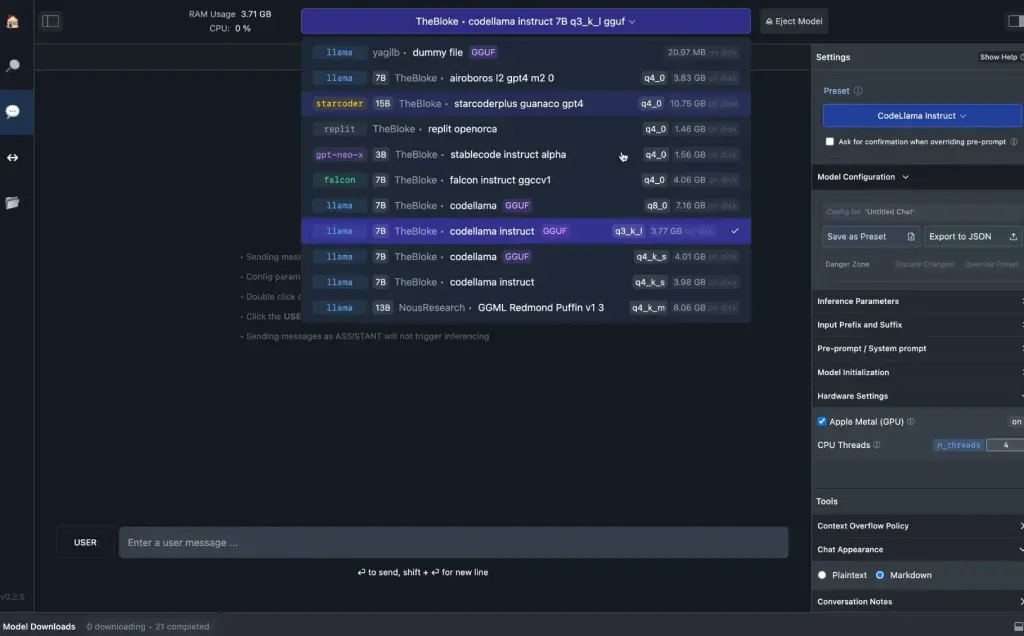
LM Studio provides a polished, user-friendly graphical interface designed for broad accessibility. By downloading the application for Windows, macOS, or Linux, users gain access to an integrated search engine connected directly to Hugging Face, the premier public repository for open-source machine learning models. Users can search for specific architectures, download the corresponding weight files, and initiate an offline chat session within a matter of minutes.
For developers and advanced users who prefer command-line efficiency, Ollama offers a lightweight, highly versatile runtime environment. Installation is streamlined via terminal commands: macOS and Linux users execute a standard shell script curl command, while Windows users utilize PowerShell installation scripts. Once installed, downloading a model requires a simple command such as ollama pull, followed by ollama run to initiate an interactive terminal session. Additionally, Ollama automatically establishes a local application programming interface (API) server at localhost, enabling other desktop applications and custom software pipelines to interface seamlessly with the local model.
Performance Enhancements and Architectural Innovations
Recent breakthroughs in local inference technology have dramatically closed the speed gap between local hardware and cloud data centers. Google’s implementation of Multi-Token Prediction drafters for models like Gemma 4 exemplifies this progress. By utilizing speculative decoding—where a smaller auxiliary model proposes multiple tokens ahead and the primary model verifies them in a single computational pass—local generation speeds can be accelerated by up to three times without requiring upgraded physical hardware.
Moreover, the integration of Model Context Protocol (MCP) servers into local runtime environments allows models running on personal hardware to securely interact with local files and perform web retrieval tasks, bridging the functional gap between isolated local models and dynamic cloud assistants.
Current Limitations of Local Deployment
Despite extraordinary advancements, local AI models still face inherent physical and architectural constraints when compared against massive enterprise cloud infrastructure. The largest frontier models maintained by major technology firms operate on clusters containing trillions of parameters—such as Alibaba’s Qwen3.8-Max, which boasts 2.4 trillion total parameters with 95 billion active at any given time. Such colossal architectures far exceed the capacity of standard consumer hardware, which is typically constrained by local memory ceilings of 80GB or less.
When a model’s memory requirements exceed available VRAM and spill over into standard system RAM, processing speeds can degrade significantly. Furthermore, maintaining large context windows—such as the 128K to 256K token capacities supported by modern iterations—demands substantial memory overhead. For complex multi-step reasoning, exhaustive web searches, and heavy enterprise workloads, cloud-based frontier models continue to hold a performance advantage.
Implications and Future Outlook
The democratization of open-weight artificial intelligence marks a foundational shift in how individuals and enterprises interact with machine learning technology. By decoupling advanced natural language processing from centralized subscription models, local AI empowers users to reclaim ownership of their digital communications. As consumer hardware continues to grow more powerful and model quantization techniques become increasingly efficient, the boundary between cloud-dependent capabilities and local autonomy will continue to blur, cementing open-weight models as a permanent pillar of the modern technological ecosystem.
