
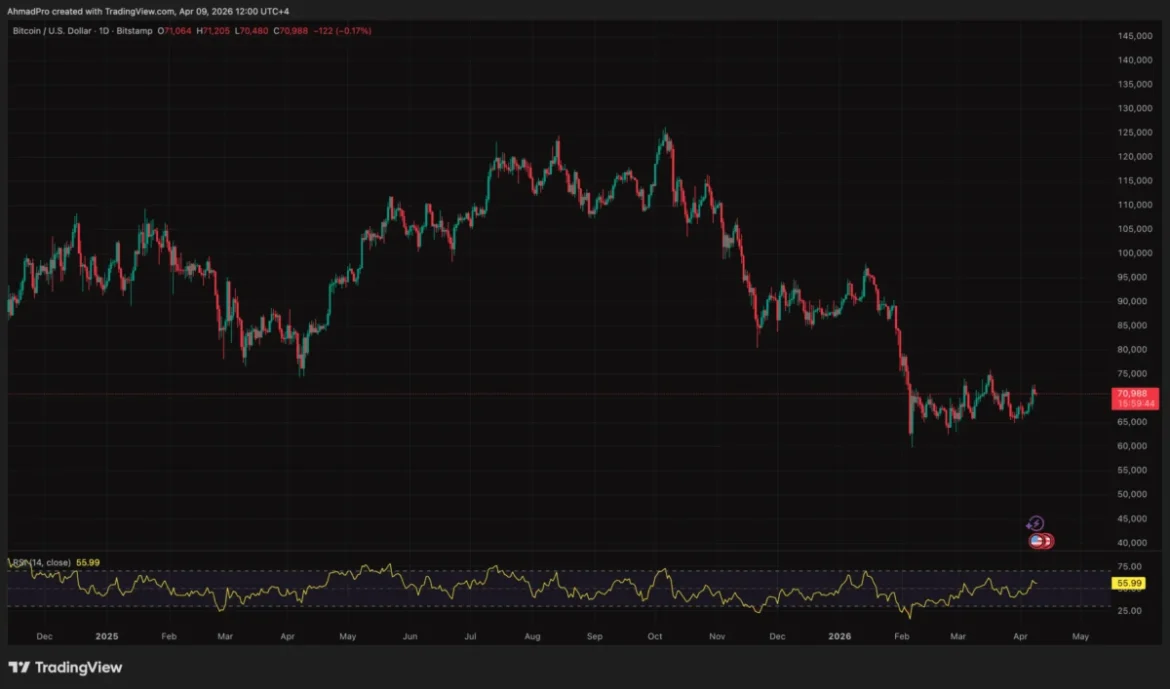
Bitcoin’s price is currently trading in the vicinity of $71,000, marking a modest 0.5% decrease over the preceding 24-hour period. This dip follows a broader cryptocurrency rally witnessed on Tuesday, which was largely attributed to a tentative two-week ceasefire agreement between the United States and Iran. However, the optimism that fueled this surge has begun to wane, with material signs of the ceasefire’s potential collapse emerging less than 48 hours after its announcement. The critical question for market analysts has shifted from the sustainability of this "relief trade" to the extent of the unwinding gains should the ceasefire falter under its first weekend stress test, and crucially, where a credible support floor for Bitcoin might be established.
The intricate relationship between geopolitical stability and digital asset markets has been starkly illustrated in recent days. The initial de-escalation between the US and Iran, perceived as a significant step towards regional peace, injected a wave of speculative buying across various risk assets, including cryptocurrencies. Bitcoin, often viewed as a bellwether for market sentiment towards global stability due to its digital and decentralized nature, experienced a notable uplift. This rally underscored the market’s sensitivity to geopolitical narratives, where even the prospect of reduced conflict can trigger substantial capital flows into assets perceived as having growth potential or acting as safe havens in times of uncertainty.
The Hormuz Re-Premium: How Doubts About the Ceasefire Ripple Through Crypto Markets
The transmission mechanism connecting geopolitical developments to the cryptocurrency market, particularly Bitcoin, is direct and multifaceted. Tensions surrounding the Strait of Hormuz, a critical chokepoint for global oil supplies, have historically been a significant driver of energy price volatility and, by extension, broader market uncertainty. The perceived fragility of the US-Iran ceasefire has directly re-introduced an "energy risk premium" into the market, a concept that had been temporarily discounted following the ceasefire announcement.
On Thursday, Iranian Parliament Speaker Mohammad Bagher Ghalibaf publicly stated that three clauses of the ceasefire proposal had been contravened, although he did not specify which particular provisions were allegedly breached. Concurrently, reports indicated that Israeli military operations continued in Lebanon. Crucially, the Strait of Hormuz, which was nominally set to reopen under the terms of the deal, remained effectively closed, with minimal tanker traffic observed. This stagnation in the reopening of such a vital shipping lane directly undermines the core of the diplomatic breakthrough.
The failure of the Hormuz reopening to materialize as anticipated is the linchpin of the current market unease. This crucial element was positioned as a central pillar of the agreement, and its non-event signifies that the market’s brief excursion into pricing out energy risk has been abruptly halted. Consequently, this risk premium is now being re-priced back into global energy markets, with immediate implications for inflation expectations and broader economic sentiment.
Brent Crude Rebounds, Equity Markets Show Signs of Weakness
The impact of this renewed uncertainty is vividly reflected in the price of Brent crude oil. After experiencing a dramatic single-day collapse of over 10% on Wednesday – its worst daily decline in six years – Brent crude rebounded by approximately 2% on Thursday, trading around $97 per barrel. This sharp reversal illustrates a market that rapidly shifted from anticipating peace and stability to pricing in renewed geopolitical uncertainty within a single trading session. The volatility in oil prices has direct consequences for inflation, as energy costs are a significant component of global economic activity.
The ripple effect of this geopolitical recalcitrance has also been observed in global equity markets. S&P 500 futures pointed to a 0.2% decline on Thursday, signaling a potential end to a four-day winning streak for global equities. Similarly, the MSCI Asia Pacific Index experienced a notable fall of 0.9%, with a clear trend of two stocks declining for every one that rose. This downturn erased a portion of the gains that had been driven by the earlier ceasefire optimism.
Treasury markets, which had initially rallied on the prospect of reduced geopolitical risk, showed signs of cooling. The earlier upward momentum faded as concerns resurfaced that elevated oil prices could reignite inflation expectations. This brings into focus the second layer of transmission for geopolitical shocks into the financial system, particularly the interplay between commodity prices, inflation, and central bank policy.
The Dual Shock: Energy Prices, Inflation, and Federal Reserve Policy
The persistent upside risks to inflation have been a consistent theme flagged by the Federal Reserve. This concern, juxtaposed with recent softening labor data, has maintained the narrative of a "higher-for-longer" interest rate environment. Analysts at Bitunix characterized the current situation as a dual shock, stemming from both the global repricing of energy and the inherent policy constraints faced by the Federal Reserve. They highlighted that central bank officials are navigating a complex balancing act, attempting to manage energy-driven inflation while simultaneously acknowledging weakening employment conditions.
The Federal Reserve’s dual mandate of price stability and maximum employment places it in a precarious position. If energy prices continue to climb due to geopolitical instability, this will exert upward pressure on inflation, potentially forcing the Fed to maintain a hawkish stance, even as the labor market shows signs of cooling. This scenario could lead to a stagflationary environment, characterized by low economic growth and high inflation, which is generally detrimental to risk assets like Bitcoin.
The market’s reaction is a direct reflection of this dilemma. The initial relief rally was predicated on the assumption of a de-escalation that would alleviate inflationary pressures and potentially allow for a more accommodative monetary policy stance in the future. With the ceasefire’s credibility now in question, the prospect of sustained higher energy prices and a protracted period of restrictive monetary policy has re-emerged, dampening investor appetite for risk.
Bitcoin Price Analysis: Navigating the $70,000 Floor and Resistance Levels
Bitcoin’s technical landscape continues to be defined by a broad range between $65,000 and $73,000, a zone that has contained all significant price movements since late February. However, the current situation sees the asset testing the upper half of this range rather than consolidating near the lower bounds. While this might be considered a more constructive observation under normal circumstances, the prevailing geopolitical uncertainty casts a shadow over this technical positioning.
The immediate concern for traders and investors is that Bitcoin encountered technical resistance at the 23.6% Fibonacci retracement level, which stood at approximately $71,766. Following this rejection, the price has fallen below its 7-day moving average, calculated at $71,342. This decline was accompanied by a notable drop of 4.25% in futures open interest within a single session, indicative of broader deleveraging and a reduction in speculative positions as market participants reassess risk.
Key support levels that are now under scrutiny include the 50% Fibonacci retracement at $70,582, followed by the 61.8% level at $70,052. A more significant level of support, representing a full round-trip scenario should the ceasefire formally unravel, is the swing low observed at $68,338. The integrity of these levels will be crucial in determining Bitcoin’s short-to-medium term trajectory.
Earlier in the week, Bitcoin had reached an intraday peak of $76,013 before commencing its retreat. The $70,981 print observed on Thursday represents a pullback of 6.6% from this recent high. While the overarching $65,000-$73,000 macro range remains technically intact, the burden of proof has now shifted back to the bullish side, requiring sustained positive developments to reclaim upward momentum.
Geopolitics vs. Technicals: The Dominant Driver of Bitcoin’s Direction
At present, Bitcoin’s price action appears to be driven more by geopolitical headlines than by purely technical indicators. If the ceasefire were to hold firm and energy prices were to cool significantly, particularly with Brent crude dropping below the $90 per barrel mark, this would alleviate pressure on the macroeconomic front. Such a scenario would provide Bitcoin with the necessary breathing room to reclaim short-term trends above $71.3K and potentially push back towards the $73K to $74K resistance zone.
However, the market’s current sentiment suggests a lack of full conviction in this optimistic outcome. The downside risks remain very real. Should tensions escalate once more and oil prices surge past $100 per barrel, Bitcoin is likely to lose the critical $70,000 area and begin a slide towards the high $60,000s, with the $65,000 level re-emerging as a significant deeper floor.
This juncture highlights a critical moment where market direction is not solely dictated by chart patterns but is intrinsically linked to evolving news cycles. Both upward and downward trajectories remain plausible, with the market actively pricing in the inherent risk that geopolitical situations can deteriorate as swiftly as they improve. This dynamic creates a highly uncertain trading environment where adaptability and a keen eye on global events are paramount.
Broader Implications and Market Outlook
The current scenario serves as a potent reminder of the interconnectedness of global markets and the profound impact of geopolitical events on asset prices, including those in the digital asset space. The brief respite offered by the US-Iran ceasefire illuminated how quickly market sentiment can shift based on perceived de-escalation. The subsequent re-emergence of doubt underscores the fragility of such optimism and the market’s propensity to revert to pricing in risk when stability is threatened.
For the cryptocurrency market, particularly Bitcoin, this translates into a period of heightened volatility and uncertainty. Investors will be closely monitoring developments in the Middle East, as well as official statements from governments and international bodies, for any indications of a genuine de-escalation or further escalation. The interplay between these geopolitical events and macroeconomic factors, such as inflation and interest rate policy, will continue to shape Bitcoin’s price action.
The reliance on geopolitical headlines for short-term direction suggests that traditional technical analysis might be secondary to news-driven trading in the immediate future. A sustained period of geopolitical calm would likely allow technical factors to reassert their influence, potentially leading to a more predictable price discovery process. Conversely, any further flare-up in tensions could trigger significant downward pressure, testing the resilience of Bitcoin’s support levels.
The market is in a state of flux, caught between the hope for peace and the reality of persistent geopolitical risks. The coming days and weeks will be critical in determining whether the tentative ceasefire can hold or if the specter of conflict will continue to cast a long shadow over global financial markets and digital assets like Bitcoin.
Disclaimer: Coinspeaker is committed to providing unbiased and transparent reporting. This article aims to deliver accurate and timely information but should not be taken as financial or investment advice. Since market conditions can change rapidly, we encourage you to verify information on your own and consult with a professional before making any decisions based on this content.
