
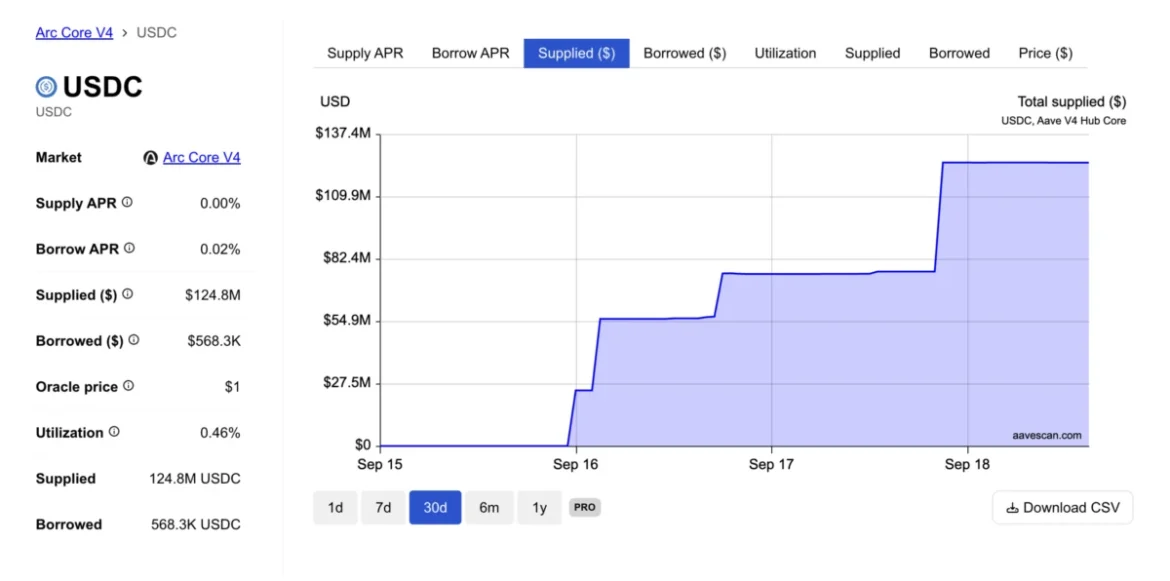
The decentralized finance (DeFi) landscape is witnessing a curious paradox on the newly launched Aave V4 Arc market, where a massive influx of capital has run headfirst into an acute lack of borrowing demand. According to data retrieved from Aavescan on September 18, users have rapidly supplied approximately $124.8 million in USDC to the platform. Yet, despite this formidable war chest of stablecoin liquidity, total active borrowing remains remarkably subdued, hovering below the $600,000 threshold.
This staggering imbalance—where roughly 99.5% of deposited funds sit completely idle—highlights a classic chicken-and-egg dilemma inherent to the launch of next-generation liquidity markets. While the heavy capital inflow demonstrates robust institutional and retail confidence in the security and brand reputation of Aave, it simultaneously underscores the challenge of cultivating organic, productive utility in nascent ecosystems. As the broader crypto industry watches Aave V4’s rollout, market participants and analysts are sharply focused on whether borrower demand can eventually scale to match the towering mountain of deposited capital.
Chronology of the Liquidity Surge
The accumulation of liquidity within Aave V4’s Arc market has occurred at a breakneck speed, catching several on-chain observers by surprise. The timeline of deposits reveals a parabolic trajectory over a matter of days in mid-September:
- September 16: The market registered approximately $24.5 million in excess reserves, marking the early stages of capital migration toward the protocol’s latest iteration.
- September 17: Deposits experienced a dramatic upward revision, climbing to roughly $75.8 million within a 24-hour window. Despite this massive leap, borrowing figures remained statistically negligible, with virtually no capital being actively leveraged by market participants.
- September 18: Data provided by Aavescan confirmed a further escalation, with total USDC supplies surging to nearly $124.8 million. This represented an approximate 65% jump in a single day and a more than fivefold increase compared to levels recorded just 48 hours prior.
Concurrently, borrowing activity showed minor signs of life, albeit from an extremely low base. On the midnight of September 18, total borrowed amounts dipped to roughly $73,400 before climbing to a recorded high of approximately $568,300 later in the day. While this upward tick in borrowing hints at the initial stages of market engagement, the delta between supply and demand remains one of the widest seen in recent DeFi protocol deployments.
Mechanics and Implications of Idle Capital
To understand why a $125 million deposit pool is not necessarily a definitive victory for the platform, one must examine the core economic mechanics of decentralized lending markets. Aave functions as a decentralized intermediary, matching entities holding excess cryptocurrency assets (lenders) with entities seeking temporary liquidity (borrowers). In a healthy, self-sustaining market, lenders are compensated with interest generated by the fees paid by borrowers.
However, when liquidity vastly outstrips demand, the economic engine stalls. Because borrowers are utilizing a mere 0.46% of the available USDC pool, the protocol is generating virtually no yield for its depositors. Current metrics for the Arc market reflect this stagnation, showing a supply return (APY) of 0.00%, alongside a nominal borrowing rate hovering around 0.02%.

For the average liquidity provider, parking funds in a pool yielding zero percent return defeats the primary financial incentive of decentralized finance. Consequently, financial analysts argue that the headline-grabbing $125 million figure is largely symbolic at this stage, serving as a display of idle capital rather than an active, functioning lending economy.
Industry Context and the Strategic Importance of Aave V4
Aave commands a dominant position within the decentralized finance sector, historically capturing nearly half of all total value locked (TVL) across DeFi lending markets. The introduction of V4 and specialized environments like the Arc network represents a concerted effort by the core development teams to push the boundaries of institutional compliance, asset management, and cross-chain liquidity architecture.
Historically, launching a new market requires a deliberate bootstrapping phase. Liquidity must always precede demand; borrowers will not arrive if there is no capital available to draw from, and lenders will not commit funds if a track record of security and infrastructure stability has not yet been established. From this strategic viewpoint, the rapid influx of $125 million can be interpreted as a necessary prerequisite. It establishes a deep liquidity buffer that reassures prospective institutional borrowers that large-scale capital is instantly accessible should they choose to execute leveraged positions, trade, or manage short-term cash flow needs within the Arc ecosystem.
Expert Perspectives and Market Outlook
While cryptocurrency communities often celebrate record-breaking Total Value Locked (TVL) figures as unequivocal proof of success, seasoned market analysts maintain a more nuanced perspective regarding utilization rates.
Industry commentators note that high-liquidity, low-utilization phases are common during the introductory weeks of specialized or permissioned market deployments, such as Aave Arc—which is typically tailored toward institutional participants requiring regulatory guardrails. Institutional entities often move with extreme deliberation, conducting rigorous legal, operational, and technical due diligence before deploying borrowed capital into live market strategies. Therefore, the sluggish borrowing rates observed on September 18 may not point to an inherent systemic flaw, but rather to the cautious onboarding pace of institutional capital allocators.
Moving forward, industry observers suggest that tracking the velocity of borrowing—rather than celebrating raw deposit milestones—will be the definitive metric for measuring the real-world adoption of Aave’s expansion. For Aave V4 to cement its status as a revolutionary upgrade, the protocol must successfully bridge the gap between passive capital accumulation and active, yield-generating credit creation. Until borrower demand scales to absorb even a fraction of the $125 million war chest, the Arc market will remain a monument to abundant liquidity awaiting its true market test.
