
The decentralized finance (DeFi) ecosystem finds itself at a critical juncture, facing a resurgence of security vulnerabilities that threaten to unravel recent market recovery and reignite widespread fear, uncertainty, and doubt (FUD) among investors and users. A series of recent cross-chain bridge exploits, collectively siphoning over $35 million, have cast a long shadow, coinciding ominously with the re-activation of the hacker responsible for a colossal $285 million exploit earlier this year. This confluence of events has pushed protocol security back to the forefront of market discourse, recalling the turbulent period of Q1-Q2 2026 when a spate of major hacks led to unprecedented liquidity outflows and a significant contraction in total value locked (TVL).
A Troubling Echo of Past Instability
The current wave of anxiety bears a striking resemblance to the challenges faced by DeFi just months ago. The Q1-Q2 2026 cycle witnessed one of the most severe security crises in the history of decentralized finance, marked by a succession of high-profile exploits that collectively drained over $600 million from various protocols. These incidents, which included compromises of major cross-chain infrastructure and lending platforms, sent shockwaves through the nascent industry. The immediate aftermath was a sharp and sustained liquidity outflow, as rattled investors withdrew their capital from perceived high-risk ventures. This dramatic exodus saw DeFi’s total value locked plummet from its peak, settling at just over $65 billion, a level not seen since Q2 2024. The impact was particularly acute on foundational networks, with Ethereum alone experiencing a staggering loss of more than $10 billion in TVL within a mere 48-hour period, illustrating the swift and decisive nature of investor reactions to security breaches.
This previous downturn underscored the fragile relationship between innovation, trust, and capital in the DeFi space. Each major hack chipped away at user confidence, prompting many to de-risk their portfolios or exit the ecosystem entirely. The collective memory of these events remains fresh, making the current string of exploits particularly potent in their potential to trigger another widespread sell-off and dampen the nascent recovery that had begun to take hold.
The Latest Onslaught: $35 Million Lost in a Single Day
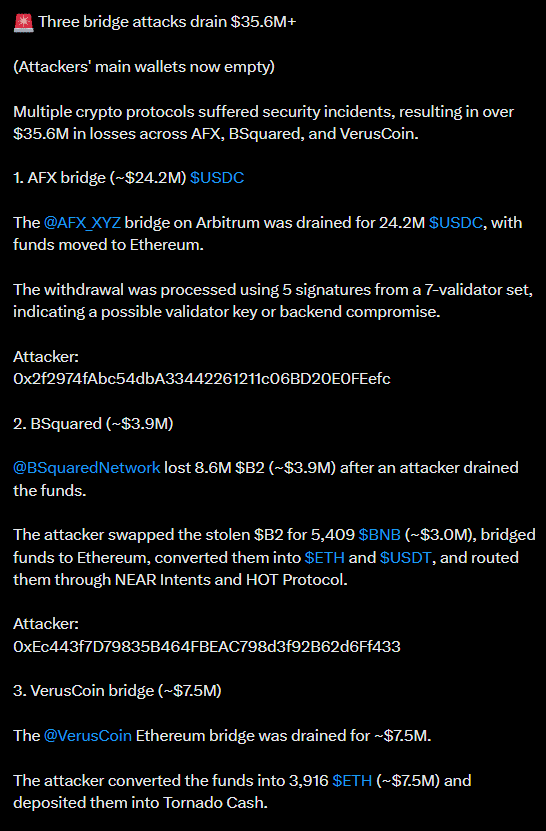
The recent wave of exploits, which market participants are already dubbing "the worst day for DeFi in months," saw approximately $35.55 million vanish across three separate protocols in rapid succession. While the total sum is significantly smaller than the multi-hundred-million-dollar losses incurred during the Q1-Q2 period, the concentrated nature of these attacks and their shared vulnerability point to systemic issues within a critical component of the DeFi infrastructure: cross-chain bridges.
-
AFX Protocol (Arbitrum Bridge Exploit): The largest of the three recent incidents struck AFX, a protocol whose specific functions are still being fully assessed by security researchers but is known to leverage Arbitrum for scalability. Attackers successfully siphoned $24.2 million in USDC stablecoin from its Arbitrum bridge, subsequently transferring the stolen funds to the Ethereum mainnet. Bridge exploits often involve manipulating smart contracts, exploiting logical flaws in cross-chain messaging, or compromising validator nodes, and the precise vector for the AFX attack is currently under forensic investigation. The transfer of funds to Ethereum, a more liquid and established network, suggests a clear intent for eventual laundering or cashing out.
-
BSquared Network Exploit: In a separate incident, the BSquared Network, a protocol likely involved in layer-2 scaling or interoperability solutions, suffered a loss of approximately $3.9 million. The attacker drained 8.6 million B2 tokens, the native asset of the network. This exploit highlights the vulnerability of native tokens locked within bridge mechanisms, where a compromise can lead to the immediate depletion of project treasuries or user funds. The nature of B2 tokens and their utility within the BSquared ecosystem will determine the broader impact on the project’s long-term viability and investor confidence.

-
VerusCoin Bridge Exploit: Completing the trio of attacks, VerusCoin, a project known for its focus on decentralization, security, and novel consensus mechanisms, experienced a bridge exploit resulting in losses estimated at roughly $7.5 million. While details regarding the specific assets stolen or the attack vector are still emerging, the incident further underscores the pervasive risks associated with connecting disparate blockchain networks.
The immediate market reaction to these simultaneous breaches was one of alarm. Although individual losses were not on the scale of previous mega-hacks, the collective impact within a single day served as a stark reminder of DeFi’s persistent Achilles’ heel. The swift spread of selling pressure and heightened risk aversion among market participants evidenced the lingering trauma from earlier, larger-scale security incidents.
Cross-Chain Bridges: DeFi’s Persistent Vulnerability
A critical commonality among AFX, BSquared Network, and VerusCoin exploits is their shared attack vector: cross-chain bridges. These vital pieces of infrastructure are designed to facilitate the seamless transfer of assets and data between different blockchain networks, a fundamental requirement for a truly interoperable multi-chain future. However, their inherent complexity, coupled with the immense value they often secure, makes them prime targets for malicious actors.
Bridge exploits typically arise from several common vulnerabilities:
- Smart Contract Flaws: Bugs or logical errors in the bridge’s smart contract code can be exploited to drain funds.
- Private Key Compromise: If the private keys controlling a bridge’s multi-signature wallet or validator nodes are compromised, attackers can gain unauthorized control over locked assets.
- Oracle Manipulation: Bridges relying on external data feeds (oracles) can be vulnerable to price manipulation or incorrect information, leading to the release of funds under false pretenses.
- Centralization Risks: Some bridges, particularly older or less decentralized ones, may have single points of failure, making them easier targets.
The recurring nature of bridge hacks, evidenced by high-profile incidents like the Ronin Network ($625 million), Wormhole ($325 million), and Harmony’s Horizon Bridge ($100 million) in prior years, highlights a systemic issue that the industry is still struggling to fully address. While new security paradigms and more robust auditing practices are continually being developed, the sheer volume of assets flowing through these bridges makes them irresistible targets for sophisticated cybercriminals. Industry experts often liken bridges to the "banks" of the crypto world, holding vast treasuries that, if compromised, can lead to catastrophic losses. The latest incidents serve as a fresh, sobering reminder that despite advancements, the fundamental security model of many bridges remains a significant point of fragility.
The Ghost in the Machine: Drift Protocol Hacker Resurfaces
Adding another layer of complexity and apprehension to the already tense DeFi landscape is the unexpected re-emergence of activity from the hacker behind the colossal Drift Protocol exploit. Earlier in 2026, Drift Protocol, a prominent decentralized exchange (DEX) on the Solana blockchain known for its perpetual futures trading, suffered one of the largest single DeFi exploits, with attackers making off with an estimated $285 million. This incident alone triggered a substantial wave of risk-off sentiment, specifically impacting the Solana ecosystem and broader DeFi liquidity.
Now, just as the industry grapples with fresh bridge exploits, the stolen funds from the Drift hack have begun to move. According to blockchain analytics firm Onchain Lens, the attacker is systematically funneling Ether (ETH) through the Tornado Cash Router. These transfers are being executed in repeated 100 ETH batches, with multiple transactions occurring every minute. Tornado Cash is a notorious cryptocurrency mixer designed to obscure the origin and destination of crypto transactions, making it extremely difficult for law enforcement and blockchain forensics teams to trace stolen funds.
While the movement of these funds does not automatically signal an immediate sell-off that would further destabilize the market, it serves as a powerful psychological trigger. The sheer scale of the original Drift hack means that any indication of the stolen funds being liquidated could inject a massive supply shock into the market, particularly for ETH. More importantly, the timing of this activity – coinciding with a new wave of exploits – amplifies the overall sense of vulnerability and uncertainty within DeFi. It brings a previously settled, albeit painful, memory back into sharp focus, reminding the market that these massive sums of stolen capital still exist and pose a potential threat.
Market Reaction and Expert Commentary
The combination of new bridge exploits and the re-activation of a major past hacker has predictably unsettled the DeFi market. Prior to these events, DeFi had shown encouraging signs of recovery. According to data from DeFiLlama, the total value locked (TVL) across decentralized protocols had climbed by more than $10 billion throughout July, marking the strongest monthly increase since the previous Q1-Q2 2026 hack wave. This recovery suggested a gradual return of investor confidence and a renewed appetite for decentralized financial products.
However, the latest $35 million in crypto hacks has injected a fresh dose of uncertainty into this nascent recovery. Industry analysts have quickly weighed in, expressing concern over the concentrated nature of the recent attacks. "It’s not just the monetary loss, but the repeated targeting of cross-chain bridges that is most concerning," stated Dr. Alistair Finch, a blockchain security consultant. "Bridges are critical for DeFi’s scalability and interoperability, but they also represent a massive attack surface. Until these fundamental vulnerabilities are addressed, we will continue to see these cycles of exploitation."
Similarly, market commentators have highlighted the psychological impact. "The re-emergence of the Drift hacker’s activity is a ‘double whammy’ for market sentiment," noted Sarah Chen, a crypto market strategist at Nexus Capital. "It reminds investors that even old wounds can reopen, and the specter of large-scale liquidations from stolen funds always looms. This could easily shift the market’s focus from capital inflows and innovation back to fundamental protocol security."
There are growing calls from within the DeFi community for more stringent security audits, greater investment in bug bounty programs, and the adoption of standardized security practices across the ecosystem. Protocol developers are under increasing pressure to prioritize security over speed of deployment, and users are being advised to exercise extreme caution when interacting with cross-chain bridges, especially newer or lesser-known ones.
Broader Implications and the Future of DeFi Security
The recent events carry significant implications for the broader DeFi ecosystem, touching upon issues of trust, regulation, and the pace of innovation.
- Erosion of Trust: Each successive hack, regardless of its size, erodes user trust. For DeFi to achieve mainstream adoption and truly challenge traditional finance, it must demonstrate an unshakeable commitment to security. A perception of perpetual vulnerability will deter institutional investors and retail users alike, limiting its growth potential.
- Regulatory Scrutiny: Increased exploits inevitably draw the attention of regulators worldwide. Governments are already grappling with how to oversee the rapidly evolving crypto space, and repeated security failures provide ammunition for those advocating for stricter, potentially stifling, regulations. Such regulations could impose significant compliance burdens on protocols, potentially stifling innovation.
- Innovation vs. Security Dilemma: The constant drive for innovation in DeFi, with new protocols and features being deployed at a rapid pace, often clashes with the meticulous, time-consuming process of rigorous security auditing. This tension creates an environment where vulnerabilities can be inadvertently introduced or overlooked. The current climate may force a re-evaluation of this trade-off, prioritizing security best practices over speed-to-market.
- The Rise of Secure Bridging Solutions: The repeated targeting of bridges will undoubtedly accelerate the development and adoption of more secure interoperability solutions. This could include advancements in zero-knowledge (ZK) bridges, optimistic rollups with enhanced fraud proofs, and native cross-chain communication protocols that reduce reliance on external validators or complex smart contracts. Projects focusing on "intent-based" architectures or shared security models may also gain traction as alternatives.
- Insurance and Risk Mitigation: The demand for decentralized insurance protocols, which offer coverage against smart contract exploits and other risks, is likely to surge. While still a nascent sector, these platforms could play an increasingly vital role in mitigating the financial impact of hacks and restoring some level of confidence for users willing to pay a premium for protection.
- The Long-Term Vision: Despite these challenges, the fundamental promise of decentralized finance – an open, transparent, and permissionless financial system – remains compelling. The current security scares are a painful but necessary part of its maturation process. For DeFi to truly flourish, it must learn from these incidents, adapt its security posture, and demonstrate resilience in the face of persistent threats. If more exploits continue to follow, the market could once again shift its primary focus from exhilarating capital inflows and groundbreaking innovation to the foundational imperative of protocol security, reviving the same DeFi FUD that dominated earlier in the year and potentially altering its growth trajectory for the foreseeable future.
The coming months will be crucial in determining whether the DeFi ecosystem can effectively batten down its hatches, bolster its defenses, and restore the confidence necessary to continue its ambitious journey towards reshaping global finance. The ongoing battle between builders and malicious actors continues, with the stakes for the future of decentralized finance never higher.