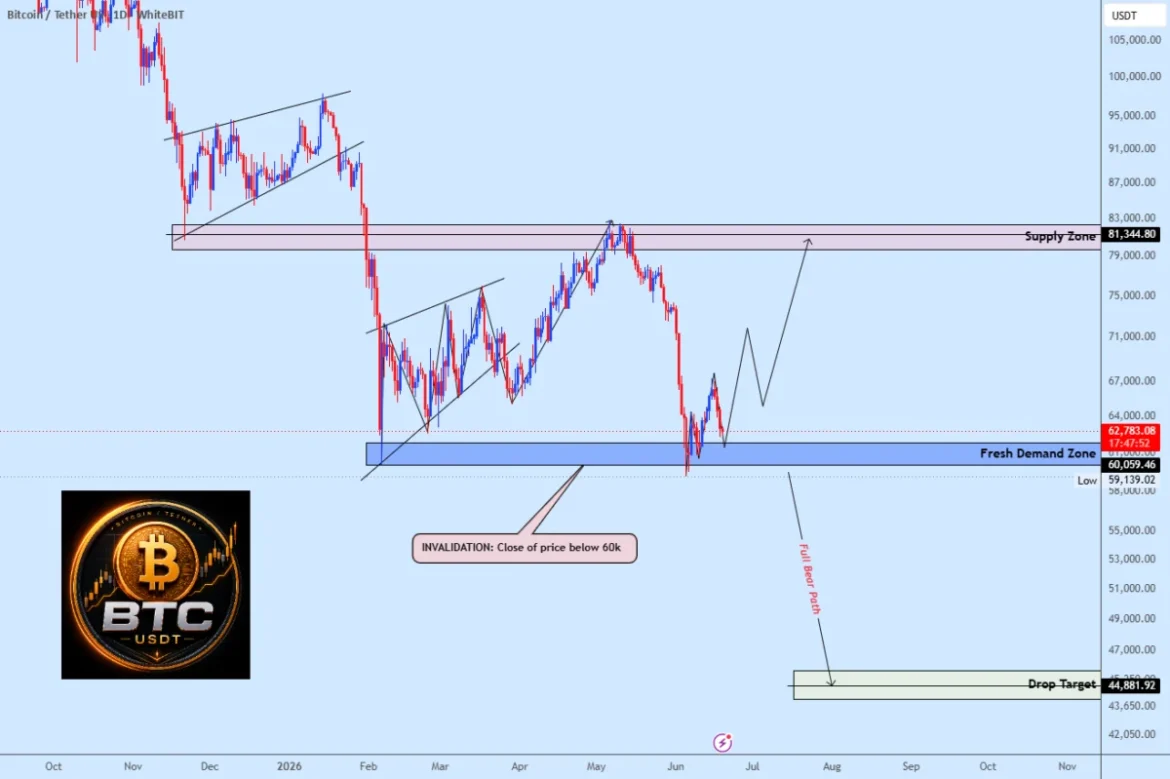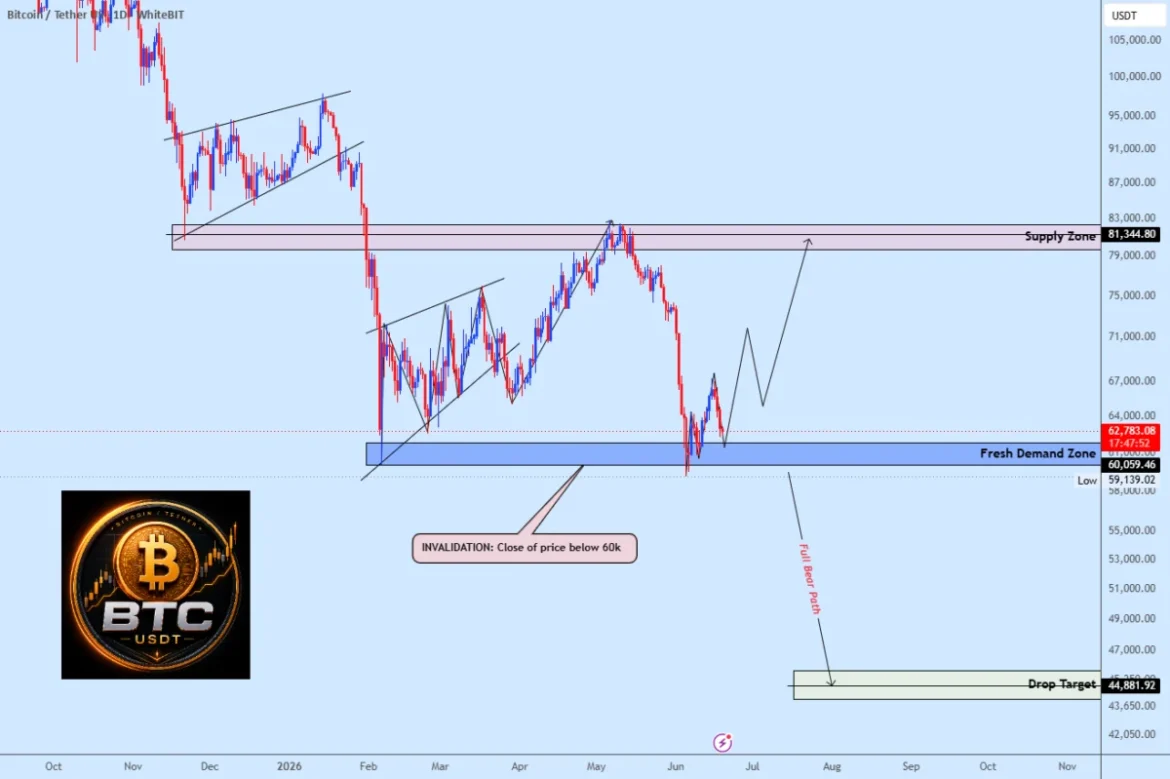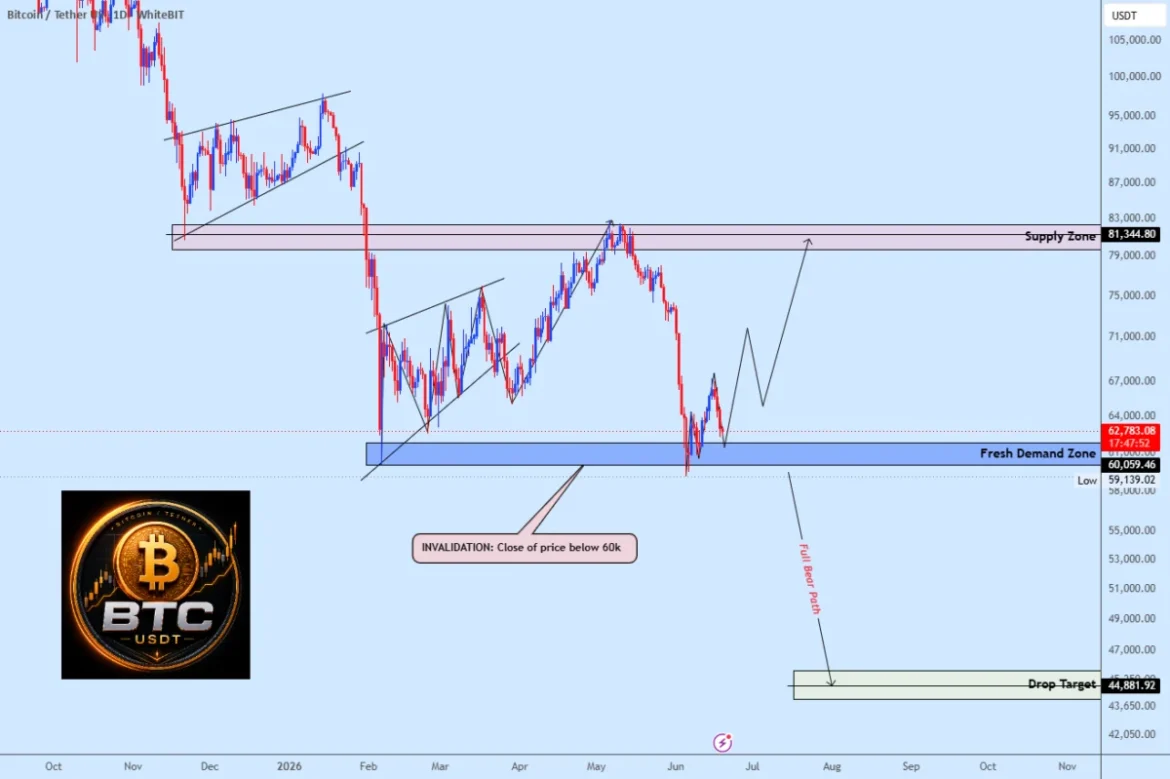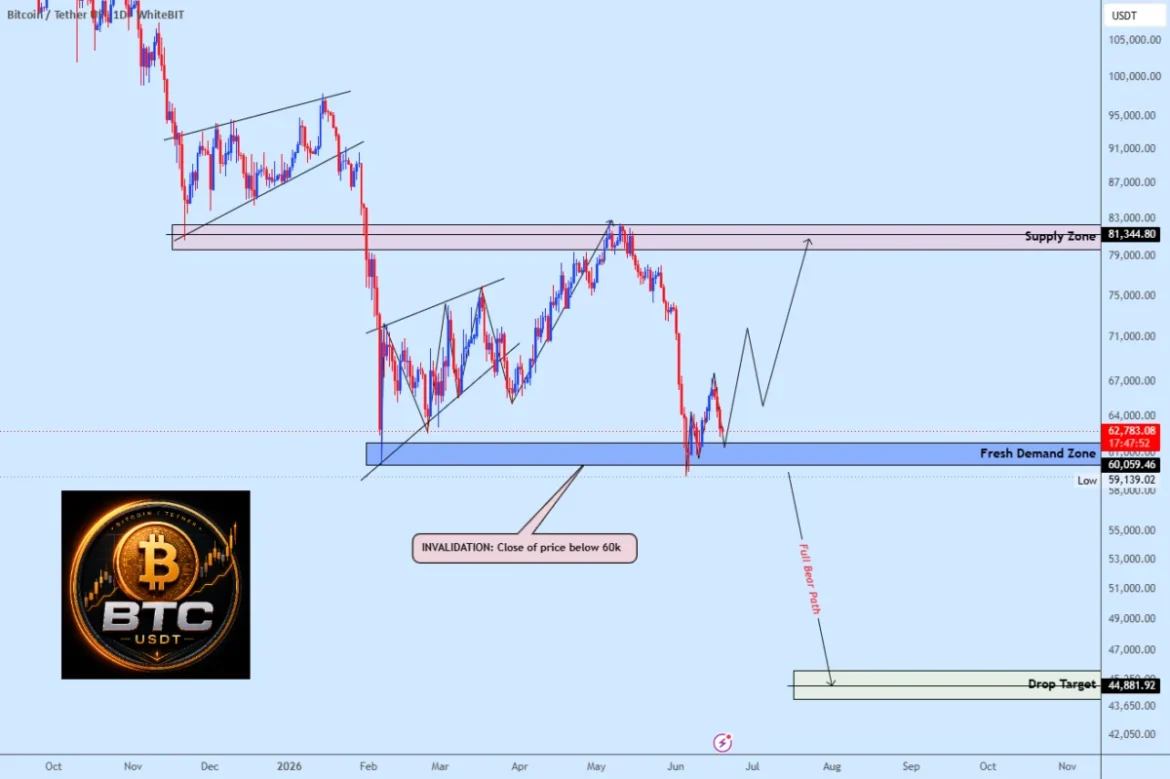
The global cryptocurrency market is currently fixated on a pivotal technical threshold for Bitcoin, as the world’s largest digital asset struggles to maintain its footing near the $60,000 support level. This price point, long considered a psychological bedrock for investors, has become the focal point of a high-stakes standoff between institutional buyers and short-term liquidity providers. According to technical analysis published on June 20 by market analyst weslad on TradingView, the current zone represents a critical demand area that could dictate the trajectory of the market for the remainder of the quarter.
The Technical Significance of the $60,000 Threshold
The $60,000 level is not merely a round number; it functions as a primary liquidity zone where significant buy orders have historically clustered. In technical analysis, demand zones are regions where buying interest is theoretically strong enough to overcome selling pressure, preventing further price depreciation. Analysts argue that this specific zone has acted as a defensive wall for bulls over the past several months, effectively absorbing the impact of macroeconomic headwinds and sector-specific volatility.
However, the current situation is characterized by a "binary" outcome. The prevailing sentiment is that Bitcoin either successfully establishes a floor at this level, allowing for a potential recovery toward the $81,000 supply area, or it fails to hold, potentially triggering a cascading liquidation event. When a price level is widely recognized by retail and institutional traders alike, the concentration of stop-loss orders below that level increases the risk of a "flash crash" if the support is decisively breached. A move below $60,000 would likely force automated trading systems and margin-leveraged traders to liquidate positions, potentially accelerating a downward trend toward lower support levels at $55,000 or $52,000.
Chronology of Recent Market Volatility
Bitcoin’s path to this $60,000 test has been marked by significant volatility over the last several weeks. Following a period of consolidation earlier this year, the asset experienced a series of price fluctuations driven by shifting expectations regarding Federal Reserve interest rate policy and geopolitical tensions.
- Early Q2 2024: Bitcoin maintained a relatively stable range between $65,000 and $72,000, bolstered by the anticipation of the quadrennial block subsidy halving and sustained institutional inflows via spot Bitcoin Exchange-Traded Funds (ETFs).
- Post-Halving Adjustment: Following the halving event in April, the market entered a phase of "sell-the-news" pressure, leading to a gradual retracement from all-time highs.
- Late May/Early June: Increased regulatory scrutiny and persistent inflation data in the United States contributed to a softening of market sentiment, pushing Bitcoin toward the lower end of its established trading range.
- The June 20th Inflection: By the third week of June, Bitcoin began testing the $60,000 mark with increased frequency, signaling a potential exhaustion of buyers or an impending shift in market structure.
Macroeconomic Factors and Institutional Sentiment
The broader market environment remains heavily influenced by macroeconomic data, particularly the U.S. Consumer Price Index (CPI) and the Federal Open Market Committee (FOMC) meeting minutes. High interest rates have historically served as a headwind for "risk-on" assets like Bitcoin. When borrowing costs remain elevated, liquidity in global financial markets tightens, forcing investors to reassess their exposure to volatile assets.

Conversely, the emergence of institutional-grade financial products has introduced a new layer of resilience to the Bitcoin ecosystem. Asset managers such as BlackRock, Fidelity, and ARK Invest have created a consistent demand profile that differs significantly from the speculative retail-driven cycles of previous years. Industry observers note that while these institutions remain committed to the long-term potential of digital assets, they are equally reactive to technical breakdowns. If the $60,000 support fails, it is possible that institutional interest will pivot toward defensive postures, awaiting clearer signals of a trend reversal before re-entering the market.
Analyzing the $81,000 Upside Objective
Should the bulls successfully defend the $60,000 support, the analysis suggests an upside target of $81,000. This target represents the origin point of the most recent downward momentum. From a market efficiency perspective, this is the area where previous sellers established their positions. Returning to this level would require not just a rebound, but a substantive increase in trading volume and a positive shift in market narrative.
Achieving this target would necessitate the clearing of several resistance layers located between $68,000 and $75,000. For the bullish outlook to remain valid, the market must show that the demand at $60,000 is not merely a temporary reaction but a foundational shift in sentiment that can sustain momentum through the summer months.
The Risks of a Breakdown
A failure to maintain the $60,000 level would likely result in a fundamental shift in the technical outlook. Traders often look at the "invalidated" support as a confirmation of a deeper correction. If the market closes decisively below $60,000, it effectively nullifies the current bullish thesis, transforming the previous support into a formidable resistance level.
This scenario would force market participants to reconsider the "exhaustion point" of the current selloff. If sellers remain dominant even after the price has retraced from the highs of earlier this year, it suggests that the market has not yet found a true equilibrium. The resulting volatility could lead to a period of protracted consolidation, potentially lasting weeks or even months, as the market searches for a new, stable base.
Broader Implications for the Crypto Sector
The performance of Bitcoin, as the primary bellwether for the entire cryptocurrency sector, carries significant implications for altcoins and decentralized finance (DeFi) protocols. Typically, when Bitcoin undergoes a period of high-stakes technical testing, capital flows out of smaller, more volatile assets and either into stablecoins or into Bitcoin itself as a "flight to safety."

Consequently, a breakdown of the $60,000 level would likely cause a disproportionate impact on smaller capitalization assets. Investors should remain cognizant of the correlation between Bitcoin’s price action and the broader liquidity environment. Should the support hold, it may provide the confidence required for a broader market recovery; should it fail, the subsequent ripple effects could dampen sentiment across the entire digital asset landscape.
Expert Perspectives and Market Guidance
Industry experts emphasize that technical levels are diagnostic, not predictive. While the $60,000 level provides a clear framework for traders, it is essential to monitor the volume accompanying any price movement. A test of support accompanied by low volume often indicates that the support is fragile, whereas a test accompanied by high buying volume suggests significant conviction from market participants.
Investors are advised to exercise caution during this period of price discovery. The combination of macroeconomic uncertainty and the technical sensitivity of the current $60,000 level warrants a disciplined approach to risk management. Market participants should monitor key indicators, such as the Relative Strength Index (RSI), moving averages, and on-chain metrics, to gain a more holistic view of the market’s internal health.
As the market approaches this defining moment, the consensus among analysts remains clear: the next move for Bitcoin will be dictated by the strength of the defense at $60,000. Whether this level holds or collapses, the result will provide the next chapter in the ongoing narrative of Bitcoin’s maturity as a global financial asset. For now, the crypto market remains in a state of watchful waiting, cognizant that the decisions made in the coming sessions will resonate through the financial markets for the foreseeable future.