The decentralized finance and crypto asset markets experienced another volatile shockwave as AVICI, a prominent digital asset network, suffered a sharp and sudden price correction following widespread user reports regarding frozen funds. The network officially confirmed a critical system malfunction affecting card-balance withdrawals, throwing customer accounts into uncertainty. As news of the technical glitch spread across digital communities and blockchain analytical platforms, automated and manual sell orders flooded the market, wiping out over a third of the token’s market capitalization within a single trading session.
While network operators have scrambled to coordinate with external partners and infrastructure providers to diagnose the root cause of the withdrawal bottlenecks, on-chain intelligence agencies and blockchain sleuths have begun tracking suspicious transaction patterns. Preliminary data from blockchain explorers suggests that the technical failure may not be merely an internal software bug, but rather an active exploit. A specific Solana address linked directly to the suspicious outflow of funds was captured holding more than $600,000 in digital assets before those funds were rapidly dispersed to secondary wallets. The unfolding situation has placed intense scrutiny on AVICI’s security architecture, risk management protocols, and overall transparency during crisis management.
Chronology of the Crisis: How the Events Unfolded
The sequence of events leading to the catastrophic drop in AVICI’s valuation began quietly before escalating into a full-scale public relations and financial emergency.
In the days preceding the public disclosure, early-bird users attempting to access liquidity through their associated payment cards began reporting persistent error messages and delayed transaction processing times. Initially dismissed by some community members as routine network congestion or minor API downtime with third-party payment processors, the issue soon proved to be systemic.
By Friday morning, complaints reached a critical mass on social media platforms, forcing the official AVICI network representatives to acknowledge the crisis publicly. In a brief statement published via their official channels, developers confirmed they were aware of an isolated issue impacting card-balance withdrawals and assured users that engineering teams were collaborating closely with key partners to restore full functionality. However, this initial communication lacked critical details, omitting explicit confirmation of a security breach, the exact volume of trapped capital, or the precise number of retail customers impacted by the disruption.
Shortly after the official acknowledgment, blockchain analytics platforms began flagging abnormal transaction spikes originating from smart contracts associated with the platform. Solscan data revealed that a designated Solana address tied to the incident had accumulated a balance totaling approximately $604,818.97. Security analysts tracking the wallet noted a rapid fragmentation and relocation of these funds, raising immediate alarms regarding an external exploit or an internal drainage vector. By late Friday, the wallet’s balances for major stablecoins had dropped to zero, and remaining native network tokens had been forwarded to unverified secondary destinations, cementing fears that user funds had been compromised.
On-Chain Analysis and Financial Breakdown of the Suspected Exploit
The exact nature and scale of the financial damage remain subjects of intense forensic investigation by blockchain security firms. While AVICI’s corporate communications have refrained from officially labeling the incident a hack, immutable on-chain data paints a concerning picture of asset migration.
According to granular tracking reports provided by Solscan, the suspicious Solana wallet address—identified on-chain as 7XigoEaHxpoHp819fnajGqsz329Lve9c2SXSq8KaFRVf—held a peak recorded balance of $604,818.97 at the time of capture. A breakdown of the assets housed within this specific address highlighted a heavy concentration of stablecoins designed to minimize volatility for everyday card users. The wallet contained approximately $570,410 in USDC (USD Coin), $34,188 in USDT (Tether), and a modest $221 equivalent in native SOL (Solana) tokens.
Furthermore, blockchain relationship graphs linked the activity of this single address to approximately 2,500 distinct user accounts within the AVICI ecosystem. This correlation strongly suggests that a systemic vulnerability allowed an unauthorized actor to bypass standard withdrawal controls, systematically draining balances across a vast swath of the user base.
Following the initial accumulation phase, the perpetrators executed a series of swift obfuscation transfers. The entirety of the USDC and USDT holdings was completely cleared from the address, leaving a zero balance for those stablecoins. Meanwhile, the remaining 886.94 SOL tokens were swept out of the primary address and routed to an unknown secondary destination, making immediate asset recovery increasingly difficult for centralized authorities or decentralized governance committees.
Financial analysts caution that while the wallet balance closely mirrors early estimates of a $600,000 financial drain, further auditing is required to definitively prove that every single dollar contained within that specific smart contract path belonged exclusively to verified AVICI cardholders. Nevertheless, the correlation between the frozen user accounts and the sudden outflow of funds remains the primary catalyst behind the market panic.
Market Reaction and AVICI Price Action
The intersection of frozen customer withdrawals and suspected malicious exploitation triggered an immediate, aggressive sell-off across digital asset exchanges where AVICI is actively traded.

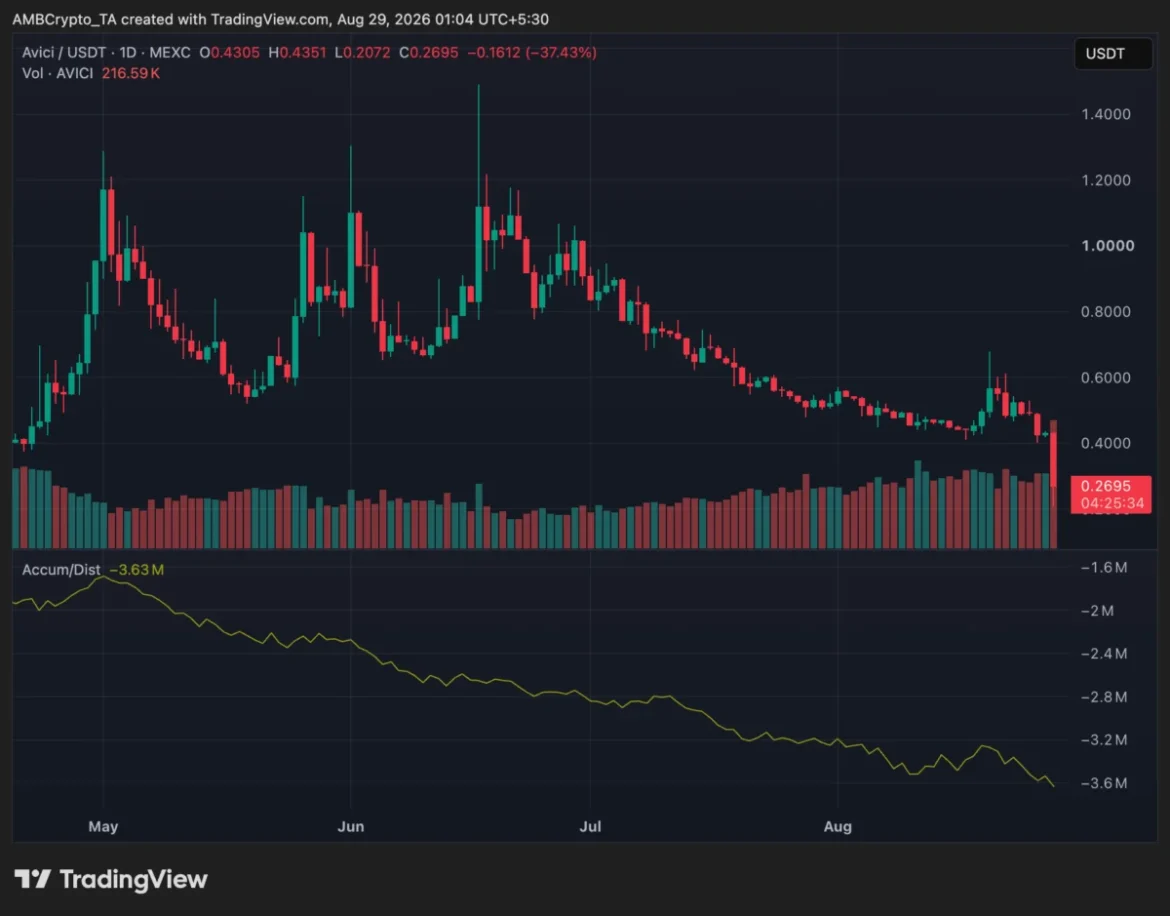
At the opening of the Friday trading session, AVICI tokens were changing hands at a relatively stable baseline of $0.30 to $0.4305. As news of the card-withdrawal failures broke and preliminary figures regarding the $600,000 exploit began circulating through Telegram and X (formerly Twitter), panic selling accelerated exponentially. Within hours, the token suffered a catastrophic plunge, bottoming out at an intraday low of $0.2072. At the depths of this market reaction, AVICI had shed more than 50% of its total valuation, erasing months of steady capital accumulation in a matter of minutes.
Following the initial crash, a wave of bargain-hunting and speculative dip-buying allowed the token to stage a modest technical recovery. Prices rebounded toward the $0.2695 region. Despite this partial retracement, the asset remained severely depressed, trading down approximately 37.43% compared to its daily opening price.
Technical chart analysis reveals that the withdrawal incident and subsequent exploit acted as an accelerant rather than the sole driver of the asset’s poor performance. A broader review of AVICI’s daily price action indicates that the token had already been locked in a persistent downtrend over the preceding several months, characterized by lower highs and declining trading volume.
Market makers and quantitative traders pointed out that AVICI operates within a relatively small market capitalization tier. Consequently, even minor shifts in retail sentiment or modest increases in selling volume are capable of inducing disproportionately large price swings and extreme volatility. As trading sessions continued to unfold, market participants closely monitored whether the token could successfully defend the psychological support floor established near Friday’s low of $0.20. Conversely, analysts noted that reclaiming the $0.40 threshold would be an essential prerequisite for bulls attempting to repair the technical damage and recover from the sudden market shock.
Official Responses and Crisis Management Strategies
As of the time of reporting, the executive team and foundational developers behind AVICI have faced mounting pressure from retail investors, institutional stakeholders, and crypto community watchdogs to provide a comprehensive post-mortem report.
The initial corporate response—distributed via social media channels—confirmed ongoing communication with external integration partners, payment gateway providers, and technical consultants. However, the decision to withhold precise figures regarding the financial impact, coupled with the avoidance of the term "hack," drew criticism from transparency advocates. In fast-moving decentralized financial environments, ambiguous messaging frequently exacerbates panic, leaving room for unchecked speculation and rumors to dominate community discourse.
Legal and compliance experts tracking the event suggest that AVICI’s management will soon be forced to release a formal, detailed incident report to mitigate potential regulatory fallout. Because the platform integrates traditional card-balance functionalities with decentralized blockchain rails, it sits at a complex intersection of consumer protection laws and decentralized finance protocols. If the platform’s payment card features are backed by traditional financial institutions or licensed fintech intermediaries, the incident could attract scrutiny from financial conduct authorities regarding user fund segregation, reserve auditing, and cybersecurity standards.
Furthermore, community leaders within the AVICI ecosystem have begun discussing prospective recovery frameworks, including potential treasury buybacks, airdrops for affected users, or the establishment of a specialized insurance fund to reimburse victims of the exploit. However, no concrete proposals had been formally ratified by token holders or core developers prior to the weekend market close.
Broader Implications for Crypto-Linked Payment Cards
The unfolding AVICI crisis serves as a stark reminder of the persistent security vulnerabilities plaguing the burgeoning sector of cryptocurrency-funded debit and payment cards.
In recent years, the convergence of traditional fiat payment rails with decentralized blockchain assets has accelerated, driven by consumer demand for real-world spending power using digital holdings. Projects like AVICI bridge the gap by allowing users to maintain balances in stablecoins such as USDC and USDT, converting them dynamically at the point of sale. However, this architectural complexity introduces multiple attack surfaces. While the underlying layer-1 networks—such as Solana—frequently maintain robust cryptographic security, third-party custody applications, middleware APIs, and smart contract bridges utilized by card issuers often present critical vulnerabilities.
When a breach or technical failure occurs within a card-balance infrastructure, the psychological impact on retail consumers is often far more severe than a standard decentralized exchange exploit. Users who treat their crypto-backed cards like traditional bank accounts expect institutional-grade safety nets and FDIC-style insurance guarantees. When these expectations are shattered by sudden withdrawal freezes and six-figure fund outflows, consumer trust evaporates rapidly, leaving lasting scars on project adoption rates.
The AVICI incident underscores a critical industry-wide challenge: as long as crypto-fiat hybrid products continue to scale without mandatory, rigorous third-party smart contract audits and transparent reserve management systems, protocols will remain highly susceptible to catastrophic market corrections. For AVICI, the immediate path forward depends entirely on the transparency of its communications, the successful tracing and potential freezing of stolen assets by centralized stablecoin issuers, and the restoration of user withdrawal functionalities. Until these milestones are decisively achieved, the token is likely to remain locked in a high-risk environment characterized by heightened volatility and cautious investor sentiment.