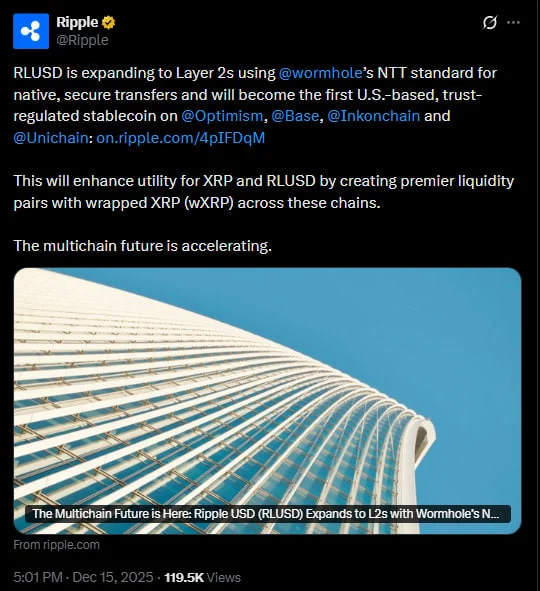
The cryptocurrency landscape is undergoing a structural transformation, shifting away from isolated, single-chain ecosystems toward an interconnected multichain environment. As users, institutional investors, and application developers increasingly demand frictionless cross-chain mobility driven by practical utility and economic opportunity, digital assets must adapt. Central to this evolving paradigm are stablecoins—digital currencies pegged to fiat reserves that consistently serve as the primary gateway for participants entering the on-chain economy. Recognizing this foundational shift, blockchain infrastructure pioneer Ripple has announced a significant expansion strategy for its proprietary stablecoin, Ripple USD (RLUSD), bringing the asset into the dynamic ecosystem of Ethereum Layer 2 (L2) scaling solutions.
According to a formal announcement made by Ripple, the company has initiated live testing of RLUSD across multiple prominent Ethereum Layer 2 platforms. This experimental phase is a critical operational milestone designed to stress-test the stablecoin’s technical architecture, interoperability, and cross-chain functionality ahead of its anticipated public debut. The official rollout is slated for 2026, pending final regulatory approvals from relevant governing bodies. By deploying the asset on high-performance scaling networks during this preparatory phase, Ripple aims to ensure robust security, deep liquidity, and seamless user experiences when the stablecoin opens to the broader public market.
The initial testing deployment leverages cutting-edge infrastructure provided by Wormhole, specifically utilizing its Native Token Transfers (NTT) standard. Through this framework, the testing rollout encompasses major Layer 2 networks such as Base, Unichain, and Ink, with Optimism serving as an initial foundational gateway. This strategic technical integration allows RLUSD to traverse different blockchain networks fluidly without fracturing its liquidity or diluting its issuance model, positioning the stablecoin to capture active user engagement where decentralized application (dApp) activity is most concentrated.
The Strategic Importance of Ethereum Layer 2 Networks
Layer 2 scaling networks have rapidly evolved into some of the most congested and active corridors within the broader digital asset economy. While the primary Ethereum Layer 1 blockchain remains the foundational security and settlement layer for decentralized finance (DeFi), it frequently encounters structural challenges, including network congestion and prohibitively high transaction fees during periods of peak market demand. These friction points make Layer 1 less optimal for high-frequency trading, microtransactions, and day-to-day decentralized application interactions.
To resolve these scalability bottlenecks, L2 solutions execute transactions off the main chain or via specialized rollup architectures before batching and settling them back onto Ethereum. This mechanism drastically reduces gas fees and accelerates transaction execution times, rendering L2 networks ideal environments for retail users, institutional liquidity providers, and developers building advanced financial applications. By introducing RLUSD directly into these high-traffic ecosystems, Ripple is positioning its stablecoin at the epicenter of active digital asset engagement.
Rather than forcing users to migrate to a proprietary or isolated blockchain, Ripple’s multichain deployment strategy acknowledges that liquidity must meet users where they already operate. By integrating with Base, Unichain, and Ink via Optimism-based infrastructure, RLUSD gains immediate exposure to diverse developer communities, decentralized exchanges (DEXs), lending markets, and yield-generating protocols. This granular accessibility is expected to accelerate adoption rates upon the asset’s full public release in 2026.
Technical Architecture: Harnessing Wormhole and the NTT Standard
A persistent technical challenge in the multichain era is the fragmentation of liquidity caused by bridged tokens. Traditional cross-chain bridges often lock an asset on one network and mint a synthetic or wrapped version on another, creating disparate pools of liquidity and exposing users to heightened security vulnerabilities, such as bridge exploits. To circumvent these systemic risks, Ripple has partnered with Wormhole to utilize its Native Token Transfers (NTT) standard.

The NTT framework enables RLUSD to move across disparate blockchain networks while retaining its status as a unified, natively issued asset. Under this configuration, Ripple maintains absolute control over the primary issuance, redemption, and compliance parameters of RLUSD. Simultaneously, end-users benefit from complete operational flexibility, allowing them to transfer liquidity seamlessly between Ethereum Layer 2 networks without the security compromises associated with conventional token wrapping.
Commenting on the architectural design and the broader implications of the L2 expansion, Jack McDonald, Senior Vice President of Stablecoins at Ripple, emphasized the asset’s alignment with institutional standards. McDonald stated that RLUSD was engineered from its inception to act as a trusted, highly liquid medium of exchange, empowering users to enter, interact with, and exit the digital asset economy effortlessly. He further highlighted that by introducing the first U.S. trust-regulated stablecoin to these L2 networks, Ripple is expanding its functional utility and establishing a definitive benchmark where regulatory compliance and high-performance on-chain efficiency successfully converge.
Chronology of RLUSD Development and Regulatory Trajectory
The expansion of RLUSD to Ethereum Layer 2 networks represents the latest phase in a carefully measured, compliance-first development timeline pursued by Ripple. The stablecoin initiative was designed to navigate the complex global regulatory landscape meticulously, setting it apart from algorithmic or undercollateralized stablecoins that faced severe market scrutiny and regulatory backlash in prior market cycles.
- Initial Conceptualization and Design: Ripple began laying the groundwork for a U.S. dollar-pegged stablecoin to complement its native XRP token, focusing heavily on regulatory compliance, transparent reserve backing, and institutional-grade security.
- Internal and Private Testing: Prior to public announcements, Ripple conducted rigorous internal trials on private ledger environments to ensure stability, cryptographic security, and efficient minting-and-burning mechanisms.
- Regulatory Framework Alignment: Operating under a U.S. trust framework, Ripple structured RLUSD to be backed 100% by cash equivalents, short-term U.S. government Treasury bills, and other secure reserve assets, subjected to regular third-party attestations.
- Public Testing Phase (December 2025): Ripple formally confirmed the expansion of RLUSD testing onto public Ethereum Layer 2 networks—specifically Base, Unichain, and Ink—utilizing Wormhole’s NTT standard.
- Anticipated Public Debut (2026): Following the conclusion of rigorous L2 testing and the receipt of final regulatory clearances, Ripple plans to roll out RLUSD for general public and institutional use globally.
This methodical progression underscores Ripple’s commitment to building institutional trust. By embedding regulatory safeguards directly into the asset’s operational framework, the company aims to attract traditional financial institutions, asset managers, and corporate treasuries that require stringent compliance assurances before engaging with decentralized financial markets.
Broad Market Implications and Ecosystem Synergy
The introduction of a regulated, high-utility stablecoin into the Ethereum Layer 2 ecosystem carries significant implications for the broader cryptocurrency market, as well as the internal dynamics of the XRP ecosystem. Historically, stablecoin dominance has been concentrated heavily among a few legacy issuers. The entry of a trusted, U.S. trust-regulated alternative backed by a major financial technology infrastructure provider introduces healthy competition and provides market participants with diversified risk management options.
Furthermore, the expansion serves as a strategic value-add for the broader XRP ecosystem. Although RLUSD operates as a distinct asset with separate reserve structures, its integration across thriving Layer 2 networks increases overall transaction velocity, enhances liquidity pools, and deepens Ripple’s footprint within decentralized finance. Stablecoins act as the lifeblood of crypto-economic activity, driving arbitrage, serving as collateral in lending protocols, and facilitating swift settlements. By establishing RLUSD as a premier medium of exchange across high-volume scaling networks, Ripple indirectly reinforces the utility and visibility of its broader product suite.
This strategic milestone unfolds against a challenging macroeconomic and market backdrop. At the time of the announcement, native XRP was hovering around $1.93, experiencing a modest 2.3% downward correction over the preceding 24-hour trading window. This price action mirrored broader market sentiment across the digital asset sector, where major cryptocurrencies experienced downward pressure. Notably, benchmark digital asset Bitcoin struggled to maintain momentum above the $90,000 threshold, consolidating around $87,700 amid cautious investor positioning and broader macroeconomic uncertainties.
Despite short-term market volatility and price fluctuations, infrastructure developments such as Ripple’s L2 stablecoin rollout demonstrate a resilient focus on long-term technological adoption. As blockchain networks continue to mature, the convergence of regulatory compliance, cross-chain interoperability, and high-performance scaling solutions will likely dictate the next phase of institutional and retail integration within the global digital economy. Ripple’s methodical deployment of RLUSD positions the company at the forefront of this structural evolution, laying the groundwork for a more interconnected and compliant financial future.