
The cryptocurrency market continues to be a dynamic arena of shifting rankings and ambitious price predictions, with Binance Coin (BNB) recently asserting its dominance by surpassing XRP in market capitalization rankings in May. This latest achievement, however, only serves as a prelude to a much larger discussion surrounding BNB’s long-term trajectory: can it reclaim its previous all-time highs, push beyond $2,000, and potentially even aspire to unprecedented valuations of $10,000 or $20,000 per token? A recent analysis by prominent crypto strategist Crypto Patel offers a granular breakdown of these prospects, suggesting that while a return to former peaks and a push towards $3,000 appears plausible, significantly higher targets necessitate a vastly different and expanded global crypto market than the one currently in existence.
BNB’s Ascent in Market Rankings: The XRP Benchmark and Beyond
BNB, the native cryptocurrency of the Binance exchange and the BNB Chain ecosystem, has been a consistent fixture in the upper echelons of the crypto market. Its recent move to displace XRP from its long-held position as the fourth-largest cryptocurrency by market capitalization was a notable development in mid-May. This shift underscored BNB’s growing ecosystem utility, investor confidence, and resilience amidst broader market fluctuations. The distance between BNB and XRP in market cap has reportedly widened since then, signaling a sustained momentum for Binance’s token.
Historically, market capitalization rankings are a crucial metric in the cryptocurrency space, reflecting not just a project’s current valuation but also its perceived stability, liquidity, and overall adoption. For years, XRP, despite its ongoing legal battles with the U.S. Securities and Exchange Commission (SEC), maintained a robust position, often oscillating between the fourth and sixth spots. BNB’s consistent growth, fueled by its robust burning mechanism, widespread utility within the Binance ecosystem, and the expansion of the BNB Chain, has allowed it to steadily climb these ranks. This "flipping" of XRP is more than just a numerical change; it represents a significant psychological victory and an affirmation of BNB’s strengthening fundamental value proposition in the eyes of many investors and analysts.
Eyeing Ethereum: A Formidable Challenge
With XRP now behind it, the next major target in BNB’s sights, from a market capitalization perspective, is Ethereum (ETH). Ethereum, the second-largest cryptocurrency, commands a substantially larger market valuation. As of recent data, Ethereum’s market cap hovers around $203 billion, dwarfing BNB’s approximately $80.6 billion. Bridging this gap presents a far more formidable challenge than surpassing XRP.
To illustrate the scale of this challenge, an analyst’s static comparison suggests that at its current circulating supply, BNB would need to trade around $1,500 per token to merely match Ethereum’s present $203 billion valuation. This price point is notably close to BNB’s projected all-time high of approximately $1,370 in October 2025, as posited by some analyses. While BNB did reach an actual historical all-time high of approximately $690 in May 2021, the prospect of reaching $1,500 would represent a significant new milestone. Such a "flip" could theoretically occur if BNB were to achieve these record levels while Ethereum’s price remained relatively stagnant. However, in a more realistic market scenario characterized by broad recovery or bullish sentiment, Ethereum would almost certainly experience its own price appreciation, moving the goalposts further for BNB. The historical dominance, vast developer ecosystem, and widespread adoption of Ethereum in DeFi, NFTs, and enterprise solutions provide it with a deep moat that BNB would need to overcome through sustained, exponential growth and innovation.
Deconstructing Ambitious Price Targets: The Math Behind BNB’s Push Above $10,000
Crypto Patel, a widely followed crypto analyst on X, recently published a comprehensive breakdown of BNB’s potential price ceiling, urging investors to consider the underlying mathematics of highly ambitious targets. BNB currently ranks fourth globally, trailing only Bitcoin, Ethereum, and Tether (USDT). The analyst highlights that a hypothetical all-time high of around $1,370 in October 2025 would imply a market capitalization approaching $185 billion at its peak, based on current or projected supply figures.

However, the leap to $10,000 or $20,000 per token enters an entirely different realm of ambition, requiring a fundamental shift in the scale and valuation of the broader cryptocurrency market. To understand the implications, it’s crucial to consider BNB’s supply dynamics. The token operates on a long-term burn trajectory, aiming for a target supply of 100 million BNB tokens. This deflationary mechanism, where a portion of transaction fees and other revenue is regularly used to buy back and destroy BNB, is designed to increase scarcity and potentially drive up value.
The Arithmetic of a Trillion-Dollar Altcoin
If BNB were to reach a price of $10,000 per token with a supply target of 100 million, its market capitalization would skyrocket to an astonishing $1 trillion. To put this into perspective, this valuation would be roughly equivalent to the entire market capitalization of Bitcoin, the undisputed king of cryptocurrencies, as it stands today. Bitcoin, with its pioneering status, global recognition, and robust network effect, has taken over a decade and a half to achieve and sustain a trillion-dollar valuation. For a single altcoin like BNB to reach this milestone, it would necessitate an unprecedented influx of capital into the crypto market, coupled with a dramatic redistribution of value away from other major assets. Such a scenario would imply that BNB has achieved a level of adoption and utility that rivals, or even surpasses, that of Bitcoin in certain respects.
The $20,000 Threshold: A Market Redefinition
The analyst further extrapolates, pointing out that a $20,000 BNB would represent a colossal $2 trillion valuation for a single asset. This figure, as Crypto Patel succinctly notes, would currently exceed the combined worth of the entire cryptocurrency market. The total crypto market capitalization has seen peaks, notably reaching over $3 trillion during the 2021 bull run, but sustaining a $2 trillion valuation for a single altcoin within that ecosystem would signify a monumental shift in market structure and investor preference. Such a scenario would imply that BNB has become not just a dominant cryptocurrency, but a globally significant financial asset on par with some of the world’s largest companies or even national economies.
Crypto Patel’s assessment is unequivocal: "Anyone throwing out $20,000 as a near-term target is selling you something, not analyzing." This statement underscores the analytical rigor required when discussing such lofty price predictions, emphasizing that while long-term potential can be vast, short-to-medium term expectations must remain grounded in current market realities and fundamental economic principles.
Fundamentals and Growth Drivers of BNB
BNB’s value proposition extends far beyond its role as a trading pair on Binance. It is deeply integrated into the expansive Binance ecosystem and the BNB Chain, formerly Binance Smart Chain (BSC). Several key drivers underpin its growth potential:
The BNB Burn Mechanism: A Deflationary Force
One of the most significant factors influencing BNB’s long-term value is its burn mechanism. Binance regularly conducts coin burns, permanently removing BNB from circulation. This process, tied to Binance’s trading volume and profits, aims to reduce the total supply of BNB to 100 million tokens. The principle behind this is simple supply and demand economics: as supply decreases while demand either remains constant or increases, the price per token theoretically should rise. These burns are transparently executed and contribute to a deflationary outlook for BNB, making it attractive to investors seeking assets with scarcity.
Ecosystem Expansion: BNB Chain and Utility
The BNB Chain is a vibrant and rapidly expanding ecosystem supporting a multitude of decentralized applications (dApps), including decentralized finance (DeFi) protocols, non-fungible token (NFT) marketplaces, and gaming platforms. BNB serves as the native gas token for transactions on the BNB Chain, meaning every interaction within this ecosystem requires BNB. This intrinsic utility creates constant demand for the token. Furthermore, BNB is used for staking, allowing holders to earn rewards by participating in the network’s security. It also offers discounted trading fees on the Binance exchange, incentivizing traders to hold the token. The continuous development and adoption of dApps on BNB Chain directly contribute to the utility and demand for BNB. For instance, the growing momentum of BNB Chain in Real World Assets (RWA) value, recently hitting $3 billion, further cements its utility and broadens its appeal.

Navigating the Binance Concentration Risk
Despite its impressive growth and robust ecosystem, BNB faces a significant structural obstacle that analysts like Crypto Patel have consistently identified: the Binance concentration risk. Nearly every value driver for BNB—its burn mechanism, exchange fee utility, on-chain activity, and institutional custody—is either directly managed by or closely adjacent to the Binance cryptocurrency exchange.
Centralization Concerns and Regulatory Headwinds
This high degree of correlation means that any serious negative development or regulatory scrutiny faced by Binance could have a substantial and immediate adverse impact on BNB’s price action. Binance, as the world’s largest cryptocurrency exchange, has frequently been a target of regulatory bodies across various jurisdictions. The past few years have seen numerous headlines detailing regulatory actions, investigations, and fines against Binance concerning issues like money laundering controls, unregistered operations, and compliance with financial regulations. For example, congressional pressure regarding Binance’s historical operations in certain sanctioned countries highlights the ongoing regulatory challenges. While Binance has made significant strides in bolstering its compliance frameworks and restructuring its global operations, the inherent link between the exchange’s fortunes and BNB’s value remains a critical risk factor for investors.
Binance’s Strategic Resilience
In response to these challenges, Binance has consistently worked to enhance its regulatory compliance, expand its global footprint through licensed entities, and foster a more decentralized ecosystem around BNB Chain. These strategic moves, while not directly commenting on BNB’s price, are implicitly aimed at de-risking the broader ecosystem and ensuring the long-term viability and growth of BNB. By diversifying its operations, seeking regulatory clarity, and empowering the community-driven development of BNB Chain, Binance attempts to mitigate some of the centralization risks. However, the intertwined nature of the exchange and its native token means that any major regulatory setback could still send ripples through BNB’s valuation.
Historical Context and Future Projections
To understand BNB’s potential, it’s essential to look at its journey and the analyst’s projected timelines.
A Look Back: BNB’s Journey to Prominence
Launched in 2017 as an ERC-20 token on the Ethereum blockchain, BNB initially served as a utility token for discounted trading fees on the Binance exchange. Its migration to the native BNB Chain (then Binance Chain) in 2019, followed by the launch of Binance Smart Chain (BSC, now integrated into BNB Chain) in 2020, significantly expanded its utility. The launch of BSC, with its EVM compatibility and lower transaction fees compared to Ethereum, proved to be a game-changer, attracting a massive influx of users and developers, especially during periods of high gas fees on Ethereum. BNB’s actual historical all-time high occurred in May 2021, reaching approximately $690 during the broader crypto bull run. This historical performance demonstrates BNB’s capacity for substantial growth under favorable market conditions.
Analyst Consensus: Realistic vs. Aspirational Targets
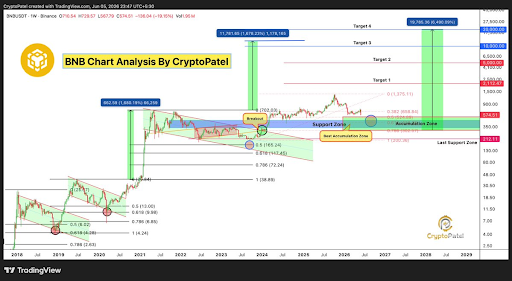
Crypto Patel’s analysis offers a nuanced view. While he acknowledges the ambitious $10,000 to $20,000 targets as requiring an entirely different market structure, his "believable bull case" for BNB is a reclamation of its old high and a subsequent push towards $3,000. This more conservative yet still significant target aligns with the potential for a new crypto bull cycle, continued ecosystem growth, and the ongoing effect of the token burn.
The analyst’s chart, while projecting a trajectory that eventually reaches the $20,000 range, explicitly places this highly aspirational scenario in 2029 at the earliest. This long-term outlook underscores that such dramatic price appreciation is not expected in the near term and would require years of sustained growth, innovation, and a fundamental expansion of the global cryptocurrency market. It also implies that achieving such valuations would likely coincide with Bitcoin and Ethereum reaching significantly higher market caps themselves, pulling the entire market upwards.
Broader Market Implications
Should BNB indeed achieve the more modest targets of $2,000 or $3,000, and especially if it were to venture into the multi-trillion-dollar market cap territory, the implications for the broader cryptocurrency market would be profound.
Reshaping the Altcoin Landscape
A BNB at $3,000 would solidify its position as a top-tier altcoin, potentially challenging Ethereum’s dominance more aggressively, or at least narrowing the gap significantly. Such a surge would demonstrate the immense power of exchange-backed ecosystems and deflationary tokenomics. If BNB were to reach a trillion-dollar valuation, it would fundamentally reshape the altcoin landscape, establishing a new benchmark for what is possible for a single digital asset. This would likely spark increased competition among other Layer 1 blockchains and centralized exchange tokens, driving further innovation in features, scalability, and utility.
The Macro Environment for Crypto Growth
Ultimately, the most ambitious price targets for BNB—$10,000 or $20,000—are inextricably linked to the overall growth and maturation of the cryptocurrency market as a whole. For BNB to command a multi-trillion-dollar market cap, the total crypto market would need to expand exponentially beyond its current valuations, possibly reaching tens of trillions of dollars. This would require widespread institutional adoption, clearer global regulatory frameworks, significant technological advancements, and a broader integration of digital assets into the global financial system. In such a future, where cryptocurrencies play a much larger role in global finance and commerce, the conditions for a $10,000 or even $20,000 BNB might become conceivable, albeit over a very long timeline.
In conclusion, BNB’s journey back into the top ranks of the crypto market underscores its fundamental strength and the robustness of its ecosystem. While a return to its historical highs and a push towards the $2,000-$3,000 range appears to be a credible bull case, the path to $10,000 or $20,000 per token is fraught with challenges and depends on a far grander expansion of the entire cryptocurrency market. Investors and analysts alike must temper aspirations with a realistic assessment of market dynamics, supply-demand economics, and the inherent risks associated with its concentration around the Binance exchange. The future of BNB, like much of the crypto market, remains a blend of significant potential and considerable uncertainty.