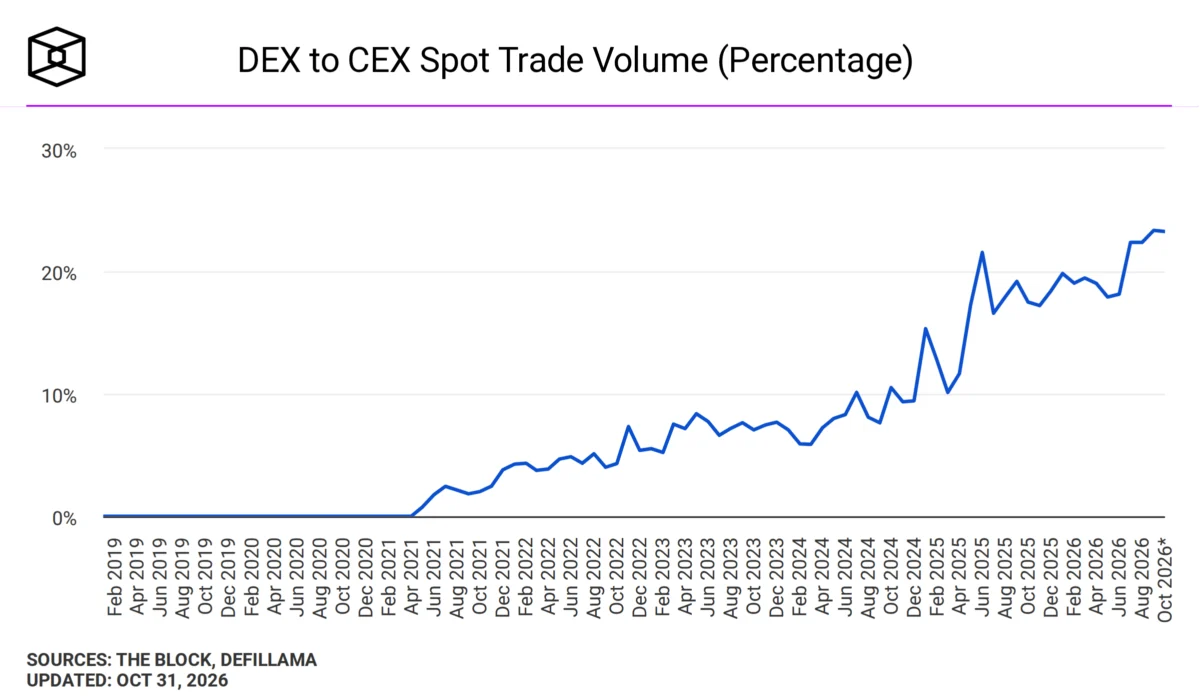
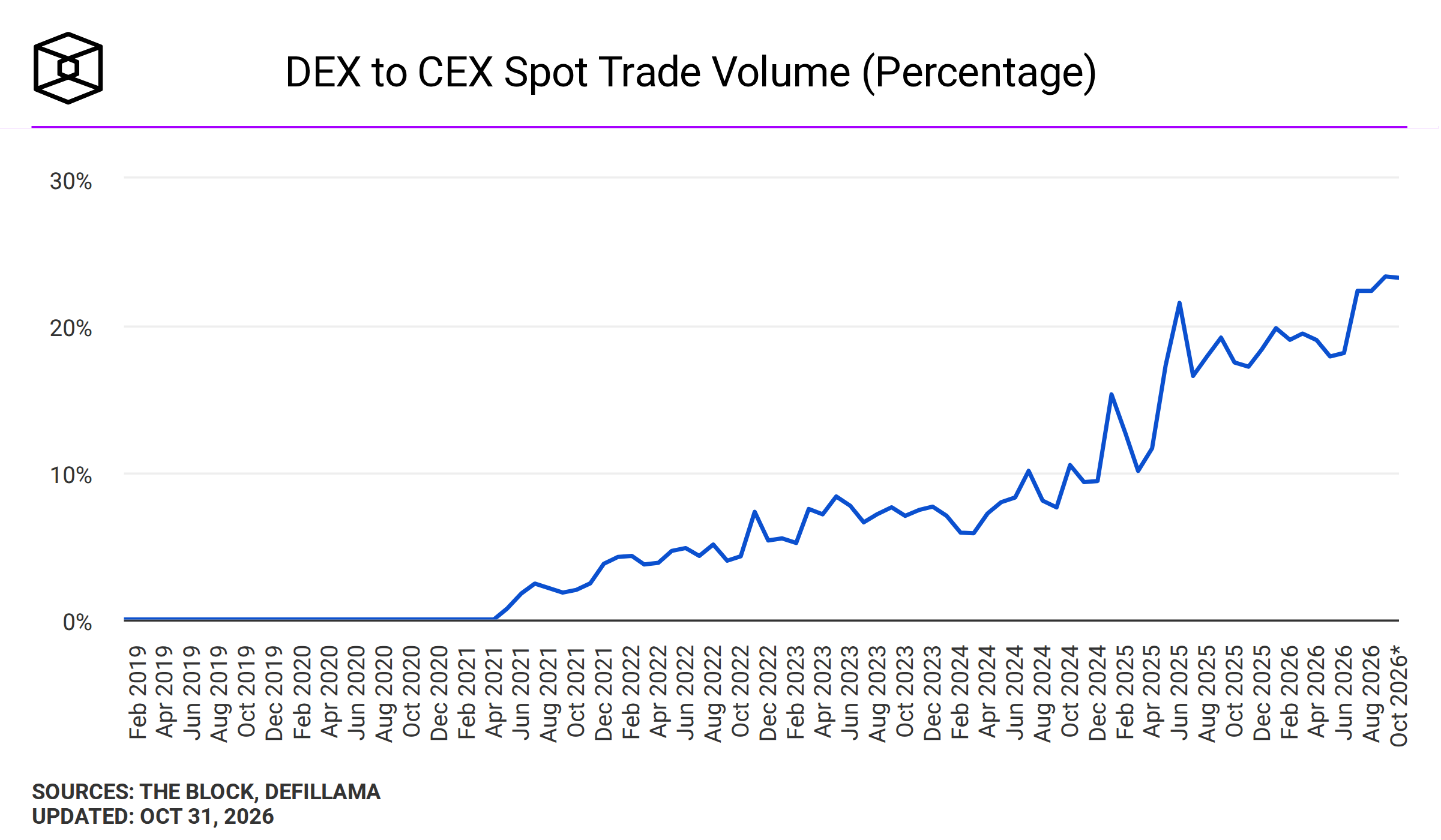
The landscape of digital asset trading is undergoing a structural transformation, with decentralized exchanges (DEXs) capturing a record-breaking 23% of the spot trading volume handled by major centralized counterparts, including industry giants like Binance and Coinbase. This milestone represents an extraordinary 1,100% expansion in DEX market share over the past five years, underscoring a profound shift in trader preference toward non-custodial, peer-to-peer financial architecture. While centralized exchanges (CEXs) have historically dominated the cryptocurrency ecosystem due to their superior liquidity, user-friendly fiat onboarding, and high-speed order matching, recent security vulnerabilities and changing macro conditions are rapidly eroding that monopoly. Industry analysts increasingly view this milestone as a definitive turning point for decentralized finance (DeFi), highlighting a growing structural preference for self-sovereignty and trustless execution among market participants.
The Evolution of DEX Market Share: A Five-Year Trajectory
The journey of decentralized exchanges from niche, experimental protocols to mainstream trading venues has been characterized by dramatic cyclical shifts. Five years ago, DEXs accounted for a negligible fraction of global crypto trading volume, hampered by high gas fees on Ethereum, slow settlement times, and fragmented liquidity pools. However, successive waves of innovation—including the rise of automated market makers (AMMs), Layer-2 scaling solutions like Arbitrum and Optimism, and alternative high-throughput Layer-1 networks like Solana—transformed the user experience.
Market data from DeFiLlama and The Block reveals that the adoption curve experienced an aggressive acceleration between 2024 and 2025, during which the DEX market share effectively doubled. This rapid expansion was fueled by a burgeoning DeFi ecosystem offering sophisticated derivatives, yield-generating instruments, and permissionless token listings that traditional centralized platforms could not match.

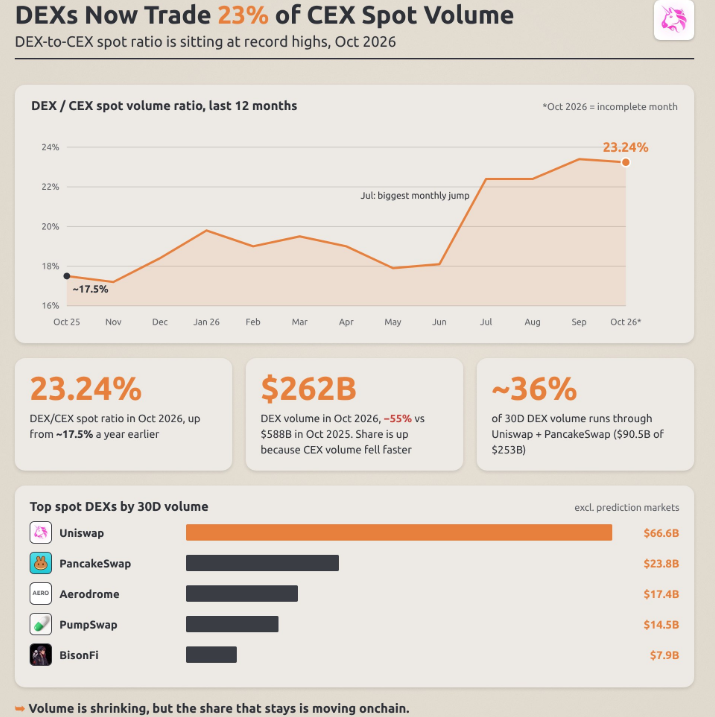
However, the momentum plateaued temporarily during the broader market consolidation and bear-leaning conditions observed in early 2026. On an absolute volume basis, decentralized spot and perpetual markets contracted significantly. Year-on-year figures analyzed by on-chain researchers demonstrate that DEX volumes fell by approximately 55%, dropping from $588 billion in 2025 to $262 billion in 2026. Paradoxically, during this same period, the relative market share of DEXs climbed from 17.5% to 23.2%.
This counter-intuitive dynamic exposes a fundamental behavioral trait among crypto traders: while retail and institutional capital routinely flees the market entirely during cooling periods, the liquidity that remains on-chain is remarkably sticky. Centralized exchanges experience severe volume drop-offs when market enthusiasm wanes, whereas core DeFi participants maintain persistent on-chain activity, artificially inflating the relative dominance of decentralized platforms even in a contracting market environment.
The Macro Turning Point: Bitcoin’s Rebound and Mid-Year Surge
The upward trajectory of DEX dominance experienced its most notable monthly acceleration in July 2026. During this period, the broader cryptocurrency market initiated a powerful recovery phase. Bitcoin, which had previously dipped below the critical $57,800 threshold, mounted a robust rebound to reclaim the $60,000 mark before extending its bullish momentum toward $87,000 across August and September.
As market participation surged alongside recovering asset prices, decentralized exchanges successfully absorbed a larger slice of the returning liquidity. Monthly spot volumes during this rally were heavily concentrated among established market leaders. Uniswap and PancakeSwap retained their commanding duopoly, jointly capturing roughly 36% of all decentralized spot volume. Meanwhile, emerging liquidity hubs such as Aerodrome and PumpSwap secured the third and fourth positions, respectively, demonstrating that innovation in protocol incentives and specialized routing continues to redistribute market share within the decentralized ecosystem itself.
Security Incidents and the CEX-to-DEX Vibe Shift
Despite the technological maturation of decentralized trading platforms, the catalyst for the most recent surge in on-chain preference has not been purely organic adoption; rather, it has been driven by profound crisis management failures within the centralized exchange sector. The cryptocurrency industry was rocked by a staggering $6.3 billion security breach on Binance, following closely on the heels of Bitget’s $388 million exploit in September 2026.
These high-profile centralized exploits triggered what industry commentators describe as a monumental "vibe shift" regarding counterparty risk. Andy Cavanaugh, founder of Web3 research collective The Rollup, encapsulated the sentiment shared by many market participants on social media, declaring that the preference for on-chain custody over off-chain custodial trust had reached an inflection point: "Onchain >>>> offchain."
Empirical data appears to validate this qualitative shift. For instance, alternative high-performance derivatives venues operating with hybrid or decentralized elements, such as Hyperliquid, saw their share of aggregate centralized exchange volume expand from 8.0% to 8.3% immediately following the Binance breach. On an individual comparison basis, Hyperliquid’s volume surged to the equivalent of 14.5% of Binance’s total output, recovering sharply from a mid-October low of 13.5%. Traders seeking alternatives to traditional centralized order books increasingly migrated toward platforms that minimize custodial risk without sacrificing execution speed.
The Dual-Edged Sword: Smart Contract Risks and Frontend Vulnerabilities
While the migration toward decentralized exchanges is being touted as a structural victory for user sovereignty, industry veterans caution against viewing DeFi as an infallible alternative. Centralized exchanges possess dedicated legal and financial reserves capable of fully reimbursing users in the event of major hacks—a remediation strategy historically deployed by both Binance and Bitget following their respective security incidents. In stark contrast, decentralized protocols operate on immutable smart contracts; if a critical vulnerability is exploited or funds are drained from a liquidity pool, end-users rarely enjoy corporate bailouts or complete restitution.
Furthermore, the threat landscape within decentralized finance is evolving rapidly. The rise of sophisticated, AI-enabled security risks targeting self-custody solutions, hardware wallets, and browser extensions introduces complex attack vectors that can rival the dangers of centralized custodial failure.
Adding weight to these concerns, blockchain security firm Blockaid flagged a coordinated cyberattack targeting the frontend user interfaces of 12 prominent DeFi projects. This incident served as a stark reminder that security risks are by no means exclusive to centralized exchanges. Vulnerabilities in Domain Name System (DNS) routing, malicious UI injections, and compromised frontend dependencies can expose unsuspecting users to wallet-draining interactions even when the underlying smart contracts remain secure.
Implications for the Future of Digital Asset Trading
The milestone achievement of a 23% spot market share signals that decentralized exchanges have moved past the periphery of the digital asset economy and established themselves as core financial infrastructure. The tension between the convenience, fiat integration, and institutional liquidity of centralized platforms and the censorship-resistant, non-custodial security of decentralized alternatives will likely define the next era of market development.
Whether recent security incidents at major centralized institutions will permanently alter user behavior remains one of the most critical questions facing the industry. As developers harden smart contract defenses, improve account abstraction to streamline user onboarding, and mitigate frontend attack vectors, the barrier to entry for decentralized trading continues to lower. Ultimately, the ongoing battle for market share between CEXs and DEXs will depend on the industry’s collective ability to innovate faster than malicious actors, ensuring that user funds remain secure regardless of where they choose to trade.