
Artificial intelligence equities attempted a tentative stabilization on Friday following a sweeping, multi-continental market rout that erased hundreds of billions in value from Wall Street to Asia. Despite the modest green session closing out the week, market participants remain deeply divided over a fundamental question: Is the recent violent pullback merely a long-overdue and healthy market correction, or does it mark the preliminary implosion of a massive speculative AI bubble?
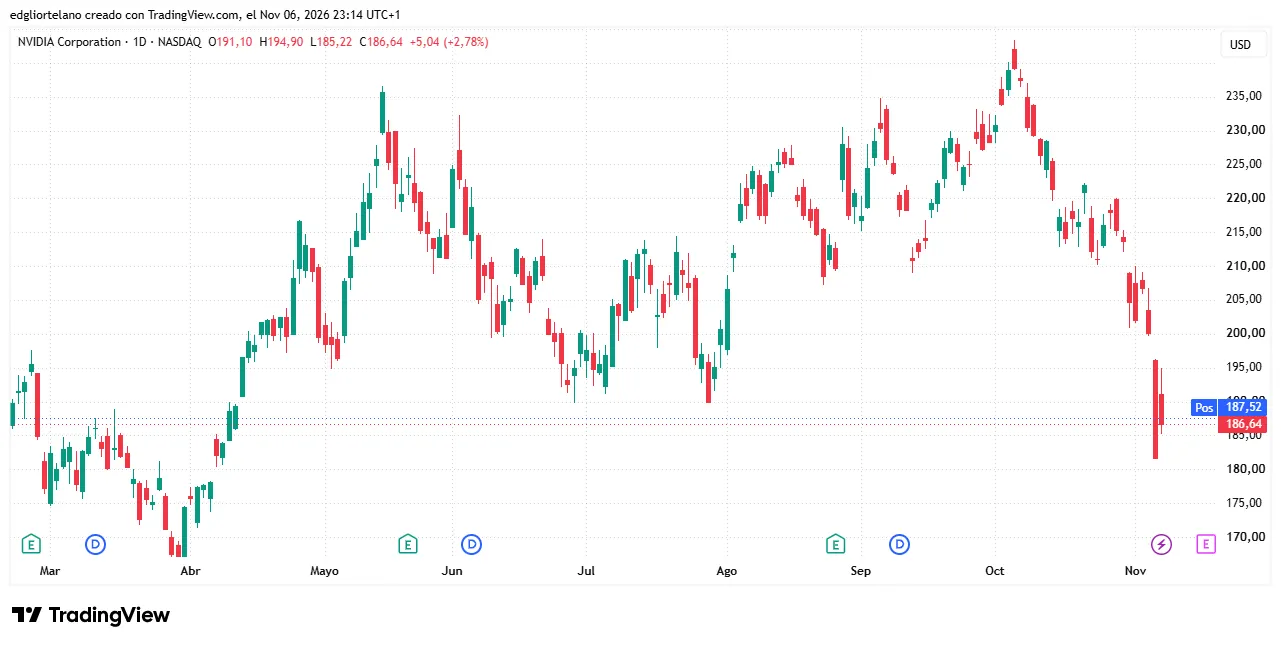
The relief bounce brought marginal gains to marquee technology names, though these increases did little to repair the substantial technical damage sustained earlier in the week. Nvidia shares advanced 2.78% to close at $186.64, attempting to claw back ground after plunging an alarming 9.3% in a single session on Thursday. Similarly, Advanced Micro Devices (AMD) rallied to $449.04 following a staggering 17.3% collapse a day prior. Despite these upward corrections, both semiconductor giants remain severely depressed relative to their lofty October peaks, underscoring the limited healing power of a one-day relief rally.
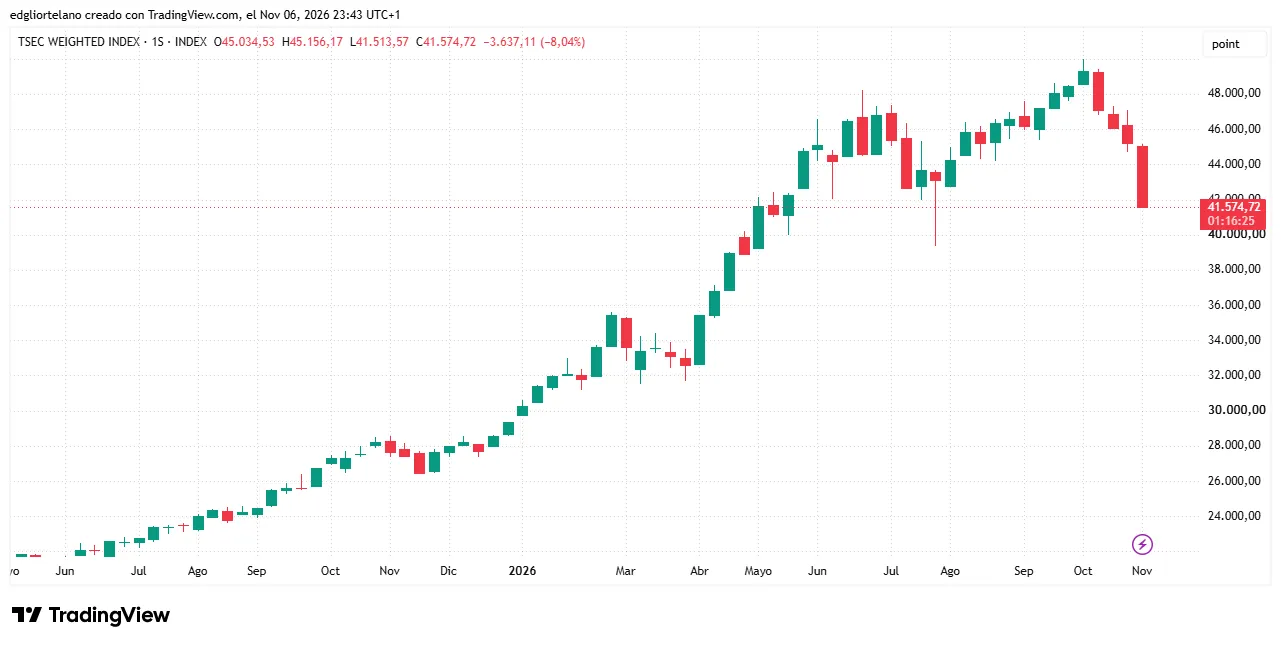
The turbulence was far from localized to U.S. exchanges. Asian markets absorbed the brunt of the panic as institutional investors aggressively de-risked their portfolios. South Korea’s benchmark KOSPI index suffered a steep 6% decline on Friday, while Taiwan’s TSEC index tumbled more than 8% over the course of the week, marking its worst performance in months. During the height of the panic, semiconductor manufacturing titan TSMC hit its daily limit-down threshold. According to reports from Reuters, the intense downward pressure prompted Taiwanese financial authorities to intervene informally, requesting that state-owned banks step in to support asset prices and stem the systemic bleeding.
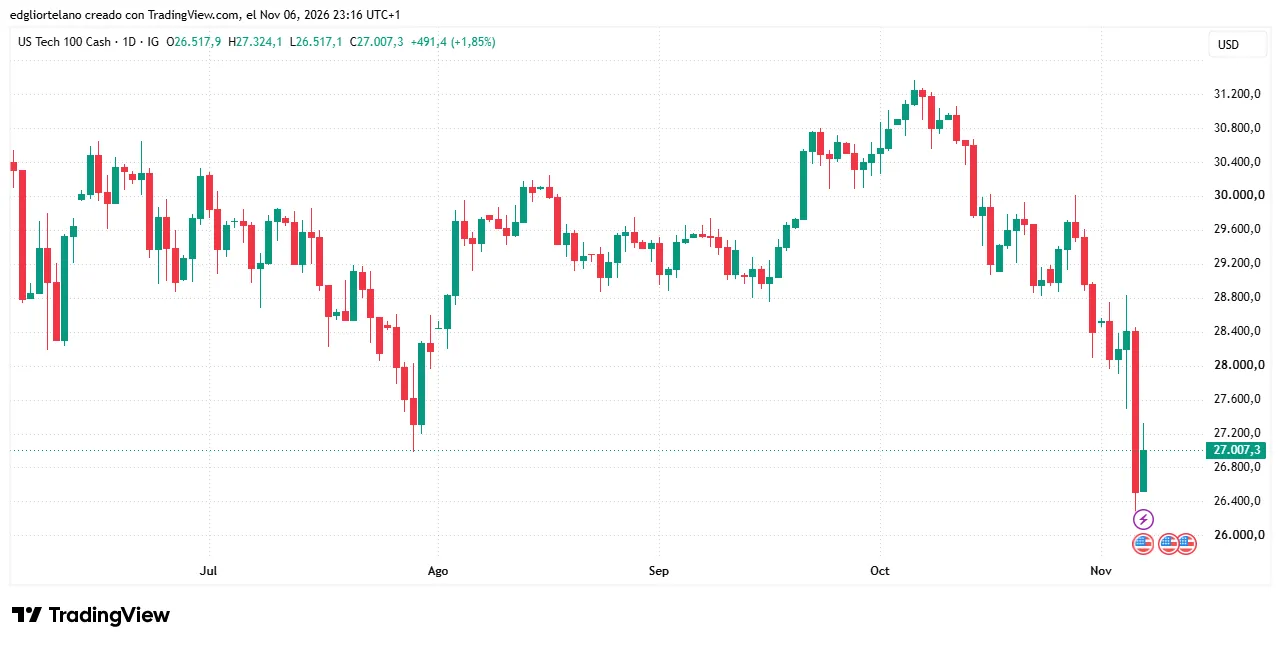
In the United States, the US Tech 100 cash-market proxy mirrored the broader recovery, ticking up 1.85% to settle at 27,007.3. Nevertheless, the index finished the week down more than 5.5%. Daily candlestick charts reveal that Friday’s bounce represents a technical reaction following a steep descent from October’s all-time highs rather than a true resumption of the previous bullish trend.
Catalysts Behind the Unraveling AI Trade

The sudden fracture in investor sentiment was catalyzed by a confluence of macroeconomic anxieties, shifting political headwinds, and mounting skepticism regarding capital expenditure returns. Domestically, the U.S. midterm elections injected a sudden dose of regulatory uncertainty. Voters across the country delivered a resounding message regarding physical infrastructure expansion; Ballotpedia data indicates that local communities voted to limit data center development in 40 out of 41 ballot contests held on November 3. Citizens routinely rejected pro-construction measures, signaling an era of heightened local resistance.
While some of these local votes carried purely advisory weight, the overarching political and social signal could not be ignored by institutional investors. Data centers serve as the primary engine driving demand for the semiconductor industry. Each facility requires colossal capital outlays directed toward advanced processors, dense server racks, specialized networking equipment, and energy-intensive cooling systems. Localized restrictions, zoning battles, and environmental pushback threaten to severely delay infrastructure deployment, forcing technology firms to reroute construction projects or face prolonged bottlenecks in monetization.
Crucially, however, underlying doubts concerning the sector’s financial viability predated the November elections. Major technology corporations and cloud providers have engaged in a relentless race to build out computational capacity, routinely investing tens of billions of dollars upfront well before establishing clear, sustainable avenues for return on investment. This aggressive capital expenditure cycle has collided uncomfortably with a tighter monetary environment. As elevated interest rates make borrowing increasingly expensive, maintaining hyper-growth through debt-fueled expansion becomes exceedingly difficult. Market strategist Steve Sosnick noted in commentary cited by Reuters that heavily owned technology equities were already aggressively "priced to perfection," leaving zero margin for operational missteps or delayed returns.
Correction Versus Bubble Bursting: Historical Parallels
To properly evaluate the current market stress, financial analysts distinguish carefully between a standard market correction and the catastrophic bursting of a speculative bubble. A correction is technically defined as a decline of 10% or more from a recent market peak in an asset class or index. Importantly, a correction does not inherently signal that the underlying corporate businesses are failing. For instance, consider a specialized semiconductor manufacturer whose shares historically trade at a price-to-earnings multiple of 60 based on expectations of exponential, perpetual growth. If market sentiment cools and investors become willing to pay only 40 times those same stable earnings, the equity can shed a third of its market value without a single dollar vanishing from the firm’s actual corporate profits.
Conversely, the bursting of an economic bubble represents a much more severe structural adjustment. This phenomenon occurs when speculative expectations prove entirely divorced from economic reality, leading to a sudden evaporation of the liquidity and credit supporting the boom.
Financial history provides a sobering precedent. During the infamous dot-com crash, the technology-heavy Nasdaq index plummeted roughly 77% between March 2000 and October 2002. History demonstrates that the foundational technology itself was not a passing fad—the internet fundamentally revolutionized global commerce. However, market participants had wildly overestimated the speed at which enterprises could commercialize the infrastructure to generate net profits.
During that era, telecommunications operators spent monumental fortunes laying vast networks of transoceanic fiber-optic cables years before end-user demand justified the expenditure. Companies like Global Crossing, which constructed a massive international telecommunications network, ultimately filed for Chapter 11 bankruptcy protection in 2002. The underlying technology survived and ultimately reshaped society, but numerous over-leveraged corporations and their equity holders were wiped out in the process.
Today’s artificial intelligence landscape bears striking structural resemblances to the telecom boom, characterized by a widening gap between long-term technological promise and short-term financial returns. At the same time, secondary markets are rapidly innovating; former cryptocurrency mining operations are aggressively repurposing their specialized hardware for cloud rentals, while a proliferation of new inference startups attempts to carve out profitable niches amid the supply constraints of high-end memory chips and processors.
Nevertheless, consider the macro-level risk: A hypothetical infrastructure firm borrows billions of dollars from institutional lenders to construct a massive data center packed exclusively with expensive Nvidia processors, projecting that it can lease out this high-performance computing capacity at premium rental rates for years to come. If end-use enterprise customers ultimately allocate smaller budgets than anticipated, interest rates remain elevated, or construction is delayed, the multi-billion-dollar debt burden remains fully due.
Should the operator default, it may be forced to cancel pending chip orders. Downstream, equipment contractors lose steady work, utility providers that planned multi-million-dollar grid expansions for anticipated power loads find themselves with idle capacity, and commercial lenders holding the debt absorb painful write-downs. Under such cascading conditions, a localized equity selloff can quickly metastasize into a broader macroeconomic headwind.
Structural Differences From the Dot-Com Era
Despite these striking parallels, financial analysts emphasize critical structural differences separating today’s AI ecosystem from the speculative excesses of the year 2000. Unlike the hundreds of cash-burning, pre-revenue dot-com startups that populated the turn of the millennium, the primary architects of the modern AI boom—Microsoft, Alphabet, Amazon, and Meta Platforms—are immensely profitable corporate behemoths. These mega-cap technology firms boast established enterprise customer bases, robust balance sheets, and substantial, recurring organic cash flows. Consequently, they possess the financial resilience to absorb strategic missteps, technological pivots, or temporary demand lulls far better than smaller, independent AI-cloud providers that rely entirely on continuous debt refinancing to fund expansion.
This dichotomy highlights a nuanced reality: It is entirely possible for artificial intelligence to continue profoundly transforming global industries over the coming decades, while simultaneously seeing a host of individual, over-leveraged AI firms fail—and while investors who piled into the market leaders at peak valuations suffer prolonged losses.
Early Warning Signs in Corporate Credit
While equity markets absorb daily volatility, financial warning lights are beginning to flicker within the corporate debt markets. Reuters reported on Friday that the cost of purchasing credit default swaps (CDS) to insure against a potential debt default by specialized AI-cloud provider CoreWeave climbed past 1,000 basis points. These financial instruments function similarly to an insurance policy on a corporate loan; as the cost of this protection rises sharply, bond market investors are signaling heightened anxiety regarding the company’s long-term ability to service and repay its extensive liabilities.
Despite localized strains in high-yield segments, broader investment-grade bond markets have continued to operate with relative normality. This divergence suggests that financial stress remains concentrated primarily within the riskiest, most speculative corners of AI financing rather than signaling an immediate, system-wide banking crisis.
Outlook: Upcoming Catalysts and Economic Data
The coming week will subject the AI trade to much more rigorous fundamental tests than the daily fluctuations of green and red candles on trading charts. Upcoming corporate earnings reports and operational updates from CoreWeave, semiconductor equipment maker Applied Materials, and enterprise networking giant Cisco will offer critical transparency. These disclosures will reveal whether corporate and enterprise customers are maintaining their aggressive orders for computing capacity and manufacturing hardware, or if capital expenditure budgets are quietly being reined in.
Simultaneously, incoming macroeconomic inflation data will heavily dictate Federal Reserve policy expectations, directly influencing the trajectory of borrowing costs. If upcoming corporate earnings reveal stable order books and manageable debt profiles, the narrative favoring a routine, healthy market correction will gain substantial credibility. Conversely, a pattern of repeated project cancellations, failed debt refinancings, and shrinking sales figures would suggest that the financial foundations supporting the AI boom are beginning to fracture. Ultimately, the central question confronting global financial markets is not whether artificial intelligence possesses a transformative future, but whether every enterprise currently betting billions of dollars on that future possesses the financial staying power to reach the finish line.