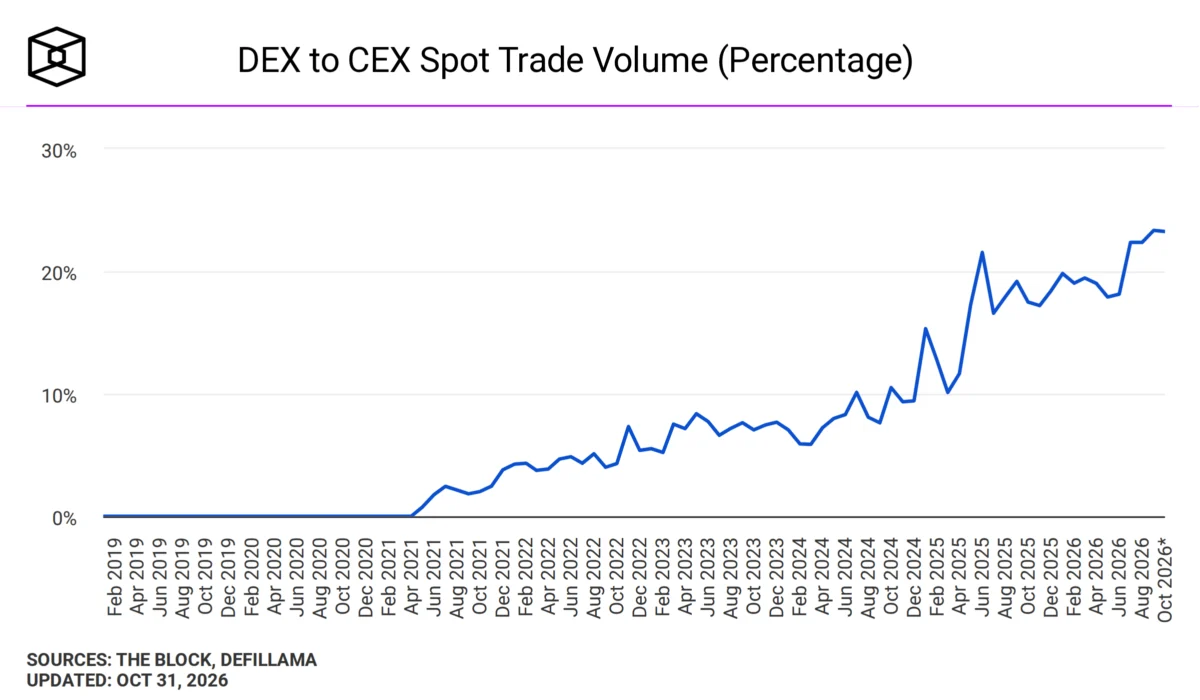
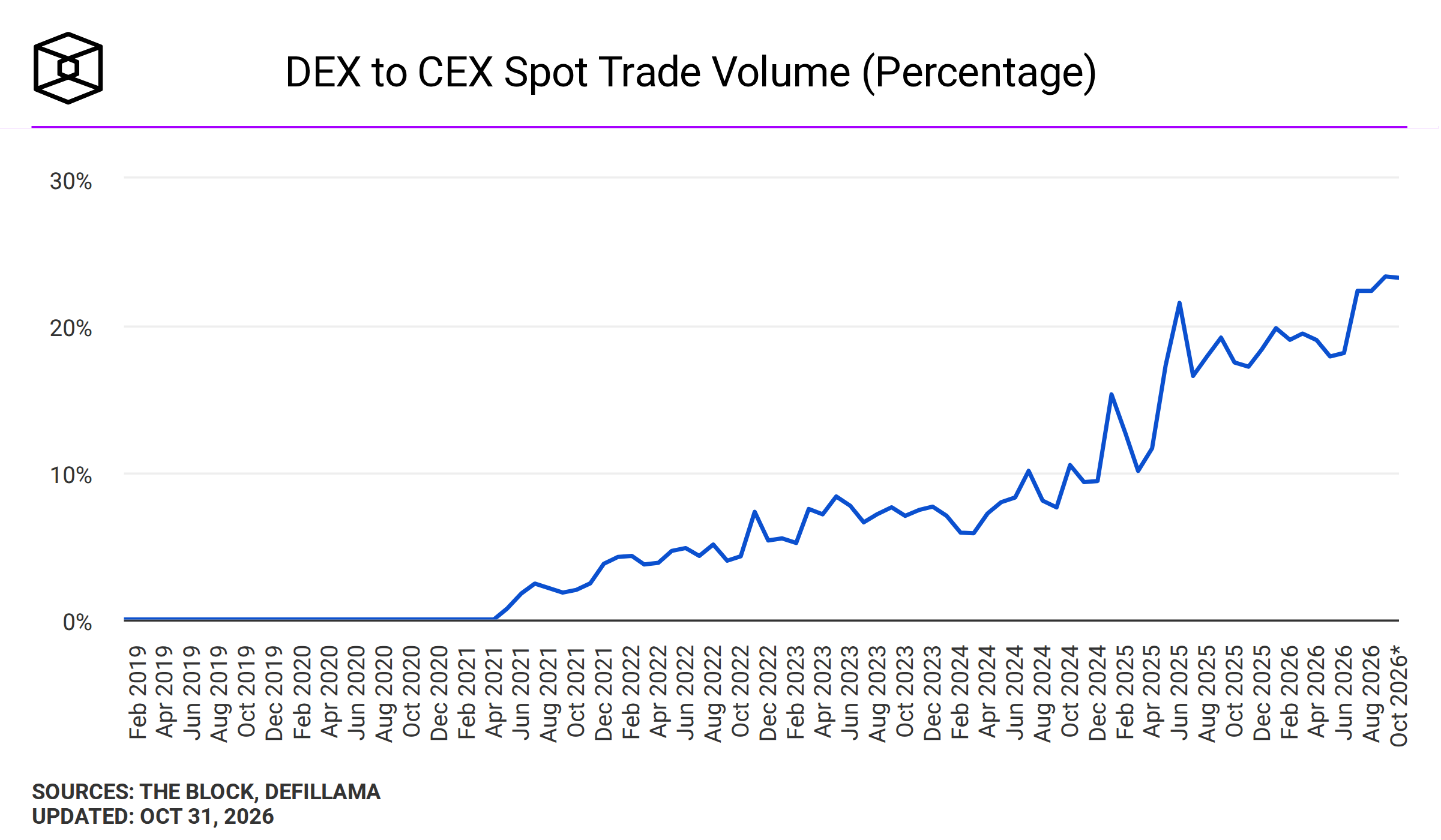
The global cryptocurrency market is undergoing a structural transformation in how digital assets are traded, driven by an accelerating shift from centralized platforms toward decentralized alternatives. Recent on-chain data indicates that decentralized exchanges (DEXs) now handle approximately 23% of the spot trading volume generated by major combined centralized exchanges (CEXs), such as Binance, Coinbase, and other leading global liquidity hubs. This milestone represents a historic high for the decentralized finance (DeFi) sector, whose market share has expanded by an astonishing 1,100% over the past five years. Industry analysts and market participants increasingly view this milestone as a pivotal turning point for the ecosystem, validating the core value proposition of non-custodial financial architecture.
The Five-Year Trajectory and Growth Dynamics
To fully understand the current market dynamics, it is essential to examine the historical trajectory of decentralized trading infrastructure. Five years ago, decentralized exchanges accounted for a negligible fraction of daily cryptocurrency spot volume. Users frequently encountered high gas fees, slower transaction execution times, and limited liquidity pools compared to the deep, fiat-backed order books of established centralized counterparts. However, continuous technological innovations—including layer-2 scaling solutions, automated market maker (AMM) optimizations, and cross-chain bridging capabilities—fundamentally altered this competitive landscape.
Market analysts note that the market share of DEXs essentially doubled between 2024 and 2025, reflecting a period of rapid institutional and retail adoption. Although this growth trajectory temporarily leveled off during the broader market consolidation and bear-leaning conditions observed in early 2026, the underlying fundamentals of on-chain trading remained remarkably resilient.
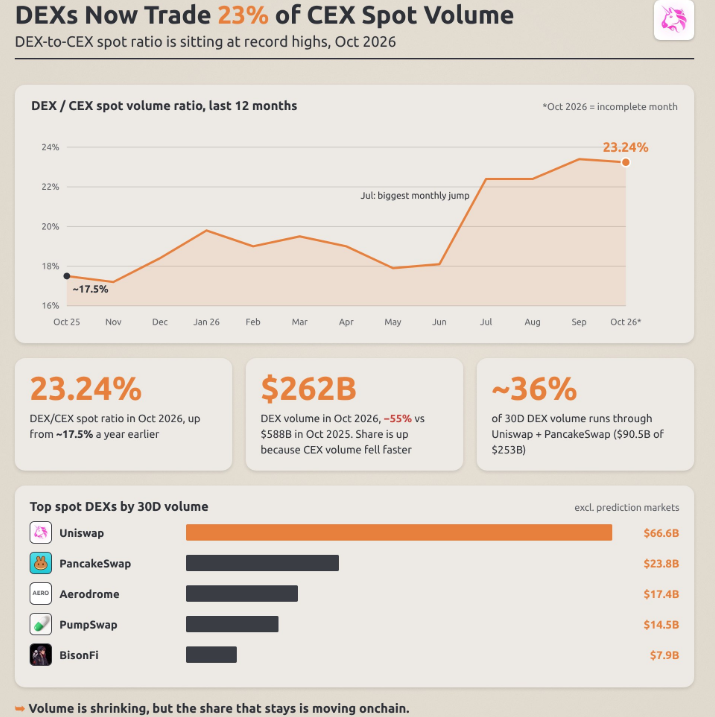
Detailed volume analyses conducted by prominent on-chain researchers reveal a nuanced story behind the statistics. Year-on-year (YoY) spot and perpetual metrics show that absolute DEX volume contracted from $588 billion in 2025 to $262 billion in 2026—a 55% reduction corresponding with a cooling macroeconomic and crypto market environment. Paradoxically, during this exact same timeframe, the relative market share of DEXs climbed from 17.5% to a record 23.2%.

This counterintuitive trend illustrates a vital characteristic of modern crypto liquidity: decentralized exchanges did not capture a larger slice of the pie merely by expanding faster than centralized competitors during a bull market. Instead, they secured their dominant market share by shrinking at a significantly slower rate than centralized exchanges during market downturns. When capital flows retreat from the broader digital asset economy, centralized exchange volume evaporates rapidly as retail traders sit on the sidelines. Conversely, dedicated on-chain liquidity providers, yield farmers, and core DeFi participants maintain sticky capital commitments that persist through varying market cycles.
Market Share Leaders and 2026 Volume Trends
Within the decentralized exchange ecosystem, a select group of protocols continues to capture the vast majority of user volume and liquidity. Monthly spot trading volume data indicates that Uniswap and PancakeSwap command an overwhelming 30% to 36% combined share of all DEX activity, cementing their status as foundational infrastructure for token swaps across Ethereum, layer-2 networks, and Binance Smart Chain ecosystems. Meanwhile, emerging protocols such as Aerodrome and PumpSwap have surged into the third and fourth positions, respectively, driven by specialized liquidity incentives and changing user preferences toward high-throughput chains.
The broader market recovery in 2026 served as an important catalyst for trading volumes across all sectors. During July, the cryptocurrency market experienced a notable rebound as Bitcoin successfully recovered from local lows beneath $57,800 to reclaim the $60,000 threshold, eventually extending its upward momentum toward new multi-month highs above $87,000 by August and September. As market sentiment shifted from cautious pessimism to aggressive accumulation, on-chain activity surged in tandem, propelling the DEX market share from approximately 18% to over 22% within a compressed multi-week window.
Security Incidents and the Centralized-Versus-Decentralized Debate
While technological maturation and changing user habits have undoubtedly contributed to the rise of decentralized finance, recent high-profile security failures at centralized institutions have acted as an undeniable catalyst for change. The trust assumptions underpinning centralized cryptocurrency exchanges have faced unprecedented scrutiny following a series of devastating cyberattacks and platform exploits.
In September 2026, Bitget suffered a major security breach resulting in the loss of approximately $388 million in digital assets. This incident was quickly overshadowed by an even larger crisis: a staggering $6.3 billion exploit targeting Binance, which sent shockwaves through the global cryptocurrency community. The scale of the Binance security breach forced management to temporarily suspend standard deposit and withdrawal operations while emergency forensic audits and asset recovery procedures were initiated.
These events triggered an immediate psychological and operational shift among high-net-worth traders, institutional funds, and retail participants alike. Industry commentators were quick to point out the stark contrast in risk profiles between keeping capital on custodial platforms versus maintaining absolute control via self-custody wallets connected to decentralized applications. Andy Cavanaugh, founder of research and analysis firm The Rollup, highlighted this sentiment shift, observing a massive macro trend favoring on-chain infrastructure over off-chain custodial models in the immediate aftermath of the Binance exploit.
Quantitative metrics began to reflect this philosophical pivot. For instance, alternative high-performance trading environments and hybrid platforms, such as Hyperliquid, experienced measurable gains in relative market share during the height of the Binance crisis. Hyperliquid’s share of aggregate centralized exchange volume ticked upward from 8.0% to 8.3%, while its individual volume output relative to Binance climbed to 14.5%, recovering sharply from a mid-October low of 13.5%.
The Counter-Narrative: On-Chain Vulnerabilities and Security Realities
Despite the growing narrative surrounding the safety and autonomy of decentralized finance, industry experts caution that the security landscape is far from black-and-white. While centralized exchanges possess corporate balance sheets and insurance funds that historically enable them to fully reimburse users following major exploits—as both Binance and Bitget demonstrated following their respective security failures—decentralized applications rarely offer comparable financial backstops or restitution guarantees for everyday users.
Furthermore, the decentralized finance sector is increasingly vulnerable to sophisticated threats. The proliferation of artificial intelligence-enabled cyberattacks has expanded the threat matrix facing self-custody solutions, hardware wallets, and decentralized protocols alike. Security researchers note that supply chain attacks targeting trusted software libraries and user interfaces continue to pose severe risks to retail asset security.
Underscoring these persistent risks, cybersecurity firm Blockaid recently issued urgent warnings regarding a coordinated attack targeting the frontend user interfaces of at least 12 prominent DeFi protocols. This coordinated exploit attempt served as a sobering reminder that security vulnerabilities are by no means exclusive to centralized corporate entities. Malicious actors continuously probe the entire spectrum of blockchain architecture, targeting weak points wherever user signatures can be intercepted or manipulated.
Implications and Future Outlook
The convergence of record-high DEX market share, recurring centralized exchange security crises, and evolving on-chain threat vectors presents a complex outlook for the future of digital asset trading.
On one hand, the milestone of capturing 23% of combined centralized exchange spot volume proves that decentralized finance has evolved from an experimental niche into a robust, battle-tested financial alternative. The structural stickiness of on-chain capital suggests that a growing segment of the global trading population prioritizes self-custody, transparency, and censorship resistance above the convenience offered by centralized platforms.
On the other hand, the long-term sustainability of this trend will depend heavily on the DeFi sector’s ability to solve its own systemic vulnerabilities. Enhancing frontend security, implementing proactive multi-layered threat detection, and establishing decentralized insurance mechanisms will be critical prerequisites if DEXs are to capture an even larger share of global trading volume in the years to come. As the industry moves forward, the ongoing competition between centralized efficiency and decentralized security will continue to define the evolution of global financial markets.