Ethereum-based liquid staking titan Lido has officially announced its upcoming expansion into the decentralized finance (DeFi) lending sector with the launch of an institutional-grade product titled Lido Lend. Scheduled to deploy within the current quarter, the protocol is designed to address mounting security vulnerabilities and structural inefficiencies that have plagued the on-chain lending ecosystem in recent years. While the development team confirmed the impending rollout via a formal announcement on social media platform X, precise milestone timelines and date specifics remain unconfirmed.
The introduction of Lido Lend represents a calculated diversification strategy for the platform, which has traditionally focused its operations strictly on liquid staking solutions. By introducing a dedicated lending facility tailored specifically to professional entities, institutional investors, and high-net-worth market participants, Lido aims to capture a distinct segment of the decentralized finance economy that prioritizes stringent risk mitigation above speculative yield generation.
Architecture and Risk Mitigation Framework
At its technological core, Lido Lend will function as a modified iteration of Morpho Blue, a decentralized lending platform recognized for its modular and immutable architecture. However, Lido’s implementation will feature a heavily customized risk framework tailored to safeguard institutional capital.
Rather than adopting an open-door policy for long-tail, low-liquidity crypto assets—a common practice in general-purpose lending protocols that has historically resulted in devastating exploits—Lido Lend will strictly restrict its collateral base. The protocol’s operational scope will exclusively support highly liquid, widely recognized digital assets, specifically focusing on Wrapped Ether (WETH) and Lido’s own staked Ether (stETH).
Industry analysts point out that this conservative asset curation strategy is a direct response to recent security breaches across the broader decentralized finance sector. By eliminating volatile, low-liquidity collateral options, Lido seeks to insulate its users from cascading liquidations and oracle manipulations that have triggered multi-million-dollar bad debt crises on competing lending markets.
The Strategic Flywheel and Ecosystem Synergy
Lido’s leadership has framed the launch of Lido Lend not as an isolated product release, but as a core component of a broader economic flywheel designed to strengthen its existing staking ecosystem. The protocol intends to leverage deep integrations with stETH and Lido Earn, creating a continuous loop of capital efficiency for participants.
According to official statements released by the Lido project team, the product architecture is intended to foster structural synergy across its existing service offerings. The team noted that the introduction of Lido Lend opens an entirely new growth vector for the wider Lido ecosystem, providing on-chain participants globally with a streamlined, user-forward, and security-first mechanism to generate yield and manage liquidity positions.
The concept of the "stETH flywheel" relies on stakers utilizing their yield-bearing tokens as collateral to borrow liquid assets without sacrificing their underlying staking rewards. By building a dedicated infrastructure for this exact use case, Lido aims to keep capital locked within its native ecosystem while simultaneously capturing secondary market value from borrowing and lending fees.
Market Context: Navigating the Aftermath of Sector Exploits
The timing of Lido’s expansion into lending coincides with a period of profound structural reassessment within the decentralized finance lending market. Over the preceding months, the sector has reeled from high-profile security incidents that exposed systemic vulnerabilities in prominent lending protocols.
Most notably, leading decentralized lending market Aave sustained severe financial and reputational damage following a massive exploit involving KelpDAO. The security breach, later linked by investigators to malicious actors associated with the Lazarus Group, involved the theft of over 89,000 unbacked rsETH tokens. The attackers subsequently leveraged Aave’s liquidity pools to borrow substantial amounts of liquid assets, including WETH, leaving the platform with estimated bad loans exceeding $120 million out of a total $292 million incident footprint.
In the wake of this crisis, Aave enacted aggressive risk-management frameworks, including the rapid delisting of assets with low market adoption and stricter collateralization requirements. However, market observers argue that these defensive measures created a vacuum in the institutional lending space, leaving sophisticated market participants searching for more resilient, secure alternatives.
Konstantin Lomashuk, a prominent crypto analyst, addressed the strategic significance of Lido’s market entry by highlighting the current state of decentralized infrastructure. Lomashuk noted that Lido successfully solved the staking market challenge by building the most secure staking solution in the industry, which currently manages over $24 billion in staked assets. According to Lomashuk, the logical next frontier is lending, where persistent hacks and structural inefficiencies have left lenders vulnerable, making user protection the primary value proposition of Lido Lend.
Current Landscape of On-Chain Lending
The decentralized lending sector represents one of the foundational pillars of decentralized finance, characterized by a Total Value Locked (TVL) that has steadily recovered to approximately $55 billion. Within this macroeconomic framework, active outstanding loans hover around $31 billion, indicating a conservative utilization rate where nearly half of all supplied capital sits idle.
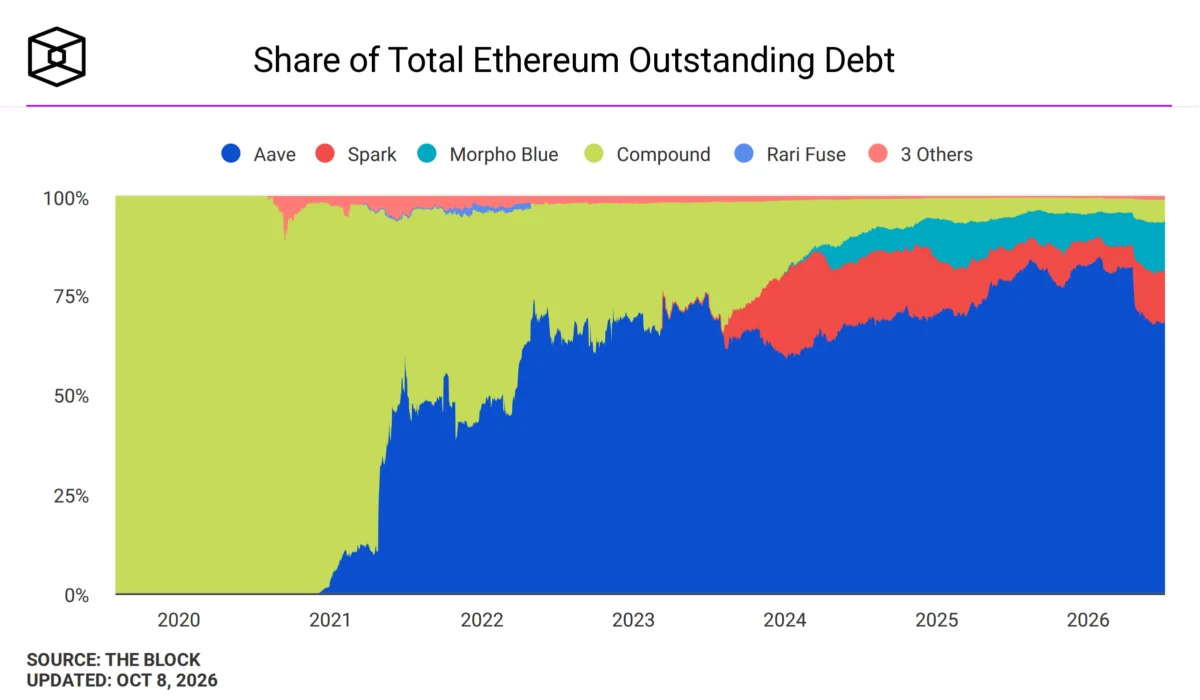
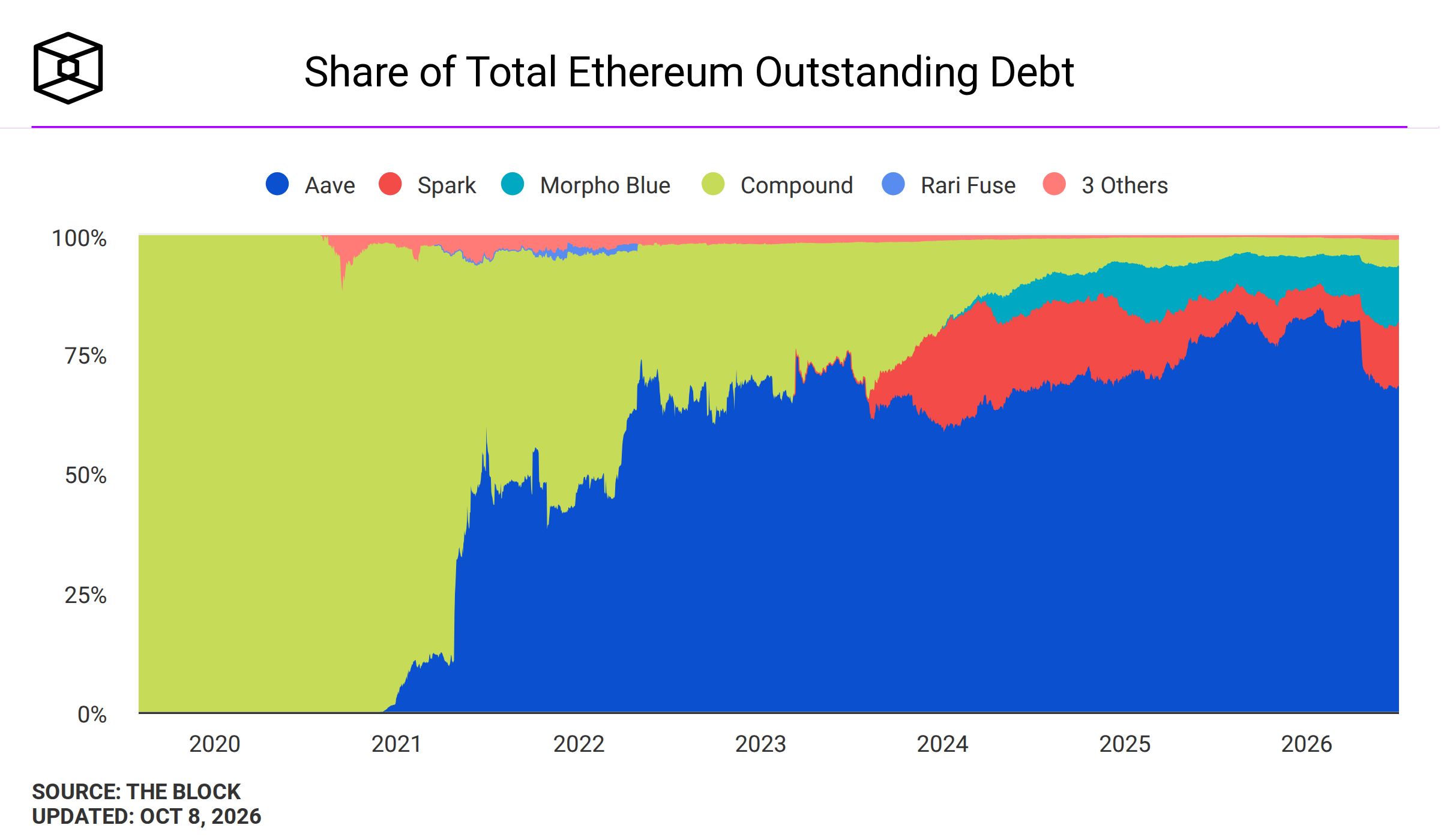
Market share distribution among incumbent protocols remains heavily concentrated. Aave has maintained its position as the undisputed market leader since 2021, commanding approximately 68% of all active loans on the Ethereum network. Spark, the lending protocol associated with the Sky ecosystem (formerly known as MakerDAO), occupies the second position with a 13% market share. Morpho follows closely behind, capturing roughly 12% of active loans.
Given Aave’s dominant market position, financial analysts initially interpreted Lido’s announcement as a direct declaration of war against established lending heavyweights. The move signaled a potential clash between the dominant staking provider and the dominant lending provider, raising questions about future competitive dynamics in DeFi.
Official Stance on Market Positioning
In response to speculation regarding a hostile competitive takeover of the lending sector, Lido representatives firmly rejected the narrative of direct conflict. Clarifying the platform’s strategic intent, project communications emphasized that Lido Lend is deliberately engineered to serve a specialized niche rather than compete for general-purpose retail volume.
The project team clarified that Lido Lend functions as a tailored solution designed explicitly to address the complex requirements of professional borrowers and long-term lenders. Rather than challenging existing platforms for retail market share, the protocol was built to complement current market solutions by offering a specialized venue for institutional-grade stETH and WETH operations.
Industry insiders note that by positioning Lido Lend as a complementary partner rather than a direct competitor, Lido may avoid aggressive retaliatory pricing or liquidity wars with established giants like Aave and Morpho, instead carving out a secure, institutional enclave within the broader lending economy.
Implications for the LDO Token and Governance
As development on Lido Lend nears completion, community focus has naturally shifted toward the potential economic implications for the Lido DAO (LDO) governance token. Questions remain regarding whether the anticipated ecosystem growth will directly accrue value to the token or provide additional momentum to the protocol’s ongoing token buyback initiatives.
Recent market data indicates that the LDO altcoin experienced a temporary 14% retracement during broader market corrections. However, technical analysis of higher timeframe charts reveals that the asset continues to trade constructively within its established rising channel configuration for the second half of the year. Technical strategists suggest that fundamental catalysts, such as the deployment of Lido Lend and the maturation of the protocol’s revenue-sharing mechanisms, could provide the necessary underlying strength for a sustained upward trend.
Ultimately, the launch of Lido Lend marks a pivotal evolutionary step for Lido. By transitioning from a single-product liquid staking provider into a diversified ecosystem encompassing both staking and institutional-grade lending, Lido is attempting to cement its structural footprint within the decentralized economy while setting a new standard for protocol-level security and risk management.