Launched in February 2025 by the Ethereum Foundation in collaboration with Hyperlane and Bootnode, the Open Intents Framework (OIF) has emerged as a pivotal development in the quest to unify the fragmented landscape of blockchain ecosystems. By providing a shared, permissionless infrastructure for executing cross-chain intents, the project aims to solve one of the most persistent bottlenecks in decentralized finance: the friction associated with moving assets and data across disparate networks. With over 30 industry-leading teams—including major Layer 2 protocols like Arbitrum, Optimism, Polygon, ZKsync, and Starknet—throwing their weight behind the initiative, OIF is establishing itself not as a competing proprietary product, but as a neutral, foundational standard for the next generation of web3 applications.
The Genesis and Evolution of OIF
The architectural design of OIF was born out of a necessity to standardize how cross-chain requests, or "intents," are processed. Historically, interoperability has been hampered by a reliance on fragmented, siloed bridges and proprietary messaging protocols. Each bridge often operated under its own security assumptions and liquidity requirements, creating a fragmented user experience that forced developers to build bespoke solutions for every new chain they wished to support.
The timeline of OIF’s development reflects a rapid industry-wide adoption strategy. Following its conceptualization and subsequent launch in early 2025, the framework quickly moved from theoretical whitepaper discussions to live deployments. By mid-2025, the OIF development team had successfully deployed core smart contracts onto Ethereum Sepolia and Optimism Sepolia, proving the viability of the infrastructure under real-world network conditions. This momentum culminated in September 2025, when Coinbase Payments joined as a core contributor, signaling a significant shift toward institutional-grade standardization for cross-chain asset transfers.
Technical Architecture: How the Framework Functions
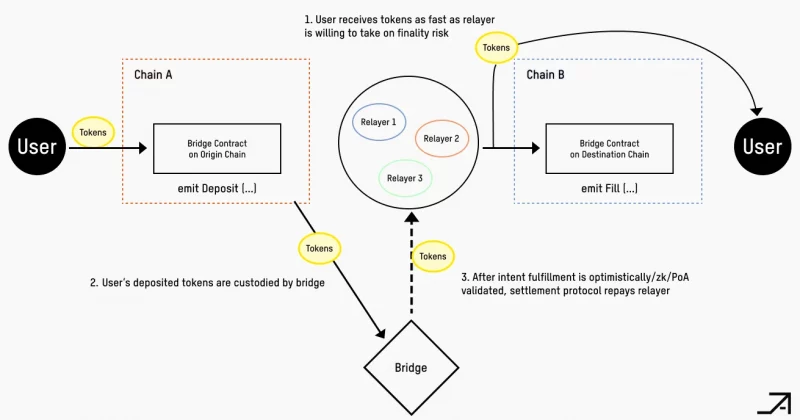
At its core, the Open Intents Framework functions as a standardized toolkit designed to facilitate the seamless movement of assets and logic. The framework is architected around the ERC-7683 standard, which serves as the fundamental language for cross-chain intent structures. This standard ensures that regardless of the specific chain or underlying blockchain technology, the request for a cross-chain action remains readable and executable by a diverse set of participants.
The framework’s technical stack is built upon three primary contract types:
- InputSettler: Manages the initial request on the source chain, ensuring that the user’s intent is properly locked or prepared for the transition.
- OutputSettler: Coordinates the completion of the intent on the destination chain, verifying that the desired asset or state change has been successfully delivered to the user.
- Oracle Contracts: Provide the necessary external data verification, ensuring that the cross-chain state is accurately reported and that the solvers involved can trust the information provided.
These contracts are augmented by an interoperability SDK, which allows developers to plug their applications into the OIF infrastructure without the need for centralized permissioning. By utilizing a modular, open-source approach, OIF allows developers to focus on the user experience—such as one-click cross-chain swaps—rather than the underlying complexities of cross-chain security and settlement.
The Solver Economy and Competitive Efficiency
A defining feature of OIF is its reliance on a competitive solver market. In this model, when a user submits an intent, such as a cross-chain token swap, the request is broadcast to an open network of solvers. These solvers are incentivized by market competition to fulfill the request as efficiently as possible. Because the framework does not dictate a specific centralized entity to process transactions, solvers compete on speed, cost, and reliability.
In testing environments, this competitive dynamic has yielded impressive results, with solver-filled orders completing in as little as 10 to 60 seconds. This efficiency is critical for parity with centralized finance (CeFi) experiences, where users have grown accustomed to near-instantaneous settlement. By abstracting the complex cross-chain pathfinding away from the user, OIF ensures that the end-user interaction remains simple, regardless of how many chains or intermediate steps are involved in the background.
Coinbase Payments and Institutional Involvement
The involvement of Coinbase Payments in September 2025 marked a watershed moment for the project. As a leading global exchange, Coinbase’s entry into the OIF ecosystem provides both technical expertise and the institutional credibility necessary for widespread adoption. Coinbase Payments is specifically focused on standardizing how cross-chain asset transfers occur, aiming to integrate OIF into broader payment rails.
Industry analysts suggest that this involvement is a strategic move to future-proof the exchange’s payment infrastructure. By supporting a neutral standard rather than a proprietary bridge, Coinbase reduces its exposure to the systemic risks associated with single-point-of-failure bridge designs. Furthermore, the collaboration highlights the broader industry trend of shifting away from "walled garden" interoperability toward open, decentralized standards that benefit the entire ecosystem.
Why a "No Token" Strategy Defines OIF
Perhaps the most unconventional aspect of the Open Intents Framework is the deliberate decision to operate without a dedicated governance or protocol token. In an industry where tokenization is often the primary driver of development, OIF’s "no token" stance is a strategic departure intended to foster long-term neutrality.
This design choice has three significant implications:
- Neutrality: Without a token, there is no incentive for the framework to prioritize one ecosystem or liquidity provider over another. It functions as a public good, similar to the foundational protocols of the early internet.
- Regulatory Clarity: By avoiding tokenomics, OIF mitigates the regulatory complexities associated with managing a crypto-asset, making it easier for large enterprises and conservative financial institutions to adopt the technology.
- Focus on Utility: Without the distraction of staking rewards or yield farming, the framework’s success is measured strictly by its utility. Solvers are driven by the inherent profitability of fulfilling intents, creating a sustainable market-based incentive structure that does not rely on inflationary token emissions.
Broader Impact and Future Implications
The long-term implications of OIF are far-reaching. By creating a standardized, permissionless interface for cross-chain intents, the framework essentially acts as a "connective tissue" for the multi-chain future. If successful, the fragmented nature of current L2s and sidechains could eventually disappear from the user’s perspective, creating a "chain-agnostic" experience.
For developers, the implications are equally profound. The removal of vendor lock-in allows for greater portability; a dApp built on OIF can easily expand to new chains as they emerge without needing to rewrite its core interoperability logic. This reduces the barrier to entry for new networks and encourages a more competitive landscape for chain development.
As OIF moves into the latter half of 2025, the focus is shifting toward rigorous security audits and the expansion of the solver ecosystem. While the framework is already live on several testnets and early mainnet environments, the next phase will involve scaling these operations to handle significantly higher transaction volumes. The ongoing collaboration between the Ethereum Foundation and the participating L2 teams underscores a unified vision: that the future of blockchain is not defined by individual chains, but by the ability to move value and data seamlessly between them.
The Open Intents Framework stands as a testament to the maturation of the blockchain industry. By prioritizing modularity, neutrality, and open-source collaboration over short-term financial gains, OIF is laying the groundwork for a more cohesive, efficient, and user-friendly web3 environment. As the project continues to evolve, it remains a primary focal point for developers and institutions seeking to navigate the complex, multi-chain reality of the modern digital economy.