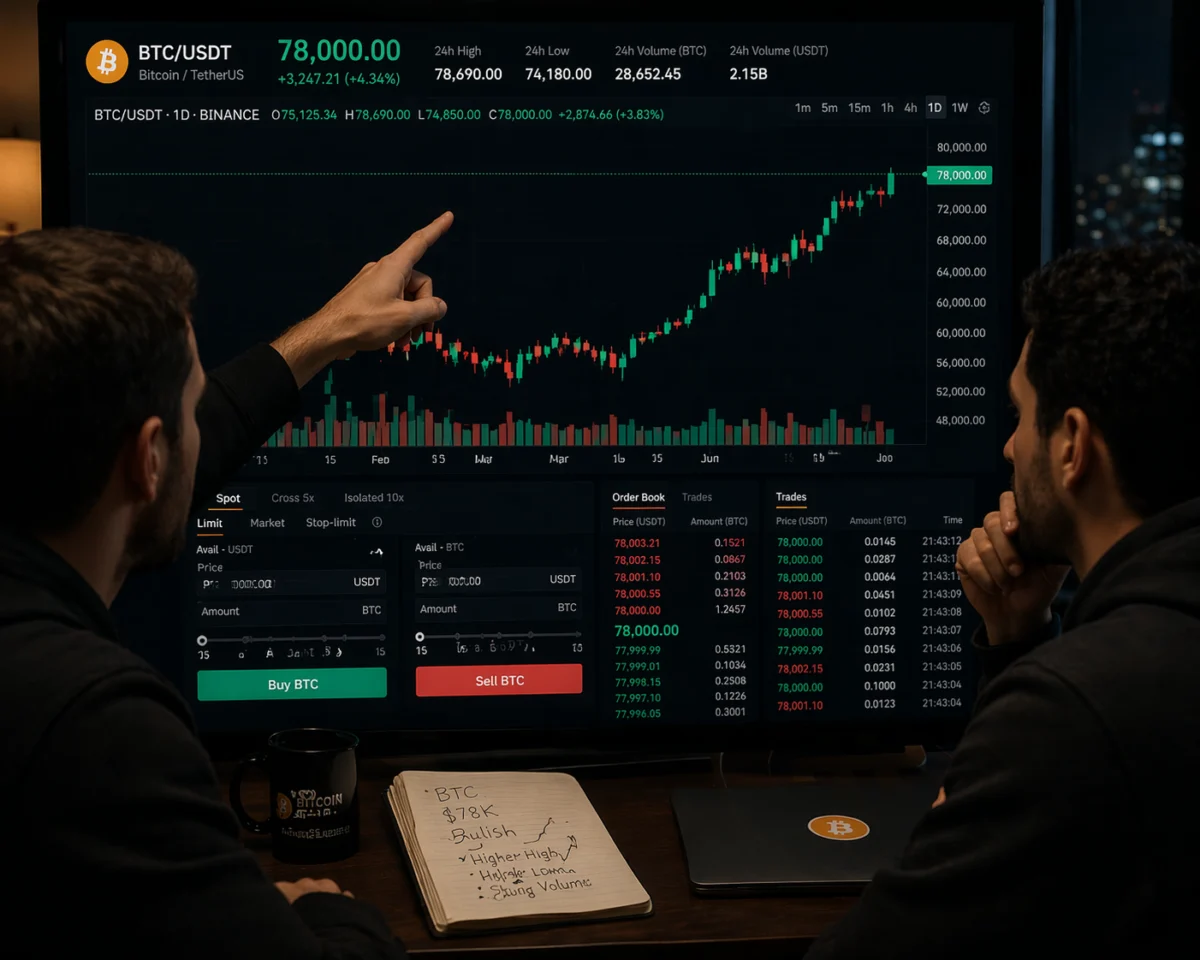
Bitcoin (BTC) surged past the $78,000 threshold on Wednesday, marking a significant milestone in its current bullish trajectory after gaining more than 6% over the course of the week. This price action comes amid a complex interplay of macroeconomic policy shifts and high-stakes international diplomacy, which have collectively bolstered investor confidence in high-risk assets. While institutional demand via spot Bitcoin Exchange-Traded Funds (ETFs) appeared relatively subdued on Tuesday, the broader market sentiment remains overwhelmingly positive as traders react to a rare convergence of increased dollar liquidity and a de-escalation of tensions in the Middle East.
The digital asset reached a daily high of $78,452, its most robust performance since early February. This rally is particularly notable given the cautious atmosphere that characterized the start of the month. Analysts suggest that the current momentum is not merely a technical breakout but a fundamental repricing of Bitcoin in light of two major developments: the extension of a critical ceasefire involving the United States and Iran, and a massive debt buyback program initiated by the US Treasury Department. Together, these factors have created a "goldilocks" environment for Bitcoin, where geopolitical risk is temporarily sidelined and monetary conditions are easing.
Geopolitical Stability: The Role of the US-Iran Ceasefire Extension
A primary driver of the mid-week rally was the announcement from Washington late Tuesday evening regarding the extension of a two-week ceasefire. US President Donald Trump confirmed that the truce, which was originally slated to expire on April 22, 2026, would be extended. This decision followed a direct request from Pakistan, which has been acting as a diplomatic intermediary between Washington and Tehran. The extension is intended to provide a window for the US administration to receive and review a unified proposal from the Iranian leadership regarding long-term regional stability.
While the President maintained a firm stance, emphasizing that the US naval blockade of Iranian seaports would remain in effect to ensure compliance, the mere postponement of renewed hostilities was enough to trigger a "risk-on" rally across global markets. For Bitcoin, which often fluctuates based on global uncertainty, the extension provided a reprieve from the "war premium" that had previously suppressed prices. Market participants viewed the move as a sign that both sides are seeking a diplomatic exit ramp rather than an escalation into direct kinetic conflict. This geopolitical breathing room allowed traders to pivot back to growth-oriented assets, pushing Bitcoin to levels not seen in months.
Macroeconomic Liquidity: The US Treasury’s 15 Billion Dollar Buyback
Parallel to the diplomatic breakthroughs, the US Treasury Department has moved to inject a substantial amount of liquidity into the financial system. This week, the Treasury is set to execute a $15 billion buyback of its own debt securities. This operation matches the largest buyback in the history of the US Treasury and is designed to improve market functioning and provide liquidity to the primary dealer network.
In the context of Bitcoin, liquidity is a primary price catalyst. As a decentralized asset with a fixed supply, Bitcoin is highly sensitive to the expansion of the "M2" money supply and the availability of excess capital in the banking system. When the Treasury buys back debt, it effectively puts cash back into the hands of institutional investors, who then seek higher yields in other sectors. Historically, periods of significant liquidity injections have correlated with rallies in the cryptocurrency sector. By removing $15 billion in debt from the market and replacing it with liquid cash, the Treasury is inadvertently creating a favorable tailwind for Bitcoin as investors look for alternative stores of value and hedges against potential currency debasement.
Institutional Sentiment and the Spot ETF Landscape
Despite the impressive price action, data from the spot Bitcoin ETF market suggests a degree of institutional hesitation. On Tuesday, Bitcoin spot ETFs recorded a modest net inflow of $11.84 million. While positive, this figure represents a sharp decline from the $238.37 million in inflows recorded just twenty-four hours earlier. This deceleration in ETF buying suggests that while retail and algorithmic traders are aggressively bidding up the price, larger institutional players may be adopting a "wait-and-see" approach.
The discrepancy between price growth and ETF inflows can be attributed to the ongoing uncertainty surrounding the US-Iran peace negotiations. Institutional fund managers often prioritize capital preservation and may be waiting for a more definitive resolution to the geopolitical standoff before committing larger tranches of capital. However, market analysts point out that if the ceasefire holds and transitions into a more permanent agreement, a surge of "sideline capital" from these ETFs could provide the necessary fuel to push Bitcoin toward the psychological $80,000 barrier and beyond.

Technical Analysis: Bulls Maintain Control Above Key Moving Averages
From a technical perspective, Bitcoin’s market structure remains decidedly bullish. On the 4-hour chart, BTC/USD is trading comfortably above its 50-day and 100-day Exponential Moving Averages (EMAs), which are currently situated at $72,345 and $75,368, respectively. The ability of the asset to maintain support above these levels is a strong indicator of sustained buying pressure.
Key momentum oscillators, including the Relative Strength Index (RSI) and the Moving Average Convergence Divergence (MACD), are currently in constructive territory. The RSI is trending upward without yet reaching overbought extremes, suggesting there is still room for further appreciation before a cooling-off period is required. The MACD histogram continues to show positive bars, reinforcing the idea that the short-term trend is favoring the upside.
The immediate challenge for Bitcoin bulls lies at the 50% Fibonacci retracement level, located near $78,962. A clean break above this resistance would likely clear the path for a test of the $80,000 level. Beyond that, the 200-day EMA at $82,769 stands as the next major objective for long-term holders. Conversely, on the downside, the prior channel top at $75,680 serves as the first line of defense. Should a correction occur, the 100-day EMA ($75,368) and the 38.2% Fibonacci level ($74,487) are expected to provide significant structural support.
Timeline of Recent Events Leading to the 78,000 Dollar Breakout
To understand the current price action, it is essential to look at the chronology of events over the past seven days:
- April 15: Bitcoin faces selling pressure near $72,000 as rumors of an end to the ceasefire begin to circulate.
- April 18: The US Treasury hints at a massive buyback program to stabilize the bond market, causing a slight recovery in BTC to $74,000.
- April 20: Spot ETF inflows spike to $238 million as institutional investors front-run the expected liquidity injection.
- April 21 (Late): President Trump announces the extension of the ceasefire following Pakistan’s mediation. BTC breaks $76,000 in after-hours trading.
- April 22 (Morning): Bitcoin clears $78,000, reaching a peak of $78,452 as the market digests the dual impact of the ceasefire and the $15 billion buyback.
Broader Market Implications and Expert Reactions
The rally in Bitcoin has had a secondary effect on the broader digital asset ecosystem. Ethereum (ETH) and several high-cap "altcoins" have also seen gains, though they continue to lag behind Bitcoin’s dominance. Analysts believe this "Bitcoin-first" rally is typical of early-stage liquidity cycles, where investors flock to the most liquid and established digital asset before moving down the risk curve into smaller projects.
Industry experts have offered varied perspectives on the sustainability of this move. "What we are seeing is a rare alignment of fiscal policy and geopolitical de-escalation," stated Marcus Thorne, a senior market strategist at a leading digital asset hedge fund. "The Treasury buyback is essentially a form of ‘stealth QE’ (Quantitative Easing). When you combine that with the removal of the immediate threat of war, you create a vacuum that can only be filled by higher asset prices. However, the low ETF inflows on Tuesday are a reminder that the ‘smart money’ is still watching the headlines very closely."
Other analysts warn that the reliance on the ceasefire extension makes the market vulnerable to "headline risk." If the unified proposal from Tehran fails to meet Washington’s expectations, or if the naval blockade leads to a fresh confrontation, the gains could be erased as quickly as they were made.
Conclusion and Outlook
As Bitcoin trades near its all-time highs, the focus for the remainder of the week will be on the execution of the Treasury’s buyback and any further updates regarding the diplomatic situation in the Middle East. If the $15 billion liquidity injection proceeds smoothly and the ceasefire remains intact, the path of least resistance for Bitcoin appears to be upward.
Investors will be closely monitoring the $80,000 level, which represents not only a psychological milestone but also a potential trigger for a new wave of FOMO (Fear Of Missing Out) among retail investors. For now, the "bullish bias" remains the dominant narrative, supported by a unique blend of government intervention and international diplomacy that has, for the moment, turned the tide in favor of the world’s largest cryptocurrency.