Foundry, the digital asset infrastructure provider that operates the world’s largest Bitcoin mining pool, has officially signaled its intent to diversify its operations by launching a specialized Zcash (ZEC) mining pool. The new initiative, scheduled to go live in April 2026, is specifically designed to cater to the requirements of institutional investors, public companies, and large-scale enterprise miners. By leveraging the same infrastructure that propelled Foundry USA to the top of the Bitcoin mining rankings, the company aims to address a perceived deficit in high-grade, compliant mining options for the Zcash ecosystem.
This strategic pivot comes at a time of renewed interest in privacy-preserving technologies within the digital asset space. While Foundry has long been synonymous with Bitcoin’s Proof-of-Work (PoW) dominance, the decision to branch into Zcash highlights a growing institutional appetite for assets that offer advanced cryptographic privacy features alongside transparent, compliant frameworks. The move is expected to significantly alter the competitive landscape of the Zcash mining sector, which has historically been fragmented among smaller, less regulated pools.
The Strategic Shift to Institutional-Grade Privacy
The core motivation behind Foundry’s expansion, according to company leadership, is the maturation of Zcash as an asset class. For several years, Zcash has been recognized for its pioneering use of zero-knowledge proofs, yet the infrastructure supporting its network security—specifically the mining pools—has often lacked the robust compliance and operational standards required by Wall Street and public corporations.
Mike Colyer, CEO of Foundry, emphasized that while Zcash has achieved the status of an institutional-grade asset through its technological milestones and market presence, the underlying mining infrastructure has failed to keep pace with this evolution. By introducing an enterprise-grade pool, Foundry intends to provide a bridge for institutional capital to participate in securing the Zcash network through mining. This involves not only high-uptime server infrastructure but also the rigorous Know Your Customer (KYC) and Anti-Money Laundering (AML) protocols that institutional miners require to satisfy regulatory mandates.
The April 2026 launch date provides a window for Foundry to optimize its Equihash-based mining software. Unlike Bitcoin, which utilizes the SHA-256 hashing algorithm, Zcash uses Equihash, a memory-hard algorithm designed to be resistant to the extreme centralization seen in early ASIC (Application-Specific Integrated Circuit) development. While ASICs for Zcash now exist, the operational requirements for managing an Equihash pool at scale differ significantly from those of a Bitcoin pool.

Understanding Zcash: Technology and Tokenomics
Zcash was launched in 2016 as a fork of the Bitcoin codebase, inheriting many of its predecessor’s fundamental economic properties while introducing radical improvements in transaction privacy. At the heart of Zcash is the zk-SNARK (Zero-Knowledge Succinct Non-Interactive Argument of Knowledge) protocol. This technology allows users to prove they possess certain information—such as the right to spend a specific amount of currency—without revealing the information itself, such as the sender, receiver, or transaction value.
In the broader cryptocurrency market, assets like Bitcoin and Ethereum are often described as "pseudonymous." Every transaction is recorded on a public ledger, and while names are not attached to addresses, the flow of funds is entirely transparent and susceptible to chain analysis. Zcash offers a dual-structured approach: "transparent" addresses (t-addresses) that function like Bitcoin, and "shielded" addresses (z-addresses) that utilize zero-knowledge proofs to ensure total privacy.
The economic model of Zcash mirrors Bitcoin’s scarcity. It features a hard cap of 21 million tokens and undergoes "halving" events approximately every four years, during which the block reward issued to miners is reduced by 50%. This disinflationary pressure is a key component of its value proposition to institutional holders. Foundry’s entry into this space suggests a belief that Zcash’s privacy features will become increasingly valuable as global financial surveillance intensifies and as institutions seek ways to conduct legitimate business on-chain without exposing proprietary transaction data to competitors.
Analyzing the Hashrate Boom and Network Security
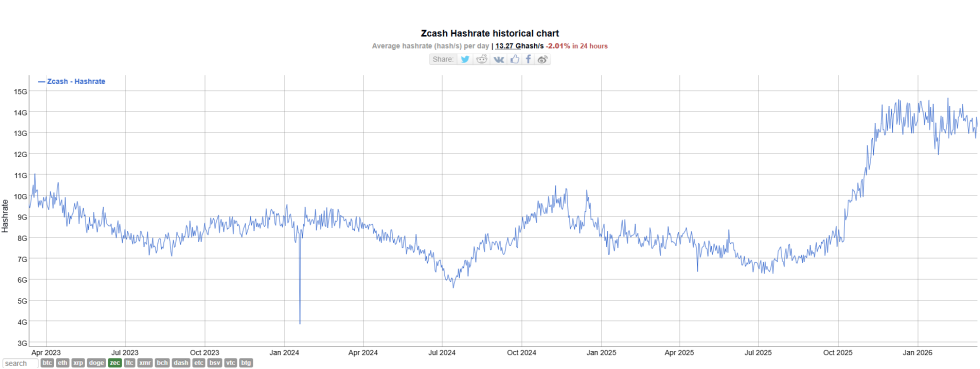
Foundry’s announcement follows a period of unprecedented growth in the Zcash network’s computing power. Data from BitInfoCharts indicates that the ZEC hashrate has experienced a significant surge over the past several months. In October, the total computing power connected to the Zcash blockchain hovered below 8 Gigahashes per second (Ghash/s). By early 2026, that figure has climbed to over 13 Ghash/s, representing a nearly 60% increase in network security.
A rising hashrate is a critical health metric for any Proof-of-Work blockchain. It indicates that more miners are dedicating hardware and electricity to the network, making it increasingly expensive and difficult for a malicious actor to perform a "51% attack." The influx of hashrate suggests that mining hardware manufacturers are continuing to innovate in Equihash-compatible machines and that miners are finding the current ZEC price levels and reward structures profitable.
The entry of a dominant player like Foundry could potentially catalyze further hashrate growth. As the operator of Foundry USA—which at times commands over 30% of the total Bitcoin hashrate—the company brings a massive client base of North American institutional miners. If even a fraction of these miners diversifies their operations into Zcash, the network’s security could reach new historic highs, further legitimizing it in the eyes of risk-averse institutional custodians.

Collaboration with Shielded Labs and the North American Factor
The launch of the Zcash pool is being coordinated with support from Shielded Labs, an independent organization based in Switzerland dedicated to the advancement and support of the Zcash ecosystem. Zooko Wilcox, the founder of Zcash and Chief Product Officer at Shielded Labs, expressed strong support for Foundry’s involvement. Wilcox noted that having a North American-based, enterprise-grade pool is a milestone for the project, providing a level of geographical decentralization and operational transparency that has been lacking.
Foundry’s decision to base its Zcash operations in the United States is significant. In the current regulatory environment, institutions are often hesitant to join mining pools located in jurisdictions with opaque legal frameworks. By offering a U.S.-domiciled pool, Foundry provides a compliant path for publicly traded companies to earn ZEC rewards. This "North American" stamp of approval has been a major factor in Foundry USA’s success in the Bitcoin market, and the company clearly intends to replicate this model for Zcash.
Market Context: ZEC Price Action and Volatility
At the time of the announcement, Zcash (ZEC) was trading at approximately $209. While the asset has seen a general recovery from the depths of the previous bear market, it remains subject to the high volatility characteristic of the privacy coin sector. Over the seven days preceding the announcement, the price of ZEC declined by approximately 11%, a retracement that analysts attribute to broader market cooling and profit-taking following a multi-month rally.
The relationship between mining infrastructure and price is often cyclical. Increased institutional mining support can lead to greater coin distribution among "strong hands" (entities less likely to sell during minor dips), which can eventually lead to price stabilization. Conversely, the commitment of a firm like Foundry—which requires years of planning and capital expenditure—signals a long-term bullish outlook on the asset’s price and utility.
Broader Implications for the Privacy Coin Landscape
Foundry’s expansion into Zcash is more than just a business move; it is a statement on the future of privacy in the digital age. For years, privacy coins have faced a bifurcated path: on one hand, they are championed by privacy advocates and cypherpunks; on the other, they have faced scrutiny from regulators concerned about illicit finance.
However, the "institutional-grade" narrative pushed by Foundry and Shielded Labs suggests a third path: "Compliant Privacy." Zcash’s technology includes features such as "viewing keys," which allow a user to selectively disclose their transaction history to a third party (such as an auditor or tax authority) while keeping it hidden from the general public. This capability is essential for businesses that must satisfy regulatory audits but do not want their trade secrets or vendor payments visible to the entire internet.
By providing the infrastructure for this "compliant privacy" model, Foundry is positioning itself at the intersection of two major trends: the institutionalization of crypto and the growing demand for data sovereignty. If the April 2026 launch is successful, it may pave the way for Foundry to explore other privacy-preserving protocols, potentially expanding its footprint across the entire spectrum of secure digital assets.
Timeline and Future Outlook
Between now and the April 2026 launch, Foundry is expected to undergo a series of beta tests and security audits. The company’s track record with Foundry USA suggests a methodical rollout, prioritizing pool stability and payout accuracy. For the Zcash community, the next year and a half will be a period of preparation, as the network braces for an influx of institutional-grade hashpower.
The long-term impact of this move will likely be measured by the degree of "hashrate migration" from existing pools to Foundry. If Foundry can replicate its Bitcoin success, it could become the dominant force in Zcash mining within months of its launch. While this raises some questions about hashrate centralization, the company’s proponents argue that a highly professional, transparent, and U.S.-regulated pool is a net positive for a network seeking to attract the next wave of global capital.
As the digital asset industry moves toward 2026, the focus will remain on whether other major infrastructure providers follow Foundry’s lead. For now, the announcement stands as a significant vote of confidence in Zcash and a clear indicator that the world’s largest miners are looking far beyond Bitcoin to find the next frontier of institutional growth.