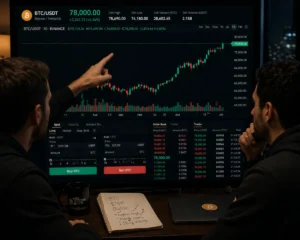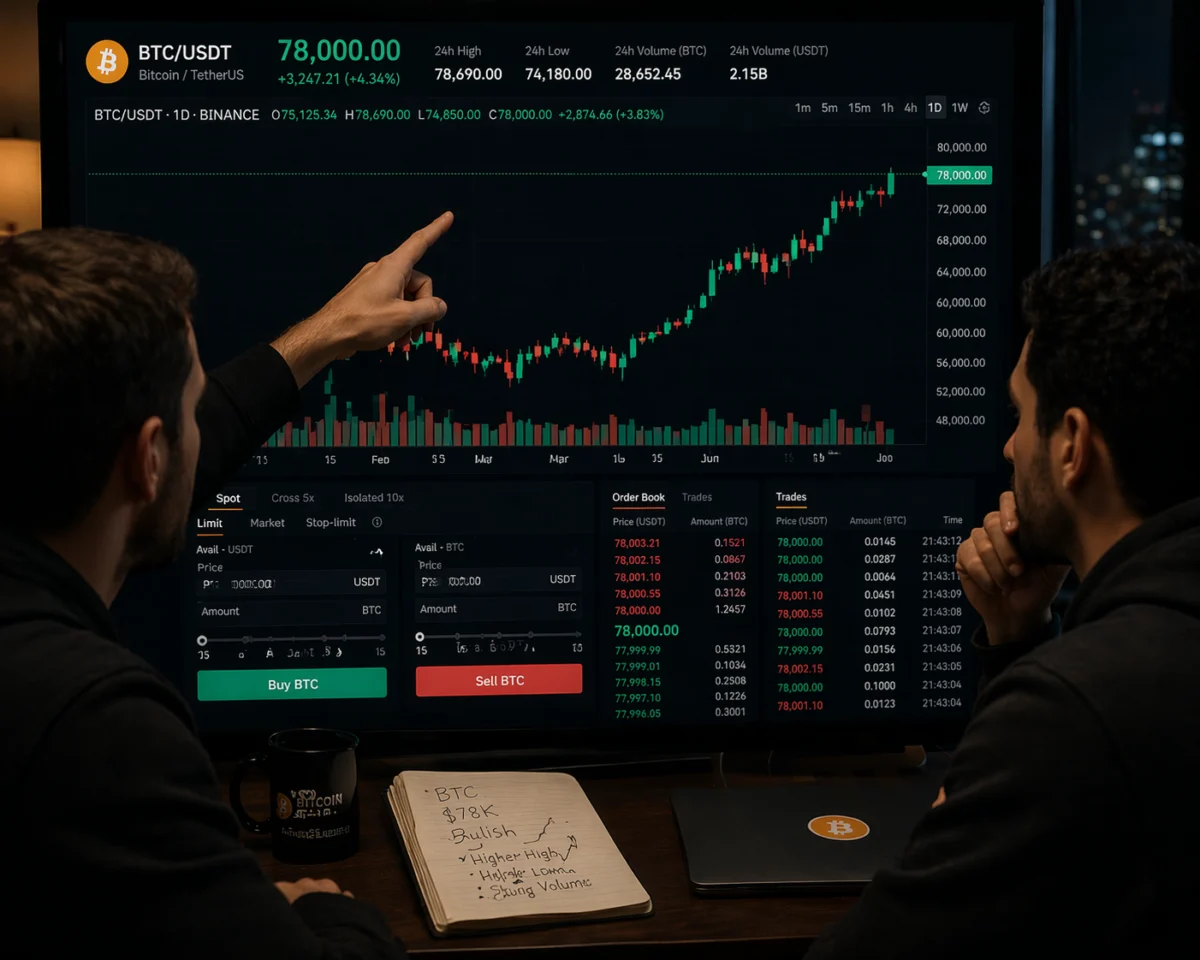
Bitcoin (BTC) extended its upward trajectory on Wednesday, climbing past the $78,000 threshold following a robust 6% price increase over the course of the week. This bullish momentum has propelled the world’s largest cryptocurrency to its highest valuation since early February, as traders react to a confluence of favorable macroeconomic conditions and easing geopolitical tensions. While institutional demand via spot Exchange Traded Funds (ETFs) showed signs of moderation on Tuesday, the broader market sentiment remains decidedly optimistic, supported by significant fiscal maneuvers from the United States Treasury and diplomatic breakthroughs in the Middle East.
The digital asset reached a session high of $78,452, marking a significant recovery and reinforcing its status as a leading indicator of global market liquidity. This price action comes at a critical juncture for the cryptocurrency market, which has been grappling with volatility stemming from high interest rates and international instability. The current rally suggests that investors are increasingly viewing Bitcoin not only as a speculative asset but as a strategic beneficiary of increased dollar liquidity and regional de-escalation.
Geopolitical De-escalation: The Ceasefire Extension
The primary catalyst for the mid-week surge appears to be the extension of a two-week ceasefire involving regional powers and brokered by the United States. Late Tuesday, U.S. President Donald Trump announced that the ceasefire, originally slated to expire on April 22, would be extended. The decision followed a formal request from Pakistan, which is acting as a diplomatic intermediary, to allow more time for Washington to receive a unified proposal from Tehran.
This diplomatic breathing room has significantly lowered the "war premium" that had been weighing on global markets. Although President Trump clarified that the U.S. blockade of Iranian seaports would remain strictly in place until a final agreement is reached, the extension was enough to trigger a broad "risk-on" rally. In such environments, capital typically flows out of safe-haven assets like gold or the U.S. dollar and into equities and cryptocurrencies.
The ceasefire extension has provided a rare moment of stability in a region often characterized by volatility. For Bitcoin, which often reacts sharply to changes in global risk appetite, the news served as a green light for bulls to push the price through previous resistance levels. Analysts note that the geopolitical situation remains fluid, but the avoidance of an immediate escalation has given market participants the confidence to increase their exposure to high-beta assets.
US Treasury Buybacks and the Liquidity Influx
Parallel to the geopolitical developments, the U.S. Treasury Department has introduced a fiscal measure that is expected to significantly bolster market liquidity. The Treasury is poised to execute a $15 billion buyback of its own debt this week, a move that matches the largest buyback operation in the nation’s history.
A debt buyback involves the government purchasing older, less liquid Treasury securities and replacing them with newer, more liquid issues. This process effectively injects cash into the financial system, lowering the pressure on bond yields and increasing the overall supply of available capital. For Bitcoin, which is highly sensitive to the expansion of the M2 money supply and overall global liquidity, this move is a major fundamental driver.
Historically, Bitcoin has performed exceptionally well during periods of "quantitative easing" or similar liquidity-providing operations. As the Treasury buys back debt, the resulting influx of cash often finds its way into risk assets. Market analysts suggest that the $15 billion injection provides a "liquidity floor" for Bitcoin, making it more difficult for bears to drive the price down in the near term. This fiscal support, combined with the current pause in regional hostilities, has created what some traders are calling a "Goldilocks" environment for digital assets.
Institutional Participation and ETF Performance
Despite the record-breaking price levels, institutional demand via spot Bitcoin ETFs showed a marked slowdown on Tuesday. Data indicates that spot Bitcoin ETFs recorded a modest net inflow of $11.84 million, a sharp decline from the $238.37 million seen only twenty-four hours prior.
This deceleration in ETF inflows suggests a degree of institutional caution. Many large-scale investors and fund managers appear to be adopting a "wait-and-see" approach, closely monitoring the progress of the U.S.-Iran peace talks. The discrepancy between the surging spot price and the cooling ETF inflows highlights a tension in the market: while retail and momentum traders are buying the breakout, institutional players are seeking more concrete evidence of long-term geopolitical stability before committing further capital.

However, the fact that inflows remained positive—even at a lower volume—is a testament to the underlying strength of the market. If the peace negotiations yield a unified proposal and the ceasefire transitions into a more permanent diplomatic solution, analysts expect a massive resurgence in institutional buying. Such a scenario could provide the necessary fuel to push Bitcoin toward the psychological milestone of $80,000 and beyond.
Technical Analysis: Resistance and Support Levels
From a technical perspective, the Bitcoin/USD 4-hour chart paints a decidedly bullish picture. The asset is currently trading well above its key moving averages, specifically the 50-day Exponential Moving Average (EMA) at $72,345 and the 100-day EMA at $75,368. These levels now serve as critical support zones in the event of a price correction.
The Relative Strength Index (RSI) remains in constructive territory, hovering near the 65-70 range. While this indicates that the asset is approaching "overbought" levels, it also confirms strong buying pressure and positive momentum. Similarly, the Moving Average Convergence Divergence (MACD) indicator shows a bullish crossover, suggesting that the path of least resistance remains to the upside.
Key levels to watch include:
- Immediate Resistance: The 50% Fibonacci retracement level near $78,962. A sustained break above this could trigger a rapid move to $80,000.
- Major Resistance: The 200-day EMA, currently situated at $82,769, represents the next major target for long-term bulls.
- Immediate Support: The prior channel top at $75,680, followed by the 100-day EMA at $75,368.
- Secondary Support: The 38.2% Fibonacci level at $74,487, which provided a base for the most recent leg of the rally.
Traders are also keeping a close eye on the volume profile. The recent surge to $78,452 was accompanied by moderate to high trading volume, indicating that the move has genuine conviction behind it rather than being a "low-liquidity" spike.
Chronology of Recent Events
To understand the current price action, it is essential to look at the sequence of events leading up to the Wednesday peak:
- April 15-20: Bitcoin trades in a consolidation range between $72,000 and $74,000 as markets weigh the risk of the April 22 ceasefire expiration.
- April 21 (Monday): Institutional demand spikes, with over $238 million flowing into Bitcoin ETFs, signaling an early bet on a peaceful resolution.
- April 22 (Tuesday Morning): The U.S. Treasury confirms the details of its $15 billion buyback plan, providing a macro boost to liquidity-sensitive assets.
- April 22 (Tuesday Evening): President Trump announces the extension of the ceasefire following Pakistan’s diplomatic intervention. Bitcoin immediately breaks through the $76,000 resistance.
- April 23 (Wednesday): Bitcoin hits a high of $78,452. ETF inflows cool to $11.84 million as investors digest the news and wait for further updates from Tehran.
Broader Market Implications and Future Outlook
The current rally in Bitcoin is reflective of a broader shift in the global financial landscape. As traditional fiat currencies face inflationary pressures and governments resort to debt buybacks to manage liquidity, Bitcoin’s fixed supply and decentralized nature become increasingly attractive.
The integration of Bitcoin into the traditional financial system via ETFs has also changed the asset’s "reflexivity." Now, geopolitical events that once had a localized impact on crypto markets are being filtered through the lens of institutional risk management. The cautious inflow data from Tuesday suggests that "smart money" is increasingly treating Bitcoin like a traditional risk asset, requiring clarity on international relations before making large allocations.
Looking ahead, the focus will remain on two fronts: the diplomatic negotiations in Washington and the actual execution of the Treasury’s buyback. If the Treasury successfully injects the promised $15 billion without causing disruptions in the repo market, the resulting liquidity could support a sustained bull run through the second quarter. Conversely, any breakdown in the ceasefire or a "unified proposal" from Tehran that is deemed unacceptable by the U.S. administration could lead to a swift "risk-off" reversal.
In conclusion, Bitcoin’s ascent to $78,000 is a multifaceted event driven by a unique blend of high-stakes diplomacy and aggressive fiscal policy. While technical indicators suggest further upside potential, the modest ETF inflows serve as a reminder that the market remains sensitive to the nuances of international relations. For now, the "bullish bias" remains intact, with the $80,000 mark firmly in the sights of traders worldwide.