

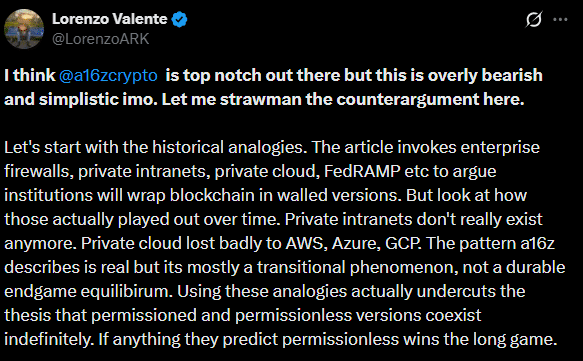
At the heart of the contention lies the question of whether traditional financial institutions are genuinely embracing the ethos of decentralization that underpins DeFi, or merely cherry-picking the underlying blockchain technology for its efficiency benefits within their existing, controlled frameworks. Lorenzo Valente, Director of Crypto Research at Ark Invest, articulated his disagreement with a16z’s perspective, stating, "I think a16z Crypto is top-notch out there, but this is overly bearish and simplistic in my opinion." This statement underscores a significant divide among leading voices in the crypto investment space regarding the trajectory of blockchain adoption by mainstream finance.
a16z’s Thesis: Efficiency Over Decentralization
Andreessen Horowitz, a prominent venture capital firm with substantial investments across the blockchain ecosystem, presented a nuanced, and arguably more cynical, view on TradFi’s engagement with the decentralized paradigm. According to a16z, the narrative of TradFi and DeFi converging into a seamless, decentralized future is a "comforting story" that is "mostly wrong." Their core argument posits that traditional financial players are not driven by an ideological commitment to decentralization but by pragmatic considerations: cost reduction and operational efficiency.
The firm elaborated on this, suggesting that TradFi’s adoption of blockchain is primarily a "compelling COGS story" – a cost of goods sold narrative. Where blockchain technology can enhance existing business processes, streamline operations, or reduce transactional overhead, it will be embraced. This adoption, however, does not signify an embrace of the core tenets of decentralization, such as permissionless access, censorship resistance, or community governance. Instead, it represents a strategic integration of a technological tool within a centralized framework designed to maintain control and regulatory compliance.
To support their argument, a16z cited several key initiatives within the traditional financial sector. They highlighted Circle’s efforts with Arc Chain, a blockchain solution tailored for institutional stablecoin payments, which emphasizes controlled access and specific use cases for corporate clients. Another example was Canton, a network designed to advance privacy features for institutional players involved in tokenization, signaling a preference for private, permissioned environments over public, transparent ledgers. Furthermore, the firm pointed to SWIFT’s ongoing initiatives to advance its blockchain capabilities for tokenization and payments, demonstrating a clear focus on integrating distributed ledger technology into established global financial messaging systems. The conclusion drawn by a16z analysts was stark: "TradFi isn’t adopting DeFi. It’s selectively adopting parts that fit its model." They believe TradFi will extract viable innovations from DeFi and public chains and re-implement them within their controlled, often private, environments.
Ark Invest’s Counter-Argument: The Irresistible Pull of Open Access

Ark Invest, known for its bullish stance on disruptive innovation, presented a more optimistic outlook, emphasizing the inherent advantages and growing traction of public, permissionless blockchains. Lorenzo Valente argued that a16z’s analysis fails to capture the full picture, overlooking significant developments that suggest a deeper embrace of decentralized principles by some corners of TradFi.
Valente specifically pointed to the success of BlackRock’s BUIDL fund, a tokenized treasury money market fund that operates on public blockchains. This initiative, from one of the world’s largest asset managers, represents a significant endorsement of public chain infrastructure for institutional-grade financial products. The BUIDL fund’s choice to leverage a public blockchain platform for its operations challenges the notion that TradFi is exclusively interested in private, permissioned networks. It demonstrates a recognition of the benefits associated with transparency, composability, and broader market access that public chains offer.
Beyond specific institutional products, Valente also underscored the widespread success and adoption of major stablecoins like Tether (USDT) and USD Coin (USDC). These stablecoins, predominantly settled on public blockchains such as Ethereum and Tron, have achieved massive scale and utility, serving as critical infrastructure for both retail and institutional users globally. Valente argued that the market’s continued "voting for open access" through the pervasive use of these public chain-based stablecoins indicates a strong demand for permissionless financial infrastructure. He contended that private chains risk "dying in isolation unless they join permissionless public chains," suggesting that the long-term viability and innovation potential lie with open, interoperable networks.
This sentiment was echoed by Carlos Domingo, CEO of Securitize, a leading tokenization issuer. Domingo articulated a vision where "Private chains or pseudo ones are the intranet and private clouds of this era, a transitional step into a truly open and permissionless innovation model." This perspective positions private blockchains as an interim solution, a necessary stepping stone for traditional institutions to experiment with distributed ledger technology before ultimately migrating towards more open, decentralized architectures. It implies that while TradFi might start with controlled environments, the inherent benefits of public chains—such as network effects, liquidity, and censorship resistance—will eventually drive a broader shift.
The Hybrid Reality: Data Supporting Both Sides
The debate is further complicated by the emerging market data, which presents a more nuanced reality where both a16z and Ark Invest hold valid points depending on the specific application. The financial industry’s engagement with blockchain technology is not monolithic; different segments are adopting different approaches based on their unique needs, regulatory requirements, and risk appetites.
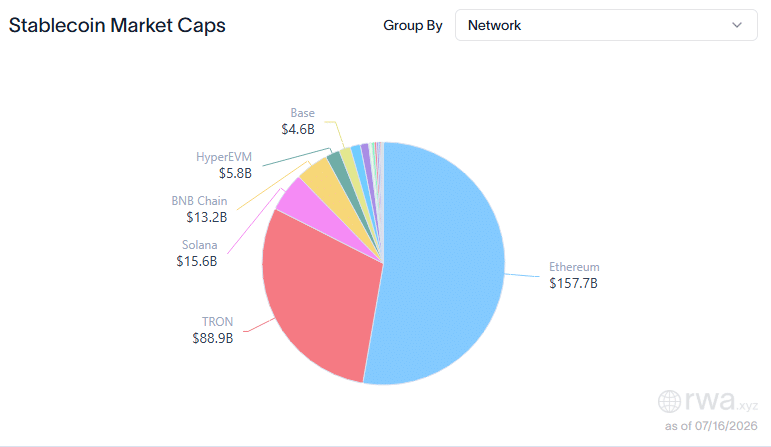
In the realm of stablecoin payments, public chains have indeed demonstrated dominant market share. Data indicates that Ethereum and Tron collectively control nearly 75% of the stablecoin sector. This robust adoption highlights the power of permissionless networks for facilitating fast, efficient, and globally accessible value transfers. The open nature of these blockchains allows for broad participation, fostering liquidity and network effects that are difficult for private, siloed systems to replicate. The ease of integration for various financial services and payment providers, including major players like Mastercard, Stripe, Visa, and PayPal, which have adopted stablecoins, further validates the utility of public chains in this segment. This widespread adoption of stablecoins by mainstream payment giants partly supports a16z’s claim that TradFi is selectively adopting parts that fit its model, but it simultaneously reinforces Ark Invest’s argument about the market’s preference for open access, as many of these stablecoins primarily reside on public ledgers.
However, the landscape for tokenized assets presents a different picture. While the tokenization of real-world assets (RWAs) is gaining significant traction, corporate chains currently hold a substantial lead. Networks like Canton and Provenance together command an impressive 85% market share in the tokenized assets segment. Ethereum, despite its dominance in stablecoins, comes in third with approximately 4% of this market. This stark contrast suggests that for complex financial instruments, particularly those involving illiquid assets, sophisticated legal frameworks, and stringent regulatory oversight, traditional institutions currently prefer the controlled, permissioned environments offered by corporate blockchains. These private chains allow for greater control over participant identity, transaction privacy, and compliance mechanisms, which are critical for institutional adoption of tokenized securities, real estate, and other high-value assets.
The emergence of various private chains specifically designed for institutional use further underscores this bifurcated approach. Beyond Canton and Provenance, new initiatives like Stripe’s Tempo and Google Cloud Universal Ledger (GCUL) are entering the fray, all primarily eyeing payments and tokenization within controlled ecosystems. These developments indicate a strong institutional preference for solutions that offer bespoke features, enhanced privacy, and a more predictable regulatory environment, at least in the initial phases of adoption.
Broader Implications: The Future of Finance
The ongoing debate between Ark Invest and a16z has profound implications for the future architecture of global finance. It highlights a tension between the transformative potential of truly decentralized systems and the pragmatic, risk-averse nature of established financial institutions.
If a16z’s "TradFi wants blockchain, not DeFi" thesis prevails, the future financial landscape might be characterized by a proliferation of private, permissioned blockchains, often interoperating through complex, bespoke agreements rather than open, standardized protocols. This would likely lead to a more fragmented ecosystem, where efficiency gains are realized within individual corporate silos or tightly controlled consortiums, but the broader benefits of global, permissionless liquidity and composability remain limited. Innovation might be slower, governed by top-down corporate strategies rather than emergent community-driven development.
Conversely, if Ark Invest’s vision of public chain dominance for financial innovation takes hold, we could see a more interconnected and accessible global financial system. Public blockchains offer the potential for unprecedented transparency, auditability, and resilience, reducing counterparty risk and fostering a new era of financial inclusion. The "open access" narrative suggests that the inherent advantages of permissionless innovation – lower barriers to entry, faster development cycles, and superior network effects – will eventually compel TradFi to integrate more deeply with public chains, moving beyond their initial "intranet" phase. This could lead to truly global, real-time markets for a vast array of assets and services, accessible to anyone with an internet connection.
It is also plausible that the future will be a hybrid model, a "multi-chain" or "cross-chain" reality where public and private blockchains coexist and interact. TradFi might continue to leverage private chains for sensitive internal operations and highly regulated assets, while simultaneously utilizing public chains for stablecoin settlements, specific tokenized products, and gaining access to broader liquidity pools. Interoperability solutions will become paramount in such a scenario, allowing value and data to flow securely and efficiently between these disparate environments.
Challenges and Opportunities
The path to either outcome is fraught with challenges. Regulatory uncertainty remains a significant hurdle for widespread DeFi adoption by TradFi. Governments and financial regulators are grappling with how to classify, oversee, and integrate decentralized protocols into existing legal frameworks. The lack of clear guidelines often pushes institutions towards more controlled, private blockchain solutions where compliance can be more readily demonstrated.
Technological integration also poses complexities. Bridging existing legacy systems with new blockchain infrastructure, whether public or private, requires substantial investment in development and infrastructure. Security concerns, scalability issues, and the need for robust oracle solutions further complicate the picture.
Despite these challenges, the opportunities are immense. Blockchain technology, in both its permissioned and permissionless forms, offers the potential for significant improvements in settlement times, cost efficiency, transparency, and risk management across the financial sector. The tokenization of assets could unlock vast amounts of illiquid capital, making a wider range of assets tradable and accessible.
In conclusion, the debate between Ark Invest and a16z reflects a critical juncture in the evolution of finance. While a16z rightly identifies TradFi’s initial cautious approach, prioritizing efficiency within controlled environments, Ark Invest highlights the undeniable pull of open, permissionless innovation, particularly in areas like stablecoin payments and the burgeoning real-world asset tokenization space. The current data suggests that both perspectives hold merit, indicating a dynamic and evolving landscape where TradFi is indeed selective in its adoption, but where the importance and utility of public chains cannot be overlooked. The ultimate convergence of TradFi and DeFi may not be a simple absorption of one by the other, but rather a complex, iterative process of integration, adaptation, and co-evolution, leading to a more efficient, interconnected, and potentially more decentralized global financial system.
