
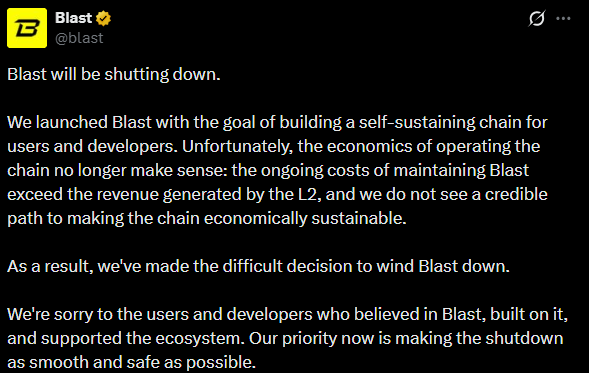
The decentralized finance landscape is facing another major contraction as Blast, a prominent Ethereum Layer 2 scaling network, officially announced that it will shut down its operations by the end of October. Citing insurmountable financial pressures, unrelenting operational maintenance costs, and a lack of a clear trajectory toward economic sustainability, the network’s leadership team shared the decision via a public statement on the social media platform X. The abrupt closure marks a dramatic fall for a protocol that once commanded billions of dollars in total value locked (TVL) and highlights a broader, unforgiving trend of consolidation and shutdowns affecting crypto platforms throughout 2026.
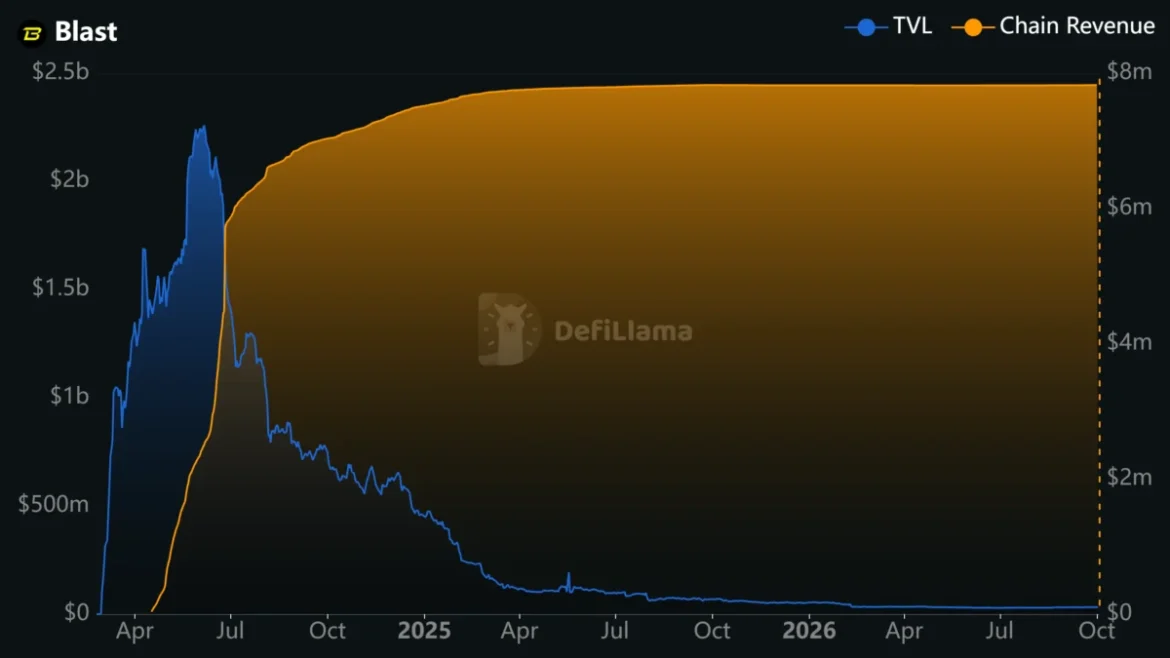
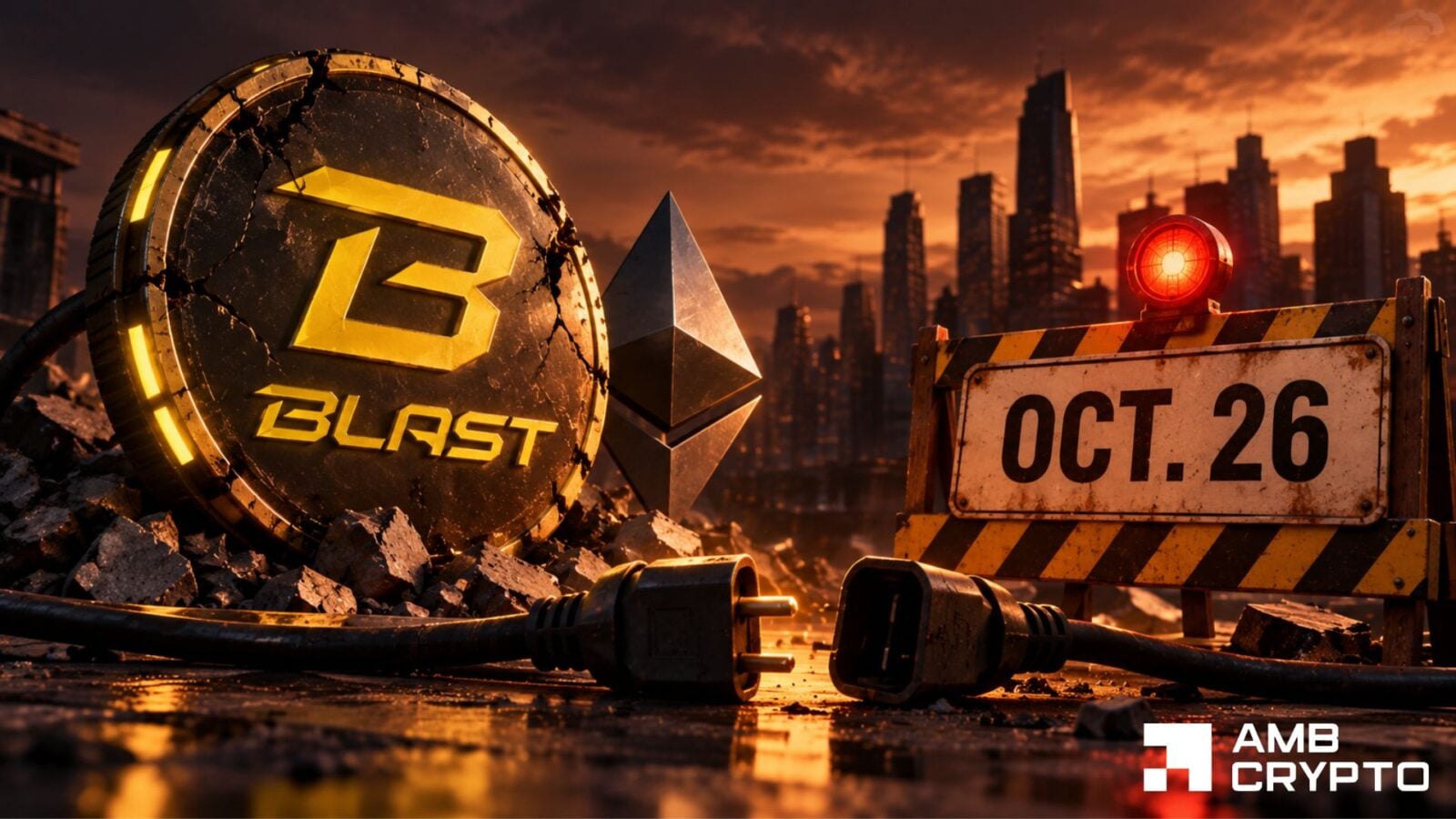
According to the core team, the ongoing expenditures required to keep the Layer 2 infrastructure secure, functional, and competitive consistently exceeded the protocol’s declining revenues. With flat cumulative revenue generation persisting since early 2025, the team concluded that continuing operations was no longer viable. Users have been strongly advised to withdraw their assets from the Blast network back to the Ethereum mainnet prior to the final cutoff deadline on October 26. For assets currently locked in staking protocols such as Lido, the team noted that a mandatory one-week processing period will be required to successfully unstake and make those funds fully accessible for withdrawal.
The announcement has triggered an immediate and fierce wave of backlash from the crypto community, investors, and industry analysts, many of whom have leveled severe accusations of capital extraction and structural neglect against the project’s founder, Tieshun Roquerre, widely known by his online pseudonym "Pacman."
The Rise and Fall of a Multibillion-Dollar L2 Protocol
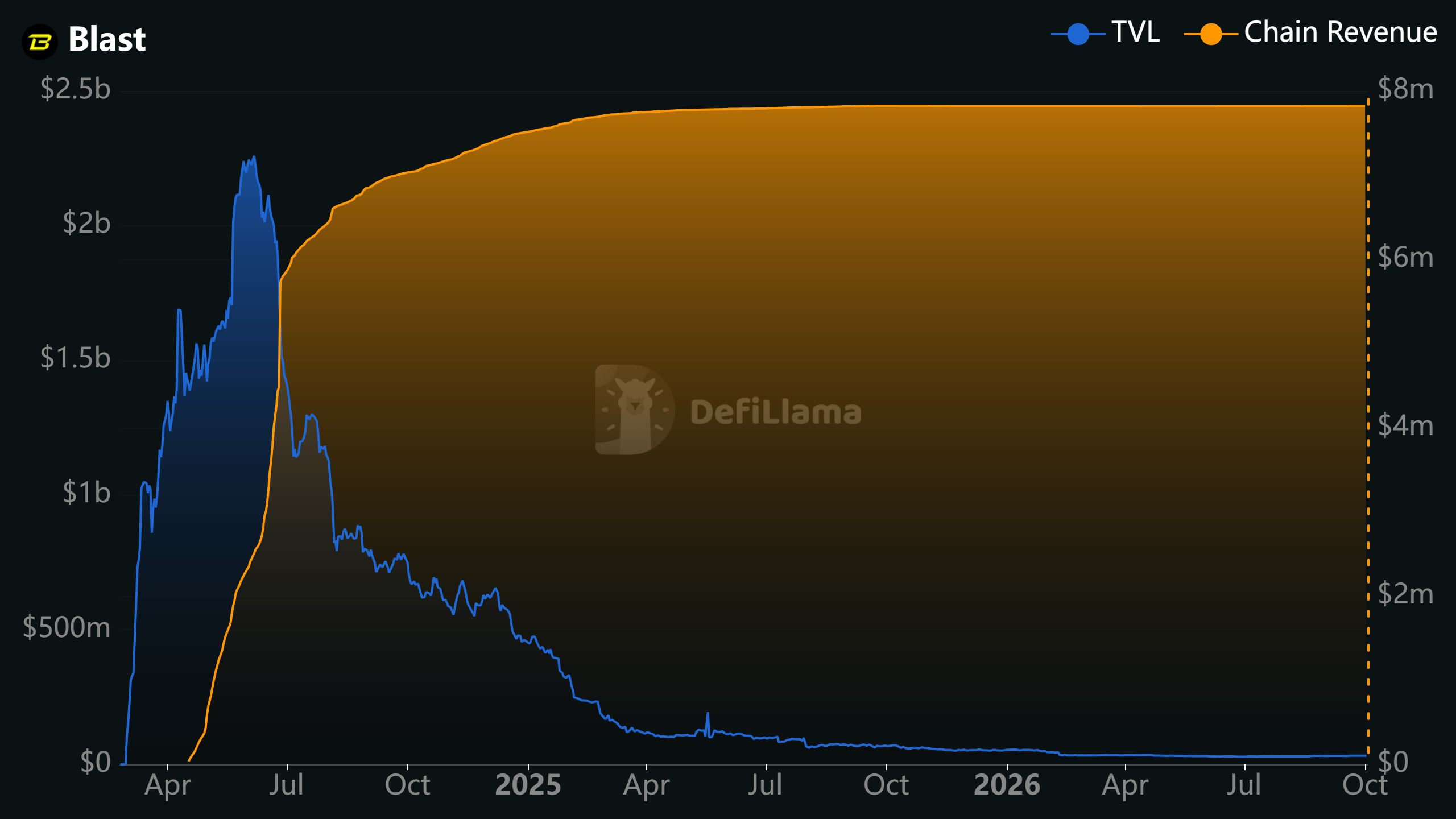
To understand the weight of Blast’s impending closure, one must examine its meteoric rise in mid-2024. Blast entered the market with substantial hype, aggressively capturing market share through innovative yield-bearing mechanisms that attracted immense amounts of capital. At its peak, the protocol boasted a staggering Total Value Locked (TVL) of approximately $2.4 billion, positioning itself as a formidable competitor in the crowded Ethereum scaling ecosystem.
However, the enthusiasm surrounding the platform was short-lived. Over the subsequent two years, the network suffered a catastrophic hemorrhage of capital and user engagement. On-chain metrics from platforms like DeFiLlama indicate that Blast’s TVL plummeted by more than 90%, shrinking from its multi-billion-dollar highs down to a meager $32 million by late 2026.
Compounding the problem was a complete stagnation in revenue generation. Financial data reveals that the chain experienced flat cumulative revenues beginning in early 2025, effectively meaning that the protocol generated virtually no meaningful income for nearly two years. As maintenance expenses mounted while revenues remained stagnant, the economic model collapsed under its own weight, culminating in the October shutdown announcement.
Chronology of the Closure and User Withdrawal Procedures
The wind-down process has strict timelines that require immediate action from retail and institutional participants alike. The operational shutdown schedule is structured as follows:
- Early October 2026: The Blast core team officially announces the cessation of network operations, citing unsustainable maintenance costs.
- Mid-October 2026: Users are instructed to begin migrating their funds from the Blast L2 network back to the Ethereum mainnet using available bridge interfaces. Assets staked in third-party protocols like Lido begin their mandatory multi-day unstaking periods.
- October 26, 2026: The final deadline for streamlined network withdrawals. After this date, the user-facing application layers and dedicated bridge interfaces may no longer be actively maintained.
- Post-October 26, 2026: Any funds left stranded on the network will require users to interact directly with the underlying Ethereum smart contracts to recover their assets.
Industry experts have expressed concern over the post-deadline withdrawal process. Pulling funds directly from underlying smart contracts without the user-friendly interface of a dedicated L2 application can be exceptionally complex, highly technical, and prone to user error—posing a significant risk to average retail participants who may miss the October 26 cutoff.
Leadership Response and Public Reactions
Reacting to the closure, founder Tieshun "Pacman" Roquerre expressed regret over the network’s inability to secure a permanent foothold in the scaling ecosystem. In his public statement, Roquerre noted that he was disappointed the chain could not achieve long-term sustainability, while extending gratitude to the developers, users, and community members who contributed to the platform during its operational lifespan.
Despite these conciliatory remarks, the crypto community has reacted with profound hostility, accusing the founding team of engineering an intentional "slow rug pull." Critics have drawn parallels between the trajectory of Blast and the lifecycle of Blur, the NFT marketplace also associated with Roquerre, suggesting that the primary objective of the protocols was token generation and initial capital extraction rather than sustainable technological development.
The native token associated with the ecosystem has mirrored the network’s fundamental decay. After achieving a peak valuation of approximately $0.80 in late 2024, the token has crashed by roughly 98%, trading at a dismal $0.02 by October 2026.
Prominent venture capitalists and industry figures did not hold back their criticism. Mike Dudas, founder of venture capital firm 6th Man Ventures, took to social media to excoriate the project’s leadership. Dudas publicly labeled Roquerre as "one of the greatest extractors of all time between Blast and Blur," criticizing him for cutting and running without facing direct accountability from the investors who originally backed the venture.
Other community members echoed these sentiments, with numerous commentators arguing that the network offered little genuine utility beyond speculative yield-farming incentives. One widely shared critique asserted that the project’s architecture was never designed to survive past its initial token generation event (TGE), once insiders and early participants had successfully liquidated their holdings.
Broader Implications for the Ethereum Layer 2 Ecosystem
The collapse of Blast is not an isolated incident within the broader digital asset economy of 2026. The year has been characterized by intense macro-environmental pressures, fierce market competition, and regulatory compliance hurdles that have forced numerous cryptocurrency platforms to shutter operations. Exchanges and infrastructure providers such as BitMart, BitMEX, and CoinEx have similarly announced wind-downs or significant retrenchments over the course of the year, driven by shrinking profit margins and unsustainable overhead costs.
For the Ethereum Layer 2 ecosystem, Blast’s failure serves as a cautionary tale regarding the realities of infrastructure monetization. While the modular blockchain thesis and L2-centric scaling roadmap have successfully reduced transaction fees and increased throughput for Ethereum, the market is demonstrating that liquidity and user attention are fleeting without genuine, organic application demand.
As the October 26 deadline approaches, the immediate priority for Blast users remains the secure extraction of their capital back to the Ethereum mainnet. Meanwhile, the broader crypto industry is left to reckon with the governance, accountability, and economic viability of heavily venture-backed infrastructure projects that fail to transition from short-term speculative hype to long-term operational sustainability.
