
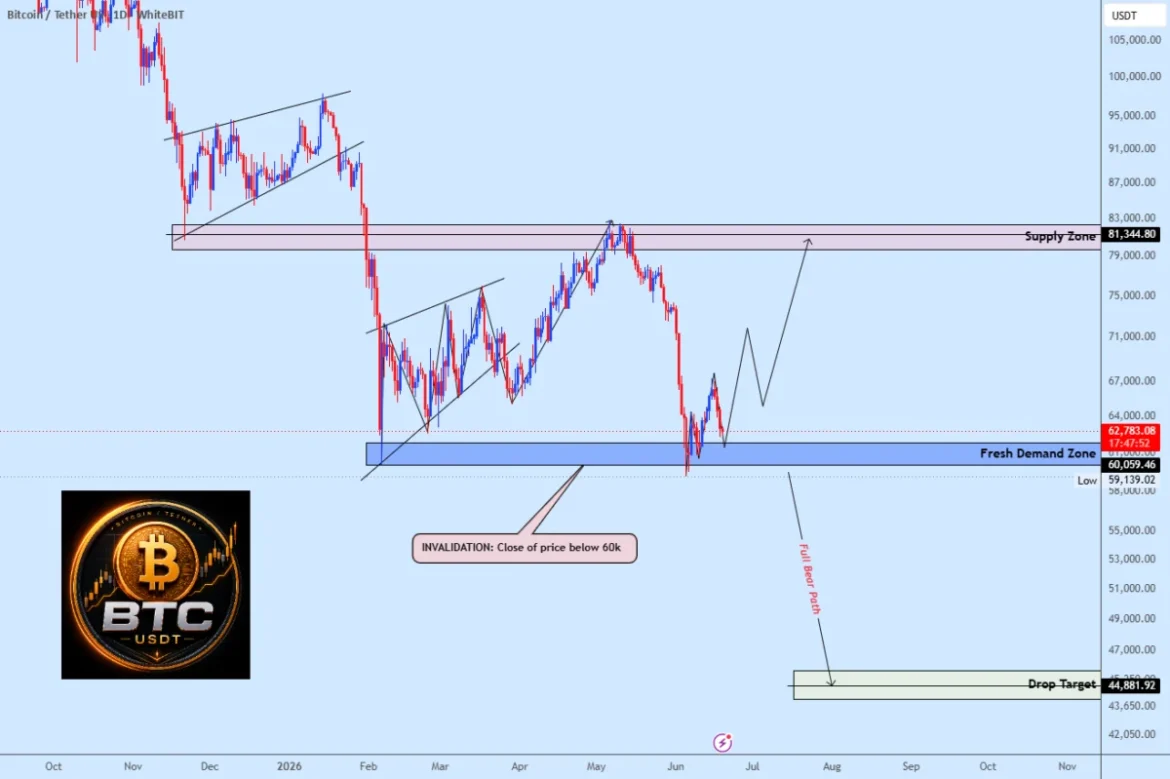
Bitcoin is once again testing a critical juncture around the $60,000 mark, a level widely considered to be both psychologically significant and technically pivotal for its short-to-medium term trajectory. In a recent analysis published on June 20 via TradingView, independent analyst weslad highlighted that the BTC/USDT trading pair has arrived at a crucial demand zone. This area, where buying interest has historically emerged, is now positioned as a potential determinant of Bitcoin’s next major price movement. The analyst’s assessment emphasizes that while buyers have previously shown their hand in this region, a decisive failure to hold this level could trigger substantial downside pressure.
The Significance of the $60,000 Demand Zone
The $60,000 level represents more than just a round number; it embodies a confluence of technical indicators and market psychology. For Bitcoin, this price point has acted as a support level in previous market cycles, attracting a significant influx of buyers eager to capitalize on perceived value. This renewed interest in the $60,000 zone suggests a potential battleground where bullish sentiment will either solidify and propel the asset higher, or bearish forces will overwhelm it, leading to a significant correction.
Weslad’s analysis, detailed in a TradingView idea titled "Bitcoin at the Edge: Hold 60K or Face a Major Breakdown," posits that as long as Bitcoin can maintain its footing within this current demand zone, there remains a strong probability of a recovery towards the $81,000 supply area. This projected upward movement would signify a return to the price levels preceding the recent downturn and could potentially lead to a significant liquidity grab by opportunistic buyers. The concept of liquidity grabs is central to many technical analyses, wherein large price swings can trigger automated buy or sell orders (stop-losses) at key levels, amplifying the initial price movement. In this scenario, a successful defense of $60,000 could liquidate short positions and fuel a rally.
Historical Context: The Resilience of $60,000
To understand the current significance of the $60,000 level, it is essential to recall Bitcoin’s price history. The cryptocurrency has a well-documented history of experiencing sharp corrections followed by robust recoveries, often finding support at psychologically important round numbers. In late 2021, Bitcoin surged to all-time highs above $69,000, only to enter a prolonged bear market that saw prices plummet to lows around $15,000 in late 2022. During this period, levels like $20,000 and $30,000 acted as crucial psychological and technical support.
The subsequent bull run in 2023 and early 2024 saw Bitcoin reclaim and surpass its previous all-time highs, briefly touching $73,738 in March 2024. This rally was largely fueled by the approval of spot Bitcoin ETFs in the United States, which brought a new wave of institutional and retail investment into the asset class. However, as is typical with volatile assets like Bitcoin, the ascent was not linear, and periods of consolidation and correction followed. The $60,000 mark has, in recent months, served as a critical pivot, acting as both a ceiling during periods of decline and a floor during periods of consolidation before the latest push towards new highs and subsequent pullback.
The current test of $60,000 comes after a period of heightened volatility and profit-taking following the March rally. Investors and traders are keenly observing this level to gauge the underlying strength of the market and the conviction of buyers. The fact that Bitcoin has revisited this zone suggests that previous demand was significant, but the question remains whether that demand is still active and sufficient to absorb potential selling pressure.

The Peril of Breaking Below $60,000
Conversely, the warning issued by weslad is equally stark. The analyst explicitly identifies $60,000 as a critical "line in the sand" for bullish investors. A decisive breach and sustained close below this price level would, according to this analysis, invalidate the current optimistic outlook for Bitcoin. Such a breakdown would not only signal a loss of immediate buying support but could also trigger a cascade of sell orders as stop-loss mechanisms are activated. This, in turn, could lead to a more significant and potentially deeper market correction.
The implications of a breakdown below $60,000 extend beyond technical chart patterns. A widely watched support level failing can have a profound impact on market sentiment. When a significant number of traders are positioned with the expectation that a certain level will hold, its failure can lead to panic selling, a rapid shift in sentiment from bullish to bearish, and a re-evaluation of future price targets. For bulls, holding $60,000 offers a tangible argument that the recent price decline has reached an exhaustion point, providing a foundation for renewed upward momentum.
The Path to Recovery: Earning the Upside
While the $81,000 price target represents an attractive potential upside, Bitcoin must first demonstrate its ability to recover from its current position. The bullish case hinges on several factors. Firstly, bulls must successfully defend the $60,000 demand zone, preventing a decisive breakdown. This involves absorbing selling pressure and ideally seeing a reversal pattern emerge from this support level.
Secondly, after defending the immediate support, Bitcoin would need to reclaim nearby resistance levels. These are price points where selling pressure has previously emerged, and their successful re-conquest would signal increasing buying conviction. The process of reclaiming resistance levels often involves periods of consolidation and testing, as buyers seek to overcome the initial selling reactions.
Most importantly, Bitcoin needs to exhibit signs that demand is robust enough to transform a defensive reaction into a genuine trend reversal. This means not just holding support but showing consistent buying pressure that pushes prices higher, breaks through resistance, and potentially establishes a new upward trajectory. Without these confirmations, the current situation remains a high-stakes "binary support test."
Broader Market Implications and Expert Perspectives
The current price action of Bitcoin has significant implications for the broader cryptocurrency market. As the largest and most influential digital asset, Bitcoin’s price movements often dictate the trend for altcoins. A successful defense of $60,000 could inject renewed optimism into the altcoin market, potentially triggering rallies in other digital assets. Conversely, a breakdown could lead to widespread sell-offs across the crypto landscape.
Industry analysts, while often differing in their specific price targets and methodologies, generally agree on the importance of key support and resistance levels. For instance, the approval of spot Bitcoin ETFs by the U.S. Securities and Exchange Commission (SEC) in January 2024 marked a significant milestone, opening the doors for traditional financial institutions to invest in Bitcoin. This influx of institutional capital has been cited as a primary driver of the recent bull market. However, the performance of these ETFs, including their net inflows and outflows, is also closely monitored as an indicator of institutional sentiment. Recent data from various financial analytics firms show periods of net inflows, interspersed with days of outflows, reflecting the dynamic nature of institutional interest.

For example, data from platforms like CoinShares has consistently tracked institutional investment flows into digital asset products, including Bitcoin. In the weeks leading up to the current $60,000 test, reports indicated a cooling of inflows compared to the initial surge post-ETF approval, a trend that often precedes periods of price consolidation or correction. The current price action will be crucial in determining whether this cooling is a temporary pause or a precursor to a more significant trend change.
Moreover, macroeconomic factors continue to play a role in Bitcoin’s price. Inflationary pressures, interest rate policies set by central banks like the Federal Reserve, and global geopolitical events can all influence investor appetite for risk assets like Bitcoin. While Bitcoin is often touted as an inflation hedge, its correlation with traditional markets, particularly technology stocks, has been observed during periods of economic uncertainty. Therefore, the ongoing economic landscape remains a critical backdrop against which Bitcoin’s price movements are interpreted.
The Road Ahead: Awaiting Confirmation
Until definitive confirmation of a sustained trend emerges, the market remains in a state of cautious observation. The setup at $60,000 is best understood as a critical inflection point. Holding this zone would provide a strong bullish signal, suggesting that the recent price dip was a healthy correction within a larger upward trend. This scenario would likely embolden buyers and set the stage for a potential retest of previous highs and a move towards the $81,000 target identified by weslad.
However, a decisive failure to hold $60,000 would significantly alter the market’s narrative. It would suggest that the selling pressure is more potent than anticipated and that a deeper correction is on the horizon. In such an event, traders would likely recalibrate their expectations, and the focus would shift to identifying subsequent support levels, which could be significantly lower.
The analysis by weslad, grounded in technical charting and market dynamics, underscores the importance of this specific price level. The coming days and weeks will be crucial in determining whether Bitcoin can muster the buying power necessary to defend its position and reignite bullish momentum, or if it succumbs to selling pressure, ushering in a period of further downside. The market is, in essence, waiting for Bitcoin to make its next decisive move, with $60,000 serving as the pivotal battleground.
This report is based on information from TradingView analyst weslad and their analysis of the BTCUSDT trading pair. The article was written by the News Desk and edited by Samuel Rae.
