
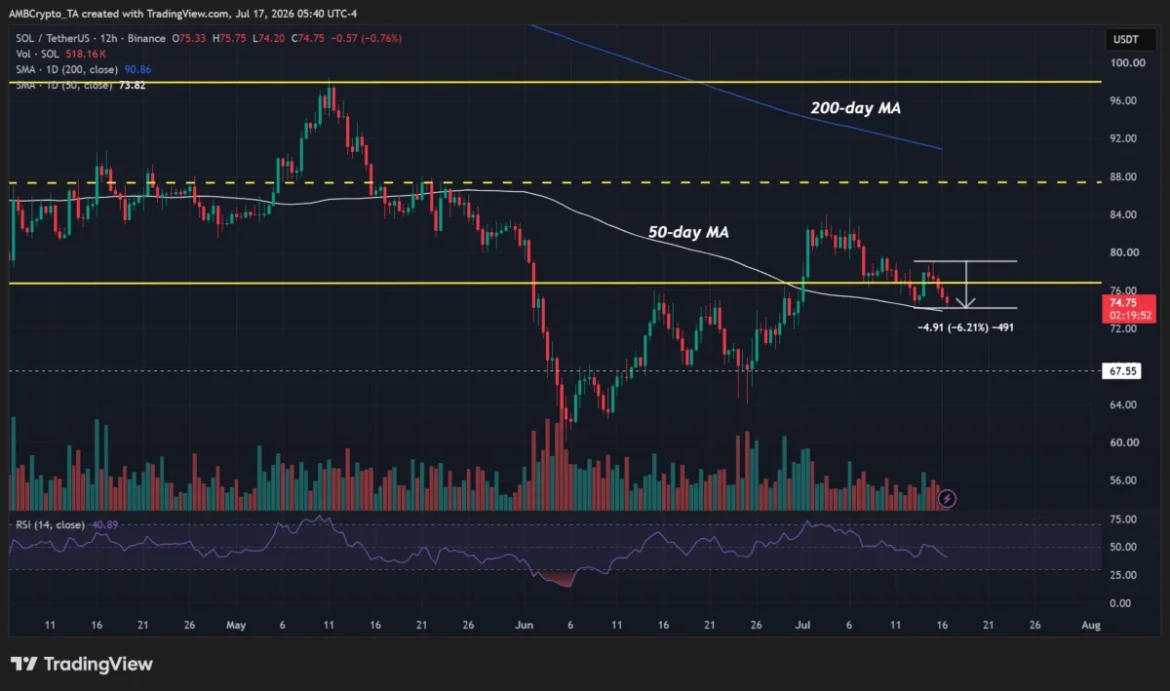
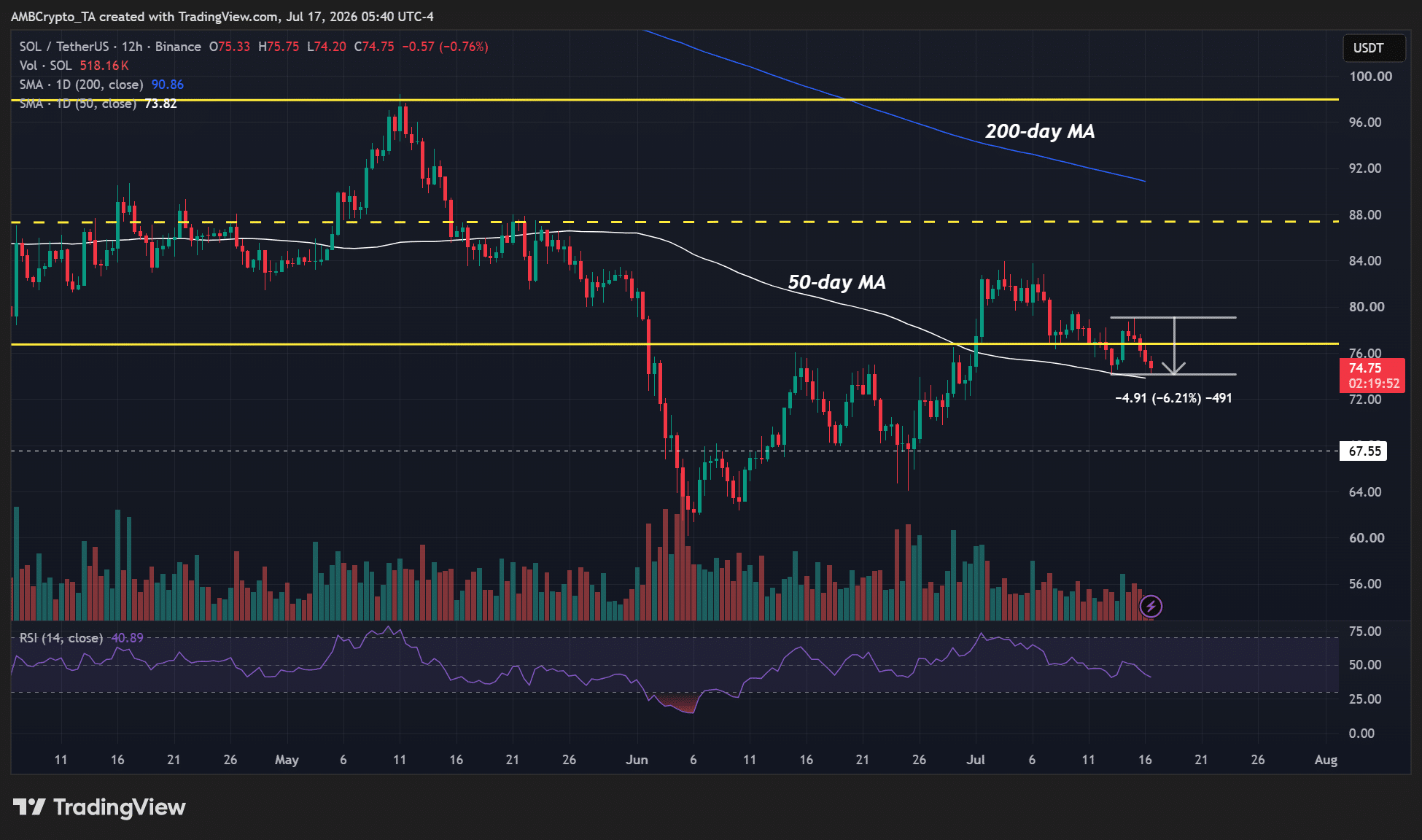
Solana [SOL] experienced a notable pullback on Friday, July 17th, surrendering gains accumulated earlier in the week. This downturn coincided with a broader market correction, as Bitcoin (BTC) slipped below the significant psychological and technical threshold of $63,000. As of the latest reporting, SOL was trading at approximately $74.8, marking a 6% decrease from its weekly high of $79. However, the cryptocurrency’s price action appears to be retesting a critical short-term support level at its 50-day Moving Average (MA). This dynamic support has historically acted as a floor for SOL throughout July, preventing deeper declines. Analysts suggest that a repetition of this trend could pave the way for a relief rally, potentially originating from either the 50-day MA or the $74 price point. Should this recovery materialize, immediate upside targets are projected at $80, $84, and potentially the mid-range level of $88, representing an 8% to 18% increase from current valuations. Conversely, a decisive breach below the 50-day MA by bearish forces would invalidate this optimistic outlook, raising the possibility of another descent below the $70 mark.
Market Headwinds and Solana’s Resilience
The cryptocurrency market, particularly the altcoin sector, often exhibits a strong correlation with Bitcoin’s price movements. The recent decline below $63,000 for BTC signals a shift in market sentiment, potentially influenced by a confluence of macroeconomic factors and profit-taking following recent rallies. For Solana, a blockchain platform known for its high throughput and low transaction costs, maintaining its support levels is crucial for sustaining investor confidence and fostering continued development. The 50-day Moving Average has emerged as a key technical indicator for SOL, demonstrating its ability to absorb selling pressure in the current month. This resilience suggests that despite broader market volatility, there is underlying demand for SOL at these price levels.
The Morgan Stanley Effect: A New Catalyst for Solana?
A significant development potentially poised to influence Solana’s trajectory in the coming days is the recent strategic move by financial giant Morgan Stanley. On Thursday, July 16th, the institution officially activated spot trading for Solana [SOL], alongside Bitcoin and Ethereum, through its ETRADE platform. This expansion of digital asset offerings marks a considerable step forward in integrating cryptocurrencies into mainstream financial services. Chad Turner, Head of Morgan Stanley Wealth Management Platforms, articulated the firm’s commitment to this evolving landscape, stating, "With the rollout of crypto trading on ETRADE, we’re advancing our digital assets strategy and bringing new capabilities to clients in an integrated way."
This decision by Morgan Stanley is particularly noteworthy given the evolving stance of traditional financial institutions towards digital assets. While other major players like Charles Schwab and Fidelity have also embraced spot crypto trading, Morgan Stanley’s inclusion of Solana sets it apart. Currently, the aforementioned institutions primarily support Bitcoin and Ethereum, making Morgan Stanley’s broader offering a potential differentiator and a significant endorsement for the Solana ecosystem. The implications of this move are being closely watched, as it could introduce a substantial new pool of capital and a broader investor base to SOL. The extent to which this institutional adoption translates into increased demand and sustained price appreciation for Solana remains a key question for market participants.

Broader Institutional Adoption and its Ripple Effects
The trend of major financial institutions incorporating cryptocurrency trading into their offerings is a testament to the growing maturity and acceptance of digital assets. Morgan Stanley’s proactive stance, especially its inclusion of Solana, can be interpreted as a signal of confidence in the long-term viability and technological advancements of the Solana blockchain. This move not only provides existing Solana holders with more avenues for trading but also potentially attracts new investors who may have previously been hesitant due to limited accessibility through traditional financial channels. The accessibility and integration offered by platforms like E*TRADE can significantly lower the barrier to entry for a wider demographic of investors.
The broader context of institutional adoption is crucial. As more banks and brokerage firms follow suit, the overall liquidity and market depth for cryptocurrencies are expected to increase. This enhanced liquidity can lead to more stable price action and reduced volatility over time. For Solana, being among the first cryptocurrencies to gain widespread institutional trading support beyond Bitcoin and Ethereum positions it favorably in the competitive digital asset landscape. This can foster a virtuous cycle, where increased institutional interest leads to greater retail adoption, further development, and enhanced network effects for the Solana ecosystem.
ETF Inflows Offer Glimmers of Hope
Adding another layer of potential positive sentiment, U.S. spot Exchange Traded Funds (ETFs) experienced a positive daily net inflow of $1.66 million on Thursday, July 16th. This inflow broke a week-long trend of zero or negative outflows, suggesting a potential resurgence of investor interest in the cryptocurrency market. If these inflows continue to be sustainable, they could provide the necessary support for SOL to defend its $74 level and initiate a recovery. The performance of spot ETFs has become a significant barometer of market sentiment and capital flow, particularly for the larger cryptocurrencies. A sustained positive trend in ETF inflows could signal a broader market recovery, which would likely benefit Solana.
Historically, periods of increased ETF inflows have been associated with upward price momentum for the underlying assets. For Solana, a continuation of this trend could not only bolster its price but also reinforce the narrative of its growing importance within the digital asset ecosystem. The correlation between ETF performance and the broader crypto market is well-established, and any positive momentum generated by these investment vehicles could have a ripple effect across various altcoins, including Solana.
Accumulation Trends and Future Outlook
Data analysis reveals a consistent pattern of accumulation for Solana in the first half of July and over the past 30 days. This suggests that despite short-term price fluctuations, investors have been actively acquiring SOL, indicating a belief in its future prospects. This underlying accumulation trend is a positive sign, as it suggests robust demand that could help cushion the impact of broader market downturns.
However, the cryptocurrency market remains susceptible to external shocks. Any exacerbation of macroeconomic or geopolitical uncertainties in the coming days could trigger a broader de-risking sentiment, potentially leading to further downward pressure on SOL and other risk assets. Investors are closely monitoring global economic indicators, central bank policies, and geopolitical developments, as these factors can significantly influence market sentiment and capital allocation.
Technical Analysis and Key Levels to Watch
From a technical standpoint, the retest of the 50-day Moving Average at approximately $74 is a critical juncture for Solana. This level has proven to be a significant support zone throughout July, and its ability to hold will be a key determinant of the near-term price action. A bounce from this level could confirm the short-term bullish sentiment and open the door for a move towards the aforementioned upside targets of $80, $84, and $88.
Conversely, a breakdown below the 50-day MA would signal a shift in momentum to the downside. In such a scenario, traders would likely look to the next significant support level, which could be below $70. This would indicate a more pronounced correction, potentially influenced by broader market weakness or specific negative catalysts affecting Solana. The Relative Strength Index (RSI), a momentum oscillator, will also be closely watched for signs of overbought or oversold conditions, which can provide further clues about potential price reversals.
The volume of trading activity accompanying any price movements will also be crucial. An increase in volume on upswings would validate bullish sentiment, while increased volume on downswings would confirm bearish conviction. Traders and analysts will be scrutinizing these on-chain and technical indicators to gauge the prevailing market sentiment and identify potential trading opportunities.
Conclusion
Solana finds itself at a pivotal moment, navigating the choppy waters of a cryptocurrency market influenced by Bitcoin’s performance and broader economic sentiment. The recent pullback, while concerning, has brought SOL to a technically significant support level. The inclusion of Solana in Morgan Stanley’s expanded crypto trading offerings presents a novel and potentially powerful catalyst, introducing a new dimension to its market dynamics. Coupled with positive ETF inflows and ongoing accumulation trends, these factors offer a degree of optimism for a potential recovery. However, the cryptocurrency market’s inherent volatility and susceptibility to external economic and geopolitical events mean that caution remains warranted. The coming days will be critical in determining whether Solana can successfully defend its support levels, capitalize on institutional interest, and resume its upward trajectory, or if it will succumb to broader market pressures. The interplay between technical indicators, market sentiment, and the tangible impact of institutional adoption will shape Solana’s price action in the near term.
