

The Regulatory Paradigm Shift
The fundamental tension in the current crypto market arises from the conflict between financial privacy and the state’s mandate for oversight. For years, proponents of privacy coins like Zcash (ZEC) and Monero (XMR) argued that financial privacy is an inherent human right in the digital age. However, the regulatory environment under the current U.S. administration, led by President Donald Trump and his designated "crypto czar" David Sacks, has moved toward a more interventionist framework.
The administration’s policy objective is clear: to integrate digital assets into the existing global financial architecture by enforcing rigorous Know-Your-Customer (KYC) and AML protocols. While this move aims to attract institutional capital by reducing the illicit use of crypto, it simultaneously undermines the core value proposition of privacy coins. When a coin’s primary utility—anonymity—is rendered incompatible with federal compliance requirements, exchanges are left with little choice but to delist these assets to avoid punitive legal actions. This is not merely a localized issue; it is a global trend that has begun to manifest in jurisdictions ranging from the United States to India, creating a cascading effect on liquidity and market sentiment.

Chronology of the Decline
The trajectory of privacy coins over the past 18 months has been one of extreme volatility, shifting from a period of high investor confidence to a state of near-total regulatory siege.
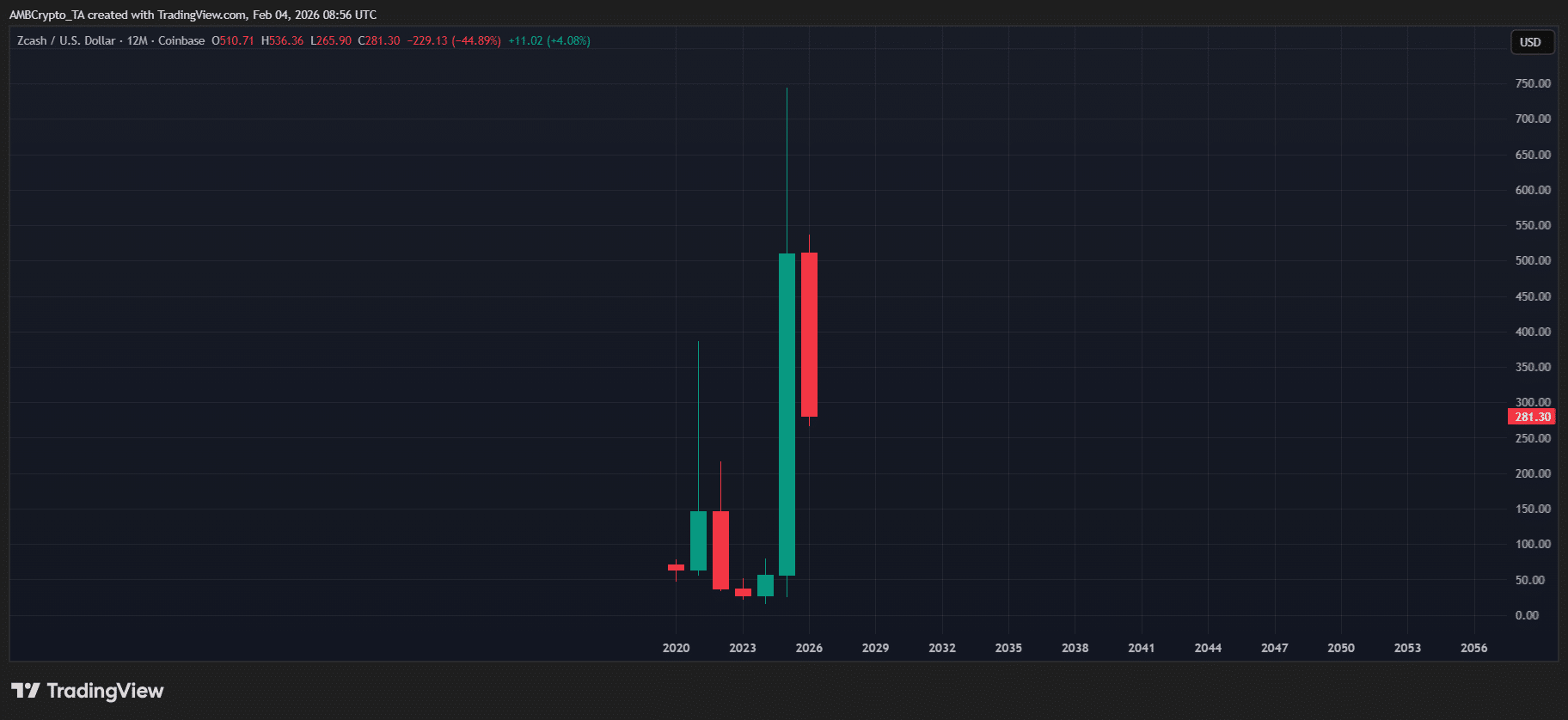
- Q1–Q4 2025: The Growth Phase. During the 2025 market cycle, privacy coins experienced a period of significant growth. Zcash (ZEC), for instance, saw an approximate 800% rally as institutional and retail investors sought hedging tools against broader market instability. During this time, privacy-focused assets were viewed as the "fortress" of the crypto world.
- January 2026: The Regulatory Pivot. Following the announcement of new federal guidelines regarding stablecoin rewards and stricter AML enforcement, the market began to sour on assets that lacked transparent audit trails.
- Early February 2026: The Delisting Wave. Major exchanges, facing pressure from international regulators and the U.S. Treasury, initiated a systematic delisting of privacy-centric tokens. India’s domestic exchanges led the charge, citing compliance hurdles as the primary driver for removing ZEC and similar assets from their platforms.
- Present Day: The market is currently witnessing a massive capital flight. Monero (XMR), the sector’s leader by market capitalization, has shed over $1 billion in value within a single week, signaling that large-scale holders are reallocating assets toward more compliant, transparent blockchains like Bitcoin and Ethereum.
Data Analysis: The Impact on Market Capitalization
The market data paints a stark picture of the current state of privacy-focused assets. As of February 2026, Zcash has experienced a drawdown of approximately 45% from its recent cycle highs. This decline is not isolated to price action alone; it represents a fundamental degradation of the asset’s utility within the ecosystem. When an asset is removed from major liquidity providers, its "price discovery" mechanism is broken.
Monero’s performance has been equally concerning. The drop in its market cap back to Q4 2025 levels serves as a barometer for the broader sector. Technical indicators suggest that the "FUD" (fear, uncertainty, and doubt) surrounding these coins is being translated into sustained selling pressure. Investors are no longer looking at these assets as long-term stores of value but rather as liabilities that could be rendered unusable in the event of a total regulatory ban.

Official Responses and the Stance of the Treasury
The regulatory pressure is not occurring in a vacuum. FinCEN’s mandate to enforce AML/CTF protocols has been bolstered by the U.S. administration’s broader strategy for digital assets. Officials have indicated that the "Wild West" era of anonymous digital transactions must come to an end to ensure the stability of the global banking system.
The reaction from industry leaders has been one of frustration. Circle’s CEO, for example, has voiced concerns regarding the broader implications of recent crypto bills, particularly those targeting stablecoin rewards, arguing that such measures could stifle innovation and inadvertently drive developers toward less regulated—and potentially less secure—foreign jurisdictions. However, when it comes to privacy coins, the industry consensus is thinner. Many major players are prioritizing survival through compliance, viewing the abandonment of privacy-focused projects as a necessary sacrifice to maintain healthy relationships with regulators.
The Erosion of Anonymity
The core feature of privacy coins—the ability to conduct transactions without revealing the identity of the participants—is exactly what regulators are targeting. To comply with federal mandates, any exchange operating within the U.S. financial system must be able to trace the provenance of funds. Because privacy coins are engineered to prevent this, they are inherently incompatible with the current regulatory requirement for "transaction transparency."

This creates a paradox: if a privacy coin upgrades its protocol to allow for "view keys" or government-mandated backdoors to satisfy regulators, it ceases to be a privacy coin. If it maintains its anonymity, it faces exclusion from the legitimate financial system. This "double-edged sword" has forced developers into an impossible corner, where they must choose between the original ethos of the project and its continued existence on mainstream exchanges.
Broader Implications for the Crypto Ecosystem
The systematic dismantling of the privacy coin market has implications that extend far beyond the tokens themselves. It signals a shift in the philosophy of the entire cryptocurrency sector. The original promise of Bitcoin was that of an "electronic cash system" that operated independently of state control. As the industry matures and seeks the stamp of approval from traditional finance, it is increasingly trading that independence for legitimacy.
If privacy coins are successfully "banned" or rendered illiquid, it will establish a precedent that the state has total oversight over all digital financial activity. This could set the stage for further interventions, potentially affecting decentralized finance (DeFi) protocols and non-custodial wallets that do not currently adhere to strict KYC standards.
Furthermore, the flight of capital from privacy coins is already fueling a trend toward "Central Bank Digital Currencies" (CBDCs) and regulated stablecoins. By removing the competition from truly anonymous assets, regulators are effectively guiding the market toward a future where every transaction is recorded, monitored, and taxed by the state.
Conclusion: A Looming Full-Scale Ban?
As the regulatory net tightens, the question is no longer whether privacy coins will be impacted, but whether they can survive as a distinct asset class. With the U.S. administration, under the guidance of figures like David Sacks, signaling a zero-tolerance approach toward assets that facilitate "dark" transactions, a full-on ban is a distinct possibility.
For investors, the current environment is a harsh reminder that regulatory risk is often the most significant factor in long-term asset performance. The 800% rallies of 2025 now seem like a distant memory, replaced by the grim reality of delistings and falling valuations. As the crypto industry aligns itself with global financial standards, the era of anonymous, decentralized finance is facing its greatest challenge yet. Whether these privacy-focused technologies will find a way to evolve and survive in a regulated world remains an open question, but for now, the headwinds are stronger than ever. The sector is, quite literally, being forced into the light—and for those who valued the shadows, the adjustment is proving to be both painful and costly.
