
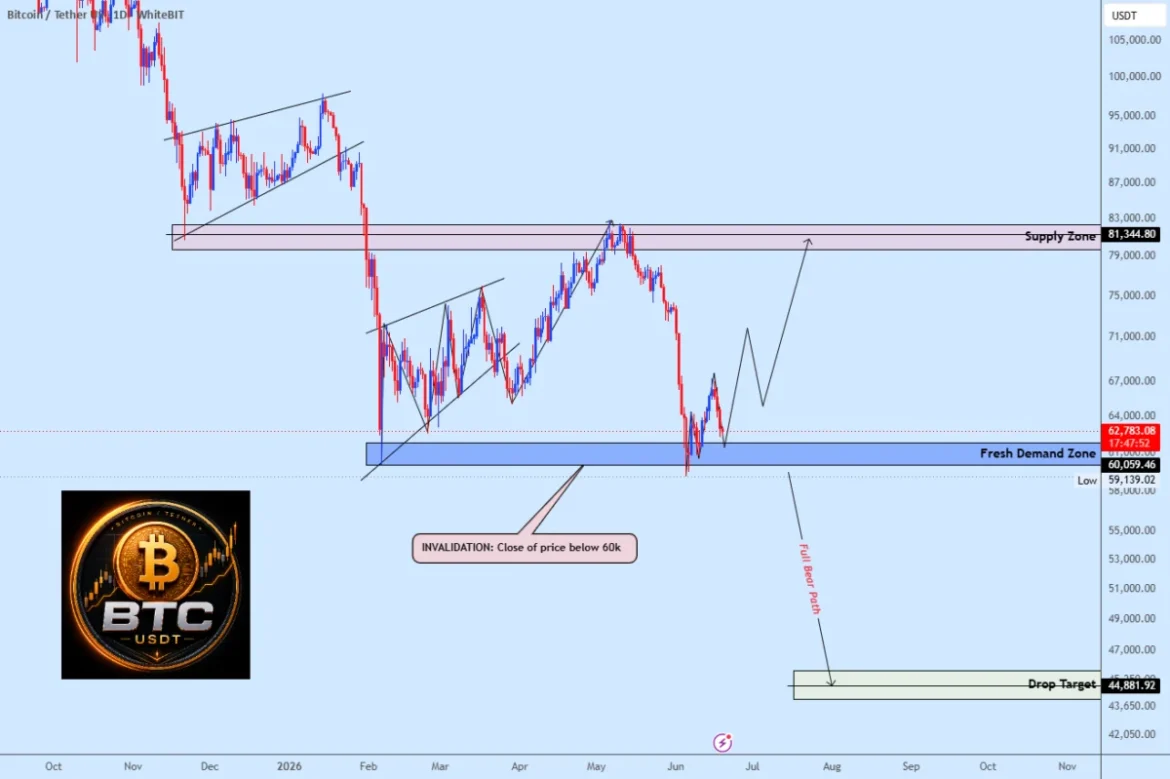
Bitcoin is once again confronting a critical juncture at the $60,000 mark, a level widely recognized by traders as both a psychological and technical pivot point. This significant demand zone represents a crucial area where buying interest has historically emerged, but its ability to hold firm now stands as a formidable test for the cryptocurrency’s next major price movement. Analyst weslad, in a TradingView analysis dated June 20, highlighted that the BTCUSDT trading pair has entered this pivotal demand zone, suggesting that its resilience will dictate whether Bitcoin embarks on a recovery or faces a significant breakdown. The current scenario presents a delicate balance, where buyers have shown their hand, but a decisive failure at this level could trigger a cascade of negative price action.
The Significance of the $60,000 Demand Zone
The $60,000 level is not merely an arbitrary round number; it carries substantial weight in the technical analysis of Bitcoin. Historically, significant price floors have often formed around such psychologically important figures. For Bitcoin, this particular demand zone has been a site of previous buying pressure, indicating that a considerable number of investors and traders have identified it as an attractive entry point. However, the narrative surrounding this zone is one of dual potential. While it represents an opportunity for buyers to reassert control and potentially initiate a rebound, it also signifies a critical support level that, if breached decisively, could signal a more profound downturn.
Weslad’s analysis, as shared on TradingView, posits that if Bitcoin can successfully defend this demand zone, the probability of a subsequent recovery towards the $81,000 supply area remains a tangible possibility. This potential upward trajectory would signify a return to the price levels that preceded the recent decline, potentially leading to a significant liquidity grab as short-sellers are forced to cover their positions. The interplay of supply and demand at this critical juncture is therefore paramount in shaping the short-to-medium term outlook for Bitcoin. The ability of buyers to absorb selling pressure and establish a firm footing above $60,000 will be a key determinant in whether this optimistic scenario unfolds.
A Breakdown Below $60K: Implications for the Bullish Outlook
Conversely, the ramifications of a decisive break below the $60,000 mark are equally stark and carry a clear warning for market participants. Weslad explicitly identifies $60,000 as the "line in the sand" for the bullish contingent. A sustained and decisive close below this level would serve to invalidate the prevailing bullish sentiment and expose Bitcoin to the risk of a more significant and potentially deeper price correction. This is not simply a matter of technical charting; it speaks to the collective psychology and trading behavior within the market.
When a widely watched support level like $60,000 is threatened, it can trigger a ripple effect. Many traders, particularly those with stop-loss orders placed just below this threshold, could find their positions automatically liquidated. This forced selling can exacerbate downward price momentum, creating a self-fulfilling prophecy of a breakdown. Furthermore, such a breach can fundamentally shift market sentiment, leading to increased fear and a reduction in buying conviction. On the other hand, the successful defense of the $60,000 zone provides bulls with a powerful narrative: that the recent selling pressure has been absorbed, and the market is showing signs of exhaustion in its downward move, paving the way for a potential reversal.

The Path to Recovery: Confirmation is Key
While the $81,000 upside target presents an attractive prospect for investors anticipating a recovery, it is crucial to acknowledge that Bitcoin must first "earn" this move. The immediate priority for bulls is to firmly defend the $60,000 demand zone. Beyond merely holding the level, reclaiming nearby resistance points will be essential to demonstrate renewed buying strength. This will involve showing that demand is robust enough to not only halt the decline but to transform a defensive reaction into a genuine trend reversal.
Until such confirmation is evident, the current market setup is best characterized as a "binary support test." This means that the outcome is largely dependent on whether the critical support level holds or fails. If the demand zone at $60,000 proves resilient, the case for a recovery remains intact. However, if this level succumbs to selling pressure, the market will likely begin to price in a more substantial corrective phase. The ensuing price action in the coming days and weeks will therefore be closely scrutinized by traders and investors alike for signs of capitulation or renewed buying conviction.
Broader Market Context and Historical Precedents
The current consolidation around the $60,000 level for Bitcoin is occurring within a broader market context that has seen periods of intense volatility and rapid price swings. Following its all-time highs in late 2021, Bitcoin experienced a protracted bear market, only to begin a significant recovery in late 2023, driven by renewed institutional interest, particularly through the approval of spot Bitcoin Exchange-Traded Funds (ETFs) in the United States. This influx of institutional capital was a major catalyst for the subsequent price appreciation, pushing Bitcoin to new record highs earlier in 2024.
However, the cryptocurrency market is inherently susceptible to rapid shifts in sentiment and macroeconomic influences. Factors such as interest rate policies by central banks, regulatory developments, and global economic stability can all exert considerable pressure on asset prices, including Bitcoin. The recent price action, characterized by a retracement from its peak, is not uncommon in bull markets. These pullbacks often serve as healthy corrections, allowing the market to consolidate and build a foundation for further upside. The $60,000 level represents a critical point where the market is grappling with whether this current pullback is a temporary pause or the beginning of a more sustained downturn.
The history of Bitcoin’s price charts is replete with examples of significant demand zones acting as launchpads for new rallies. Conversely, it also shows instances where the failure to hold key support levels led to sharp and prolonged declines. For instance, in previous market cycles, levels that were once considered strong resistance often turned into support after a period of accumulation, and vice versa. The $60,000 level for Bitcoin carries echoes of these historical turning points, making its defense all the more critical for maintaining a bullish trajectory.
Expert Commentary and Market Sentiment
While the analysis from weslad provides a clear technical perspective, broader market sentiment is a confluence of various factors, including on-chain data, macroeconomic indicators, and the sentiment of retail and institutional investors. Analysts are closely watching metrics such as exchange inflows and outflows, futures market funding rates, and the activity of long-term holders (HODlers) to gauge the underlying health of the market.

Positive on-chain signals, such as reduced selling pressure from long-term holders and increasing accumulation by active wallets, could bolster the case for a recovery. Conversely, sustained high outflows from exchanges and increasing leverage in the futures market could signal potential instability. The commentary from various market participants often reflects a cautious optimism, with many acknowledging the importance of the $60,000 level as a crucial test of Bitcoin’s resilience. The narrative is largely focused on whether the current demand zone can absorb the selling pressure and pave the way for a renewed upward move towards higher price targets.
The implications of the current price action extend beyond Bitcoin itself, impacting the broader cryptocurrency ecosystem, including altcoins. Typically, Bitcoin’s price movements lead the market, and a sustained recovery in Bitcoin often correlates with a broader resurgence in altcoin prices. Conversely, a significant breakdown in Bitcoin can drag down the entire crypto market. Therefore, the outcome of this $60,000 test is of considerable importance for the entire digital asset landscape.
Looking Ahead: A Critical Juncture
In conclusion, Bitcoin finds itself at a critical juncture, with the $60,000 demand zone serving as a vital battleground. The ability of buyers to defend this level will be instrumental in determining whether the cryptocurrency can sustain its bullish momentum and target higher price levels, such as the $81,000 supply area. A decisive breach below $60,000, however, would signal a significant setback, potentially invalidating the bullish outlook and opening the door to a deeper correction.
The market is now in a phase of heightened observation, where confirmation of sustained buying pressure and a clear reversal pattern will be crucial for instilling confidence in a continued upward trajectory. Until then, the situation remains a binary test of support, with the outcome holding significant implications for both Bitcoin and the wider cryptocurrency market. Investors and traders will be closely monitoring price action, technical indicators, and market sentiment for clues to Bitcoin’s next significant move. The coming days and weeks are expected to be pivotal in shaping the narrative for the remainder of the year.
