

As the cryptocurrency market navigates a period of significant volatility, seasoned analysts are increasingly turning to historical data models to forecast the trajectory of Bitcoin. A prominent market strategist, known as Bee, has projected that the current bear market phase will likely reach its nadir by October 2026. This outlook is predicated on a recurring 400-day cyclical pattern that has consistently manifested throughout Bitcoin’s 13-year trading history. According to this model, the leading cryptocurrency is currently 252 days into a cyclical bear phase, implying that investors may face several more months of downward price pressure before a sustainable recovery phase can commence.
Understanding the 400-Day Cyclical Framework
The 400-day cycle is a recurring technical phenomenon that identifies predictable windows for market tops and bottoms. Historical analysis reveals that Bitcoin typically undergoes a bull run spanning approximately 1,064 days, followed by a corrective bear market that lasts between 364 and 400 days. By applying this framework to the current market environment, analysts suggest that the asset is currently in the middle of a consolidation and correction period.
With 252 days already elapsed in the current cycle, historical precedent suggests an additional 112 to 148 days of volatility. If these projections hold, the market would enter a period of stabilization in the final quarter of 2026. The significance of this model lies in its historical consistency; despite various macroeconomic shifts, regulatory changes, and technological evolutions, the structure has remained intact, providing a roadmap that many institutional and retail traders use to gauge long-term market sentiment.
Price Targets and Historical Benchmarks
The financial implications of this cycle are substantial. Based on the analyst’s charts, Bitcoin could potentially test support levels as low as $30,000 by the first week of October 2026. Such a move would represent a correction of more than 75% from the asset’s all-time high of approximately $126,000.

While such a figure may appear drastic to newer market participants, proponents of the 400-day model argue that this is a standard "reset" mechanism. Historically, these price floors serve as the foundation for the next long-term bull market. The model assumes that once the cycle reaches its bottom, the market will reset, clearing out excessive leverage and speculative interest, thereby establishing a healthier environment for long-term growth.
The Institutional Factor: Does "This Time" Differ?
A frequent subject of debate within the financial community is whether the influx of institutional capital, particularly through Spot Bitcoin Exchange-Traded Funds (ETFs) managed by entities like BlackRock, has fundamentally altered the nature of these cycles. Critics of the cycle-based theory argue that institutional involvement provides a floor of support that did not exist in previous iterations of the crypto market.
However, analysts who support the cyclical view argue that the "this time is different" narrative is a recurring theme in every bear market. In previous years, the entry of major exchanges, the launch of futures markets, and the integration of retail payment processors were all cited as reasons why Bitcoin would no longer follow its established patterns. Despite these advancements, the 400-day cycle has persisted without deviation. The argument is that while the participants have changed—from individual enthusiasts to global asset managers—the underlying human psychology and capital flow patterns that drive market cycles remain fundamentally unchanged.
Comparative Analysis: The Ted Pillows Forecast
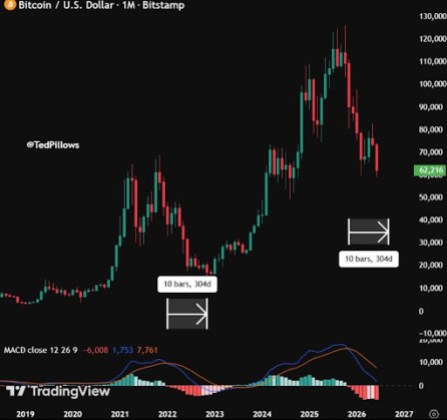
The bearish outlook for 2026 is further supported by independent technical analysis from other market observers. Analyst Ted Pillows has corroborated the timeline, drawing parallels to the 2022 bear market cycle. By examining the Moving Average Convergence Divergence (MACD) indicator—a momentum oscillator used to identify trend reversals—Pillows noted that Bitcoin historically takes approximately 10 months to establish a bottom following a bearish cross.
Applying this methodology to the current market, Pillows also anticipates a final price floor in the third or fourth quarter of 2026. His projections place the bottom in the $30,000 to $40,000 range. Significantly, Pillows has tempered expectations for a rapid recovery, explicitly dismissing the probability of Bitcoin reclaiming the $100,000 threshold within the 2026 calendar year. For investors looking for a "V-shaped" recovery, these technical forecasts present a sobering assessment of the time horizon required for the market to regain its previous momentum.

Implications for Market Participants
The prospect of an extended bear market through late 2026 has significant implications for both retail and institutional investors. For those managing portfolios, the potential for sustained downside pressure suggests a period of defensive positioning. This often involves increasing cash reserves, reducing exposure to highly leveraged positions, and prioritizing assets with proven long-term utility.
Furthermore, the data underscores the importance of long-term time preference in the digital asset space. While the short-term outlook remains bearish according to these models, the same cycles also suggest that the subsequent bull markets have historically been characterized by substantial growth. The transition from a 1,064-day bull run to a 400-day correction is a feature of market maturation, effectively filtering out speculative excess and allowing the market to re-base at more sustainable valuation levels.
Chronology of the Current Market Cycle
To visualize the progression, it is helpful to look at the timeline of the current correction:
- The Peak: Bitcoin reached an all-time high of approximately $126,000, signaling the end of the previous 1,064-day bull cycle.
- Initial Correction: Following the peak, the market entered the 400-day bear phase, characterized by heightened volatility and negative sentiment.
- Mid-Cycle (Current): With 252 days elapsed, the market is currently grappling with the mid-point of the bear cycle, defined by the "wait and see" approach of institutional investors.
- Projected Bottom (October 2026): According to the models, the final exhaustion of sellers is expected in Q4 2026, coinciding with the 364 to 400-day mark.
Addressing the Volatility Factor
Volatility remains the defining characteristic of the cryptocurrency market. The projected decline to $30,000 represents a significant deviation from current market prices, and investors are cautioned that such forecasts are based on historical patterns rather than absolute certainties. Economic factors, such as central bank interest rate decisions, global liquidity, and geopolitical developments, continue to act as external variables that can impact the velocity of these cycles.
Despite these variables, the adherence of Bitcoin to the 400-day structure over more than a decade provides a strong data-backed case for this bearish timeline. For market participants, the focus shifts to whether the market will break from this historical trend or whether the cycle will repeat, providing another opportunity for capital accumulation at lower price points.
Conclusion and Future Outlook
The prevailing technical analysis for Bitcoin points toward a challenging period ahead. By synthesizing the 400-day cycle model with MACD momentum analysis, experts have established a clear, albeit difficult, roadmap for the remainder of 2026. While the prospect of a $30,000 to $40,000 price floor may be discouraging for those currently holding assets at higher valuations, it is presented as a necessary phase in the broader, long-term lifecycle of the asset.
As the market approaches the third and fourth quarters of 2026, the behavior of institutional players, such as the major ETF providers, will likely be a primary indicator of whether the historical cycle remains the dominant force in price discovery. Until then, the consensus among these analysts is one of caution, patience, and a reliance on historical patterns to navigate the volatility of the crypto landscape. Investors are encouraged to conduct their own due diligence, keeping in mind that while history is a powerful guide, it does not guarantee future results in the rapidly evolving digital asset sector.
