
Decentralized finance lending giant Aave has unveiled a pioneering governance proposal aimed at bridging the gap between traditional institutional asset custody and on-chain liquidity markets. The initiative, officially designated as custodied collateral lending, seeks to permit regulated institutional entities to borrow stablecoins directly from Aave V4 markets while keeping their underlying backing assets securely locked within qualified, regulated third-party custodial environments, such as Anchorage.
For years, a fundamental friction point has hindered institutional capital deployment within the decentralized finance ecosystem. While traditional financial institutions, asset managers, and corporate treasuries frequently hold substantial cryptocurrency reserves—such as Bitcoin—with regulated custodians, compliance mandates and risk policies strictly prohibit them from engaging in self-custody or utilizing decentralized smart contracts directly. Consequently, a vast pool of institutional wealth has remained entirely isolated from the burgeoning on-chain credit markets. Aave’s newly introduced governance framework intends to systematically dismantle these barriers, offering a compliant pipeline that connects traditional custody solutions with decentralized lending architecture.
Mechanics of Custodied Collateral Lending
The operational framework behind Aave’s proposed model relies on a sophisticated integration of institutional-grade custody services and decentralized oracle infrastructure. Traditionally, an institution wishing to leverage its crypto holdings on-chain would be required to convert native assets into wrapped alternatives like Wrapped Bitcoin (WBTC). This process introduces several layers of vulnerability, including smart contract risk, counterparty exposure, compliance hurdles, and potential regulatory scrutiny regarding asset wrappers.
Under the new Aave V4 isolated hub-and-spoke model outlined in the governance forum, this workaround becomes obsolete. The mechanics function through a synchronization of assets and on-chain representations without requiring the physical movement of the underlying collateral out of the regulated custodian’s vault.
First, an institutional borrower, such as a hedge fund or corporate entity, deposits its native assets—such as Bitcoin—into Anchorage, a federally chartered digital asset bank and regulated custodian. Once the assets are securely stored within the custodian’s infrastructure, Chainlink’s advanced interoperability and data solutions, specifically utilizing CustodySync and Custodied Collateral Tokens (CoCTs), generate an on-chain cryptographic receipt.
These Custodied Collateral Tokens serve as verifiable, on-chain representations of the off-chain assets held in custody. The institutional borrower then deposits these CoCTs into Aave V4 as collateral, allowing them to draw liquidity in the form of stablecoins like USDC.
The lifecycle of the loan concludes when the borrower repays the borrowed stablecoins alongside the accumulated interest. Upon successful settlement, the smart contract triggers the burning of the CoCTs on-chain. Simultaneously, a cryptographic verification is sent to Anchorage, unlocking the native Bitcoin in the custodial vault and returning it to the institutional entity’s account. Throughout the entire transaction lifecycle, the core collateral never leaves the secure, regulated confines of the institutional custodian.
Background Context and Industry Evolution
The intersection of institutional finance and decentralized protocols has undergone a significant evolution over the past several years. Early iterations of decentralized finance were built primarily for retail native participants, operating entirely outside traditional regulatory perimeters. However, as the digital asset asset class matured, institutional demand for yield generation, efficient capital allocation, and on-chain leverage intensified dramatically.
Despite this growing appetite, compliance officers and risk committees at major financial institutions routinely rejected direct engagement with protocols due to the mandatory requirement of self-custody—holding private keys via hardware wallets or browser extensions. Institutional mandates require qualified custodians to hold client assets to satisfy fiduciary duties and insurance requirements.

Recognizing this structural roadblock, Aave’s core contributors and community developers began exploring protocol upgrades that could integrate directly with institutional infrastructure. The conceptualization of custodied collateral lending represents the culmination of these efforts, aligning the rigorous security standards of traditional finance with the borderless, algorithmic efficiency of decentralized liquidity pools.
Chronology of the Governance Proposal
The pathway toward implementing custodied collateral lending follows Aave’s rigorous decentralized governance procedures. The chronology of the event unfolds across several distinct phases designed to ensure community consensus and technical security:
- Initial Forum Discussion: The proposal was officially submitted to the Aave governance forum under the title of custodied collateral lending within the Aave V4 isolated hub-and-spoke architecture. This phase initiated public debate, technical critique, and preliminary feedback from tokenholders and risk management service providers.
- Community Sentiment and Refinement: Community members, risk curators, and delegates analyzed the integration risks, focusing heavily on oracle reliability via Chainlink, custody counterparty risk with Anchorage, and smart contract architecture.
- Snapshot Voting Phase: Following the resolution of initial forum discussions and adjustments to the framework, the proposal is slated to move to Snapshot for an official off-chain signaling vote. This stage measures the weighted consensus of Aave tokenholders.
- On-Chain Execution and Deployment: Subject to a successful Snapshot outcome and subsequent technical audits, the proposal will proceed to a formal on-chain governance vote for final code deployment across Aave V4 markets.
Supporting Data and Market Metrics
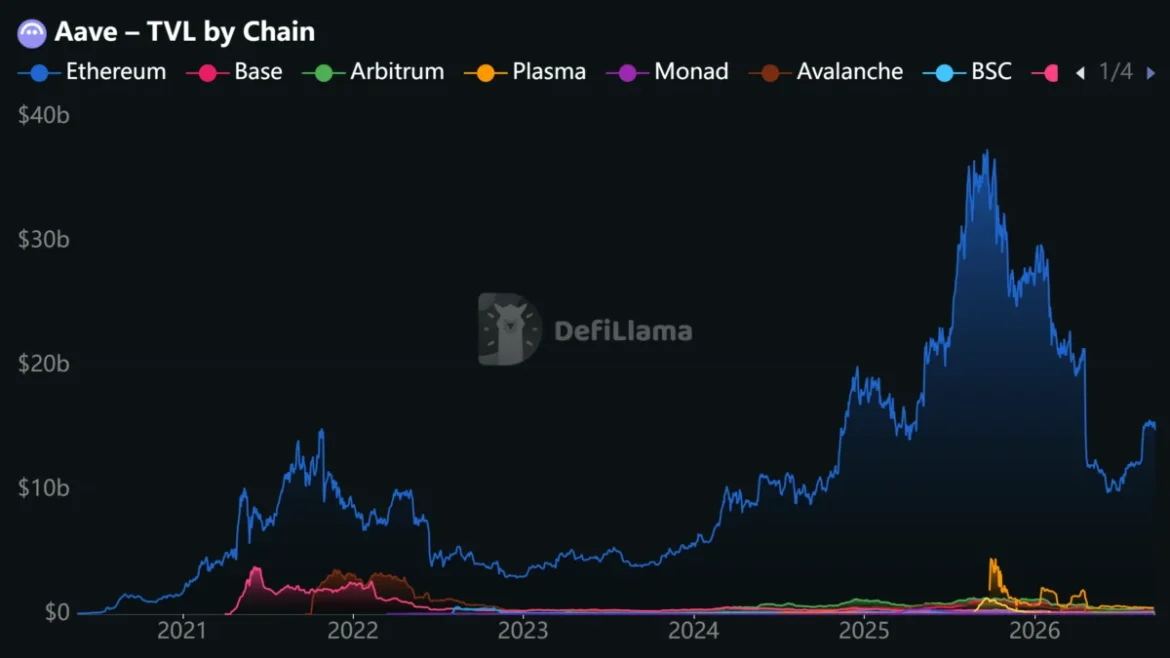
The introduction of this institutional lending framework arrives at a pivotal time for Aave’s ecosystem growth and overall market positioning. Data compiled across the decentralized finance sector indicates a robust recovery in total value locked and protocol utilization throughout the third quarter.
Aave’s total value locked recently rebounded to approximately $19 billion, marking a significant 52% recovery from the $12.5 billion low recorded earlier in June. This resurgence highlights a steadily increasing institutional and retail appetite for on-chain credit facilities. Furthermore, Aave commands a dominant market share within the decentralized lending sector, capturing nearly half of all active DeFi loans.
Despite this dominance, a substantial portion of protocol liquidity has historically remained idle due to the structural inability of traditional market participants to access on-chain credit without compromising custody mandates. By unlocking this dormant capital segment—assets currently sitting idle with regulated custodians—the protocol positions itself to capture an entirely new class of institutional liquidity that was previously inaccessible to decentralized markets.
Official Responses and Industry Reactions
Aave founder Stani Kulechov characterized the initiative as a groundbreaking development for the sector. In public statements regarding the framework, Kulechov emphasized the unique nature of the architecture, describing it as a "first-of-its-kind proposal to enable institutions to borrow stablecoins on Aave V4 against collateral held with a qualified custodian, accessing liquidity directly from Aave V4 markets."
Market observers and analysts have noted that the success of Aave’s initiative could compel competing lending protocols and liquidity marketplaces—such as Morpho, Kamino, and others—to accelerate their own institutional integration strategies. The ability to seamlessly connect off-chain custody with on-chain lending is widely viewed as the next major competitive frontier in decentralized finance.
Broader Impact and Implications
The implementation of custodied collateral lending carries profound implications for the broader digital asset economy. By successfully bridging the gap between regulated financial institutions and decentralized liquidity protocols, the initiative validates the feasibility of hybrid financial models.
For institutional borrowers, the framework eliminates the regulatory and operational hurdles associated with asset wrapping and self-custody, allowing them to optimize their balance sheets and secure operational leverage without violating fiduciary constraints. For the Aave protocol, tapping into unreachable institutional collateral assets promises to deepen liquidity pools, increase protocol revenue, and cement its status as the premier infrastructural layer for digital asset credit.
As the proposal progresses through the final stages of governance and community review, the broader crypto market continues to monitor developments closely, anticipating a potential paradigm shift in how institutional capital interacts with decentralized finance.
