
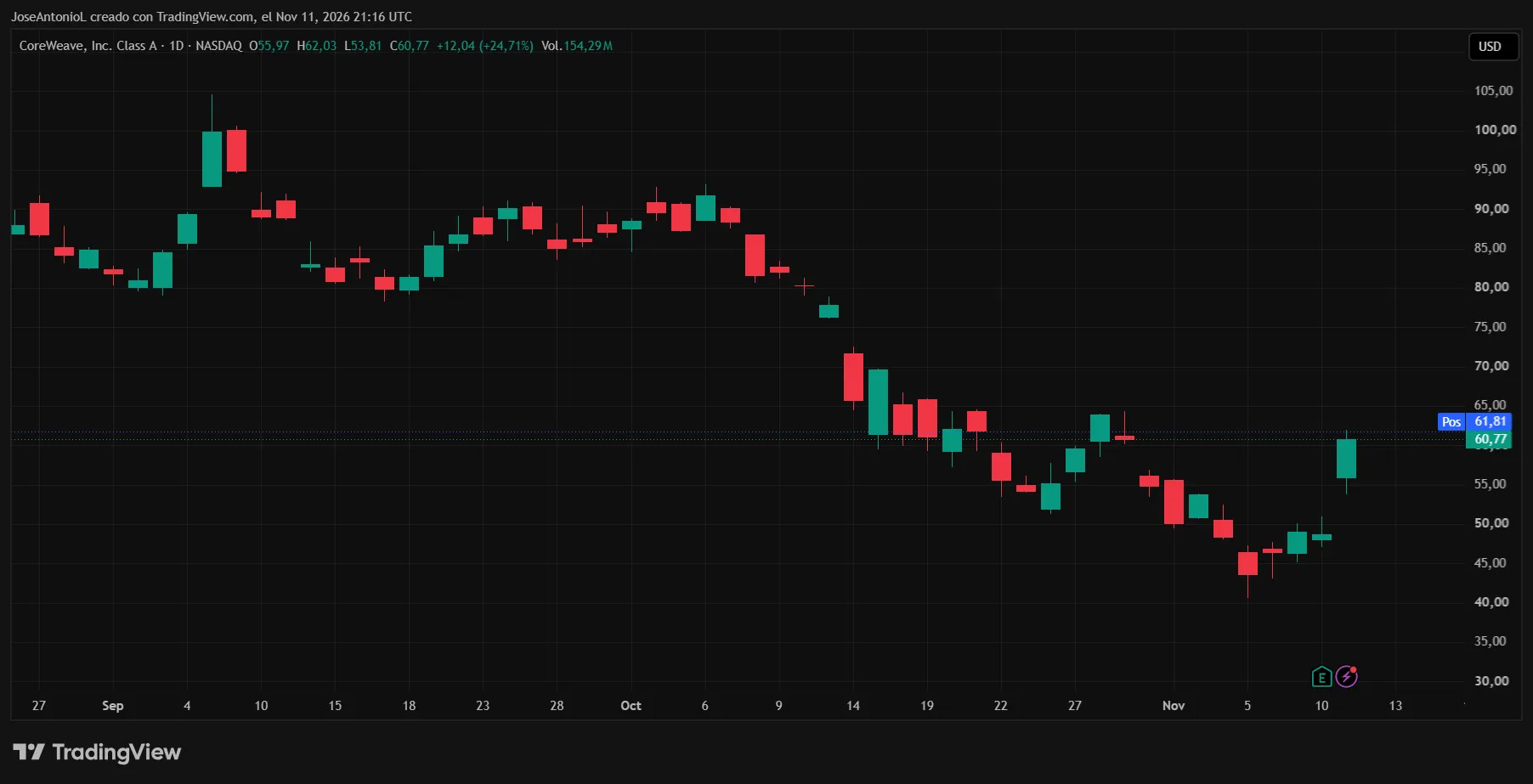
The artificial intelligence sector experienced a significant resurgence on Wednesday as CoreWeave, a specialized cloud provider backed by semiconductor giant Nvidia, recorded a massive 24.7% surge in its stock price. This sharp upward movement successfully broke weeks of consecutive selling and bearish sentiment across tech markets, driven by the release of stellar third-quarter financial results that underscored unrelenting global demand for the high-performance computing hardware powering the ongoing generative AI boom.
CoreWeave’s financial performance for the period shattered market expectations, highlighted by a staggering $3.66 billion in third-quarter revenue. This figure represents a monumental 168% increase compared to the same period in the previous year. Bolstered by these robust financials, the cloud infrastructure provider aggressively raised its sales forecast for 2026, setting its sights on annual revenue between $13 billion and $13.3 billion. The positive earnings report acted as a broad macroeconomic catalyst, immediately lifting shares of Nvidia alongside a wider cohort of AI infrastructure companies, including Nebius, IREN, Oracle, and Applied Digital, while propelling the tech-heavy Nasdaq index up by 1.6% for the day.
For Wall Street analysts and institutional investors closely monitoring Nvidia’s unprecedented trajectory, CoreWeave serves as a vital barometer for the health of the downstream AI economy—specifically illustrating how businesses utilize and monetize the expensive processors once they leave Nvidia’s manufacturing plants.
Understanding the Neocloud Business Model and Its Crypto Origins
To fully understand CoreWeave’s market position, one must examine its unique operational model. CoreWeave functions as a specialized cloud provider—often referred to in financial circles as a "neocloud"—that purchases massive quantities of advanced Nvidia Graphics Processing Units (GPUs), houses them within purpose-built data centers, and rents out that computing horsepower to major artificial intelligence laboratories, developers, and enterprises, including industry heavyweights like OpenAI, Cohere, and Perplexity.

Interestingly, the company’s corporate lineage traces back to cryptocurrency infrastructure. Originally launched as an Ethereum mining operation, CoreWeave possessed early, specialized institutional expertise in managing, cooling, and powering dense clusters of power-hungry hardware. When the crypto mining landscape shifted and the generative AI explosion began in late 2022, the firm seamlessly pivoted its existing operational framework toward high-performance computing (HPC) and AI model training.
By the close of September, CoreWeave reported operating more than 1.7 gigawatts of active power capacity. Furthermore, the company announced an astonishing $132.5 billion in total revenue backlog—representing contracted, long-term business commitments rather than immediate cash on hand. To mitigate immediate capital constraints, CoreWeave anticipates collecting approximately $9 billion in customer prepayments and cash deposits over the upcoming three months, a strategic move designed to reduce reliance on expensive debt financing amid a high-interest-rate environment.
The Deepening Alliance Between Nvidia and CoreWeave
The relationship between Nvidia and CoreWeave extends far beyond a standard commercial supplier-client dynamic. The two companies are tightly bound through multi-layered strategic investments and purchasing agreements that have profoundly shaped the modern AI infrastructure landscape.
In January, Nvidia deepened its financial commitment by injecting an additional $2 billion into CoreWeave shares at a valuation of $87.20 per share. This transaction fortified an existing partnership designed to construct more than five gigawatts of dedicated AI data center capacity globally by the year 2030. Under the terms of this expanded collaboration, CoreWeave agreed to serve as an early adopter and primary showcase for Nvidia’s next-generation hardware architectures, integrating cutting-edge platforms like the upcoming Rubin architecture and Vera Central Processing Units (CPUs) directly into its data center infrastructure.
“Together, we’re racing to meet extraordinary demand for NVIDIA AI factories,” Nvidia CEO Jensen Huang remarked when the expanded partnership was officially announced.

Additionally, Nvidia maintains a massive $6.3 billion initial agreement to purchase CoreWeave’s unused cloud computing capacity through April 2032, contingent upon specific contract conditions. While this agreement functions as an essential safety net for CoreWeave by guaranteeing a baseline buyer for surplus infrastructure, it has also become a focal point of debate among financial analysts and market skeptics.
The Circular Finance Debate and Market Skepticism
Despite the undeniable revenue growth and surging commercial adoption, CoreWeave’s intertwined financial arrangements with its primary hardware supplier have drawn scrutiny from market commentators. Critics and skeptics frequently point to what they characterize as "circular finance" within the artificial intelligence ecosystem.
The criticism stems from a closed-loop capital flow: tech giants and venture-backed AI labs (such as OpenAI) receive massive funding rounds, utilize that capital to purchase cloud computing services from providers like CoreWeave, which in turn use those revenues to purchase advanced chips and hardware investments from Nvidia, while Nvidia simultaneously invests capital back into infrastructure providers and guarantees purchases of their surplus capacity.
While financial regulators and corporate executives maintain that these are entirely legitimate, legally binding commercial contracts driven by authentic enterprise demand, the overlapping financial dependencies complicate efforts by outside analysts to measure the true, organic end-market demand for generative AI applications independent of venture capital subsidies.
Broader Industry Implications and Future Risks
The overwhelming market enthusiasm following CoreWeave’s Q3 earnings report temporarily quieted a chorus of growing investor anxiety regarding whether recent sell-offs in tech stocks signaled a permanent cooling of AI demand or merely a rational reassessment of the immense capital expenditure required to build out the necessary infrastructure.
Leading financial institutions have offered balanced assessments of the neocloud sector’s long-term outlook. Analysts at Bernstein described CoreWeave’s third-quarter performance as “about the best quarter we could have asked for,” according to statements reported by Reuters. However, the brokerage firm concurrently issued a cautionary note, warning that specialized cloud providers like CoreWeave would likely be among the most vulnerable enterprises should the global shortage of AI computing capacity eventually ease into an oversupply.
The core risk factors facing the neocloud business model remain multifaceted. Rapid hardware obsolescence poses a constant threat; the introduction of significantly faster, more energy-efficient processors by Nvidia or competitors could quickly render older GPU inventories less competitive. Furthermore, external macroeconomic and logistical pressures—including severe electricity grid constraints, municipal zoning bottlenecks for data center construction, and elevated borrowing costs—could squeeze profit margins.
Ultimately, while CoreWeave’s explosive 24.7% rally has successfully injected a fresh wave of confidence back into the artificial intelligence trade, the long-term sustainability of the AI boom will depend heavily on the ability of end-users to generate genuine, profitable commercial products from the trillion-dollar infrastructure currently being erected across the globe.
